Wu Collection, Lower Volume
Radical: Revelation (shì)
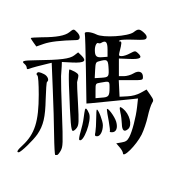
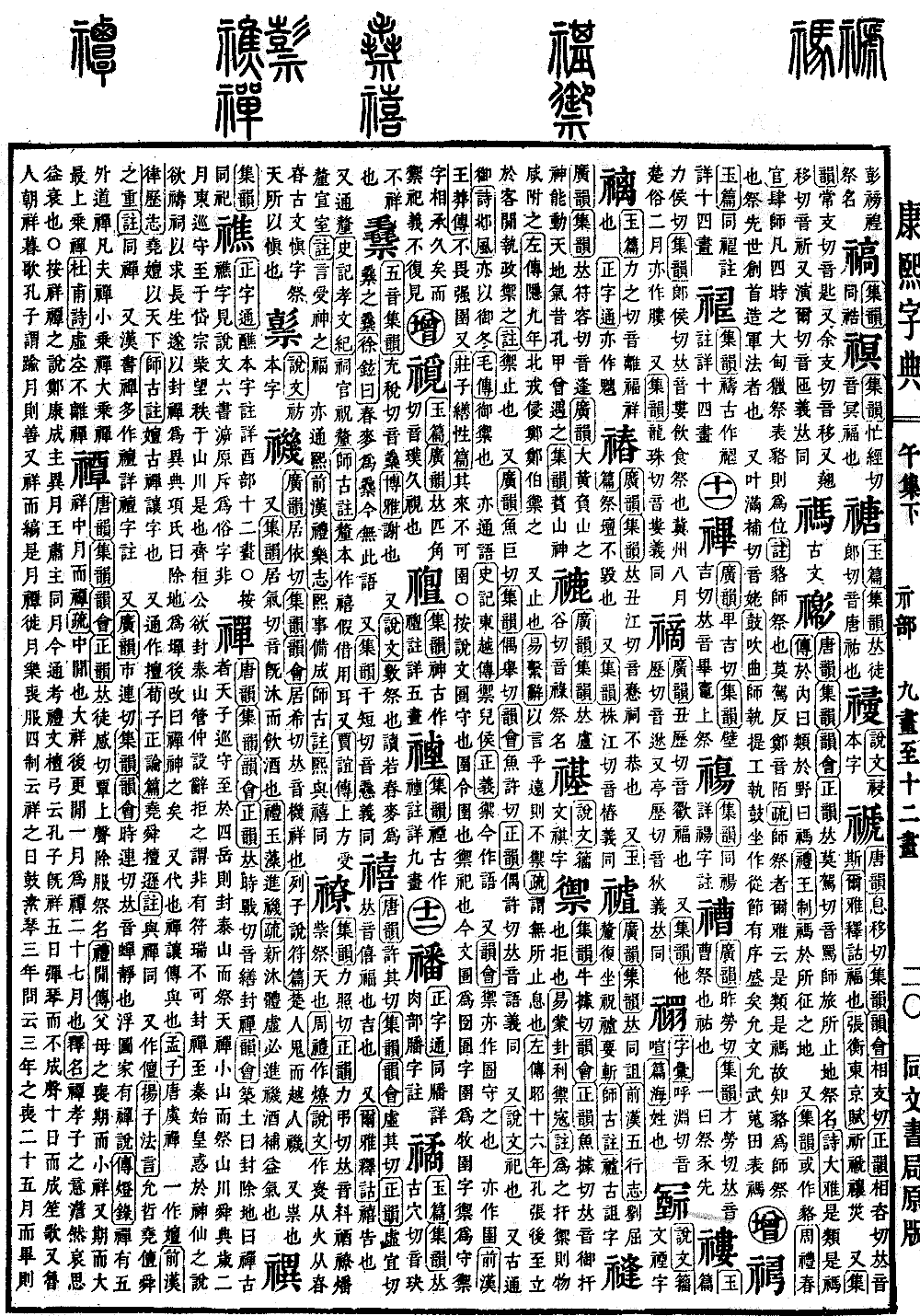
Ma; Kangxi stroke count: 15; Page 846, Entry 06
Archaic script
Tang Rhyme (Tangyun), Collection of Rhymes (Jiyun), Rhyme Compendium (Yunhui), Correct Rhymes (Zhengyun): Pronounced ma (falling tone).
The location where an army is stationed; a type of sacrificial rite.
Book of Odes (Shijing), Greater Odes (Daya): It is the lei and it is the ma.
Commentary: The rite performed within the city is called lei, and the rite performed in the field is called ma.
Book of Rites (Liji), Royal Regulations (Wangzhi): The ma rite is held at the place of a military campaign.
Also, in Collection of Rhymes (Jiyun), sometimes written in a variant form (he).
Rites of Zhou (Zhouli), Spring Officials (Chunguan): When the Si Shi official conducts large-scale seasonal hunting, the he sacrifice, which sets up a marker, is arranged in its proper place.
Annotation: He is the sacrifice of an army.
Explication of Texts (Shiwen): Pronounced mo (rising tone); Zheng Xuan reads it as mo (entering tone).
Sub-commentary: The sacrifice of an army. The Erya says: It is the lei and it is the ma; therefore, we know that he is the sacrifice of an army. The sacrifice is offered to those in former ages who first established military law.
Also rhyming with man (rising tone) and bu (rising tone), pronounced mu (rising tone).
Drum and Fife Songs (Guchui Qu): The army holds the equipment, the musicians beat the drums, and both sitting and standing follow the rhythm, all in perfect order. Truly, one possesses both literary virtue and martial achievement, manifesting the ma sacrifice through the hunt.
Editorial Note: Rites of Zhou (Zhouli), Spring Officials (Chunguan): When the Si Shi official conducts large-scale seasonal hunting, the he sacrifice, which sets up a marker, is arranged in its proper place. Annotation: He is the sacrifice of an army. Pronounced mo (rising tone). Following the original text, the words Explication of Texts have been added before the pronunciation note.