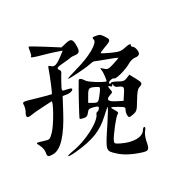
Pronounced wu yuan qie according to Guangyun (广韵), and wu yuan qie according to Jiyun (集韵). According to Yunhui (韵会) and Zhengyun (正韵), it is pronounced mei bian qie, with the same pronunciation as "mian" (勉).
Shuowen Jiezi (说文解字) explains it as: to give birth to a child, to relieve the body of its burden. The character is composed of "zi" (子) and "mian" (免). Xu Kai states that this is a huiyi (会意) character.
Furthermore, Zhenge (正讹) notes the pronunciation as fang wan qie, with the same sound as "fan" (贩). Yunhui (韵会) and Zhengyun (正韵) give the pronunciation as wen yun qie, with the same sound as "wen" (问). Zhengzitong (正字通) argues that the character "㝃" does not have the pronunciations of "fan" (贩) or "wen" (问).
According to various commentaries, the character "㝃" is pronounced mei bian qie and means to give birth to a child. The character "嬎" is pronounced fang jian qie, with the same sound as "fan" (贩), and means a child born with symmetry and regularity. One interpretation suggests it refers to a rabbit, and the pronunciation of "㝃" as "fan" (贩) is because "㝃" and "嬎" are used interchangeably.
Additionally, Yunhui (韵会) and Zhengyun (正韵) both include it in the "wen" (问) rhyme, with the annotation meaning to give birth to a child, similar to "mian" (娩) and "mian" (免). Both of these pronunciations should be retained.