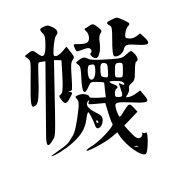
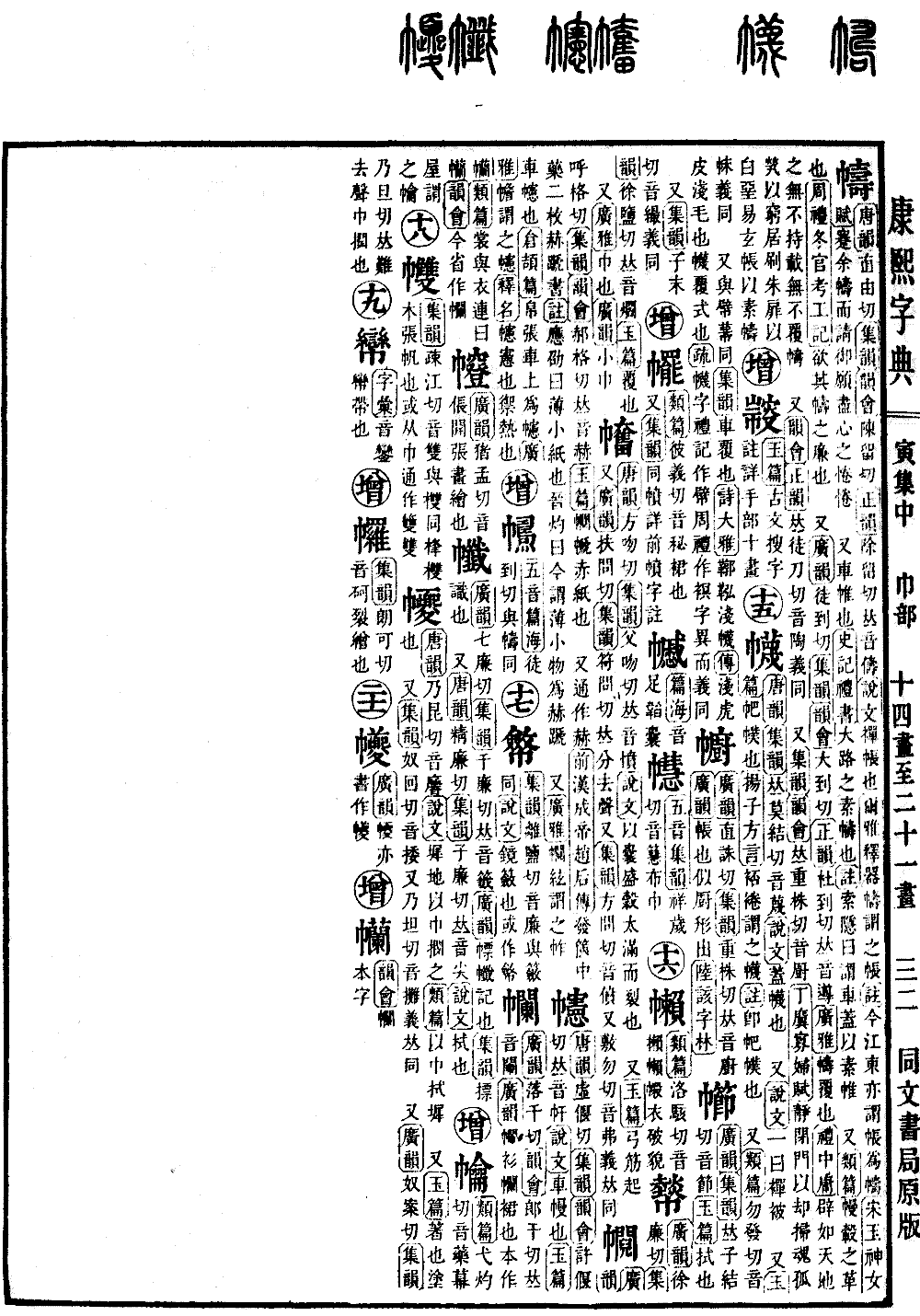
Yin Collection, Middle Volume
Radical: Turban (jīn)
Character: Mi
Kangxi stroke count: 18
Page 338, Entry 03
Pronounced mie (rising tone). According to the Tang Rhyme (Tangyun) and the Collected Rhymes (Jiyun), the pronunciation is the same as mie. The Explaining Graphs and Analyzing Characters (Shuowen Jiezi) defines it as a covering for a carriage canopy. Another interpretation in the same text is that it refers to a single-layered quilt. The Jade Chapters (Yupian) defines it as a type of headscarf or kerchief. The Dialects (Fangyan) by Yang Xiong states that a fan-yun is called a mi. The commentary notes that this refers to a headscarf or kerchief. The Classified Chapters (Leipian) states it is pronounced mo (entering tone), same as the pronunciation of mo. The meaning is the same. It is also interchangeable with the character mi. The Collected Rhymes (Jiyun) defines it as a covering for a carriage. The Book of Odes (Shijing), in the Greater Odes section, contains the phrase kuo-hong-qian-mi. The commentary explains: qian refers to the short, light-colored fur of a tiger. Mi refers to the object covering the horizontal bar of a carriage. The sub-commentary clarifies: the character mi is written as mi in the Book of Rites (Liji) and as a variant form in the Rites of Zhou (Zhouli); the characters differ in form but share the same meaning. The original form of the character fan was composed of the garment radical plus the phonetic element fou.