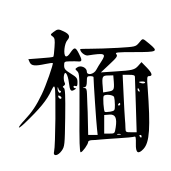
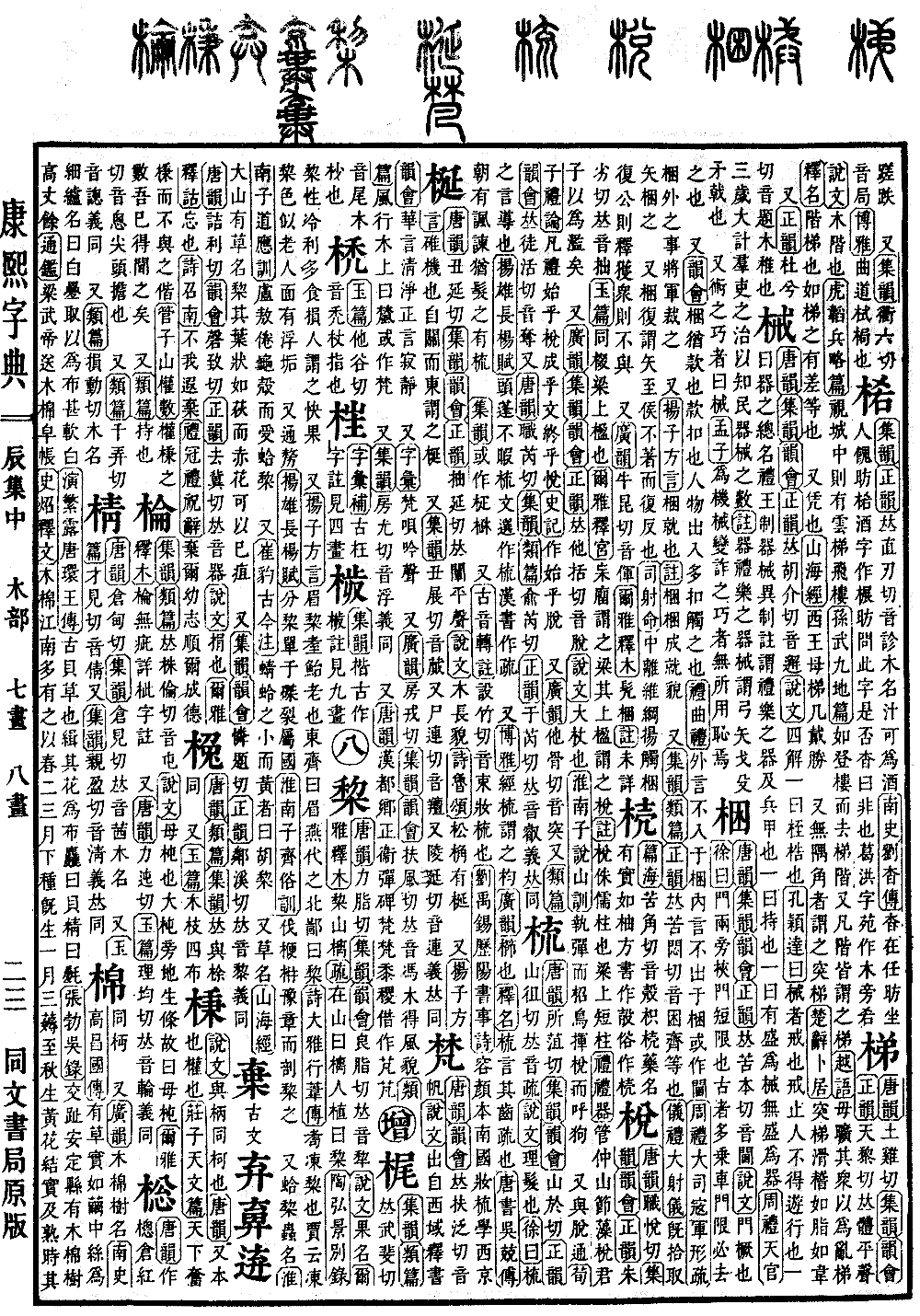
Chen Collection, Middle Volume
Radical: Tree (mù)
Mián
Kangxi Stroke Count: 12
Page 531, Entry 24
Also: According to the "Guangyun" (Guangyun), it is cottonwood, a type of tree.
According to the "History of the Southern Dynasties - Biography of the Kingdom of Gaochang," there is a plant whose fruit resembles a silkworm cocoon, with silk inside that can be spun into fine threads. It is called baidie. Cloth woven from it is very soft and white.
According to "Yanfanlu - Biography of Tang Huanwang," it is the ancient "beicao." Its flowers are spun into cloth; coarse cloth is called bei, and fine cloth is called die.
According to "Wu Lu" by Zhang Bo, in Anding County, Jiaozhi, there is a cottonwood tree that grows over a zhang tall.
According to the "Zizhi Tongjian" (Zizhi Tongjian), Emperor Wu of Liang sent cottonwood tents.
According to Shi Zhao's "Shuwen" (Shuwen), cottonwood is abundant in Jiangnan. It is sown in the second or third month of spring. After growing, the grass is hoed three times a month. In autumn, it produces yellow flowers and fruits. When ripe, its outer shell splits into four lobes, revealing a substance like cotton.
According to "Bencao" (Bencao), there are two types of cottonwood: herbaceous and woody.
Also: According to the "Guangyun" (Guangyun), it refers to a type of cotton.