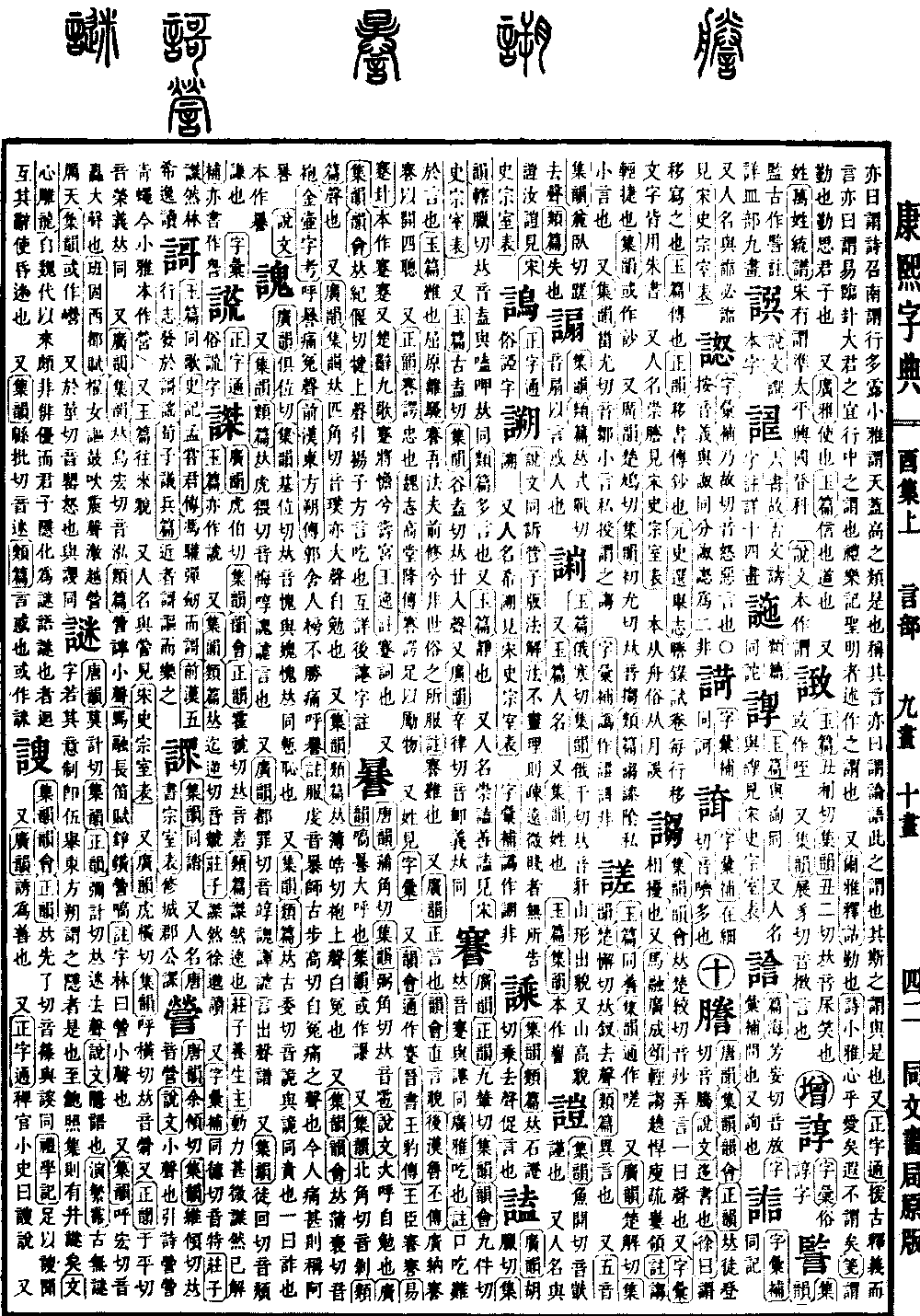
You Collection, Upper Volume
Radical: Speech (yán)
Kangxi Strokes: 17
Page 1174, Entry 01
Pronounced mi (falling tone)
Pronounced mi (falling tone)
Pronounced mi (falling tone)
Shuowen Jiezi (Shuowen) states: It is a riddle.
Yan Fan Lu (Yan Fan Lu) states: In ancient times, the word for riddle did not exist. If one investigates its original meaning and form, it is what Wu Ju and Dongfang Shuo called hidden language. By the time of the Collection of Bao Zhao (Bao Zhao Ji), the term well riddle already appeared.
The Literary Mind and the Carving of Dragons (Wenxin Diaolong) states: Ever since the Wei dynasty, people have strongly opposed the low-brow humor of jesters, and thus the refined hidden language of gentlemen evolved into riddles. A riddle is the use of convoluted and intricate phrasing to leave one confused and unable to comprehend.
Also in Collected Rhymes (Jiyun): Pronounced mi
Lei Pian (Lei Pian) states: Language that confuses people. Sometimes also written in a variant form (mi).