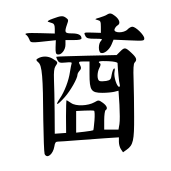
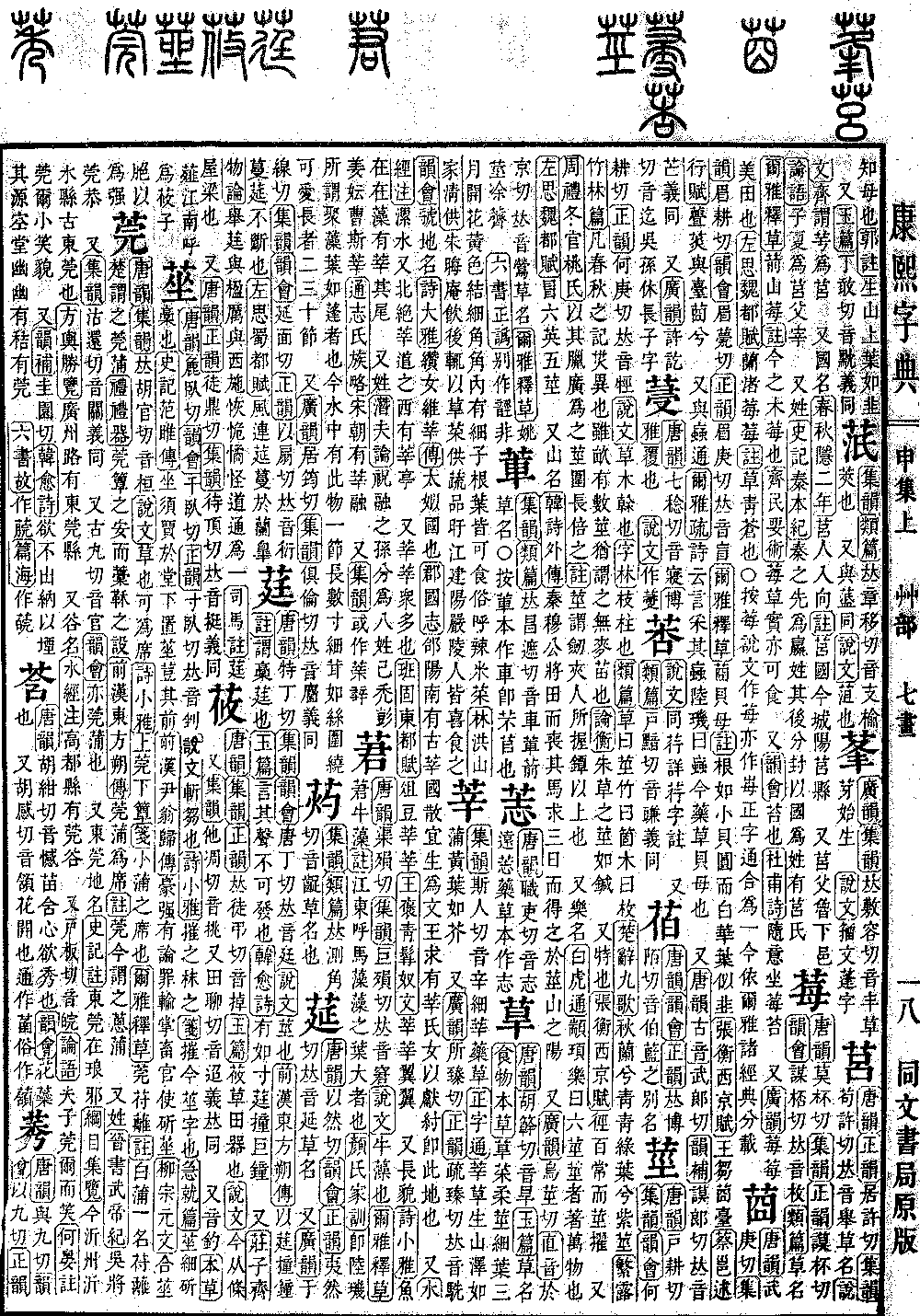
Shen Collection, Upper Volume
Radical: Grass (cǎo)
Meng
Kangxi strokes: 13
Page 1034, Entry 05
Pronounced meng. According to the Broad Rhymes (Guangyun), it is pronounced meng; according to the Collected Rhymes (Jiyun), it is pronounced meng; according to the Rhyme Collection (Yunhui), it is pronounced meng; according to the Correct Rhymes (Zhengyun), it is pronounced meng.
Literary Expositor (Erya), section on flora: Meng refers to the fritillary bulb.
Note: The root resembles a small seashell, round and white; the flowers and leaves resemble garlic chives.
Zhang Heng, Western Capital Rhapsody (Xijing fu): Mentions royal rushes and meng-terraces.
Cai Yong, Rhapsody on Describing a Journey (Shuxing fu): Writes of spreading marsh grasses and meng-terraces.
Also used as a variant for the character meng.
Commentary on the Literary Expositor (Erya shu): The Book of Odes (Shijing) contains the line "Go and pick the meng." Lu Ji explains: Meng is the herbal medicine known as fritillary bulb.
Also, according to the Ancient Pronunciation in the Tang Rhymes (Tangyun guyin), it is pronounced mang; according to the Supplement to the Rhymes (Yunbu), it is pronounced mang. The meaning is the same.
Also, according to the Broad Rhymes (Guangyun), it is pronounced qi. This was the name of the eldest son of Sun Xiu, emperor of Wu during the Three Kingdoms period.
Textual research: In the Rhapsody on Describing a Journey (Shuxing fu) by Cai Yong, the text reads: Marsh grasses and meng-terraces. Note: The original text has been amended to include the character for spreading before marsh grasses.