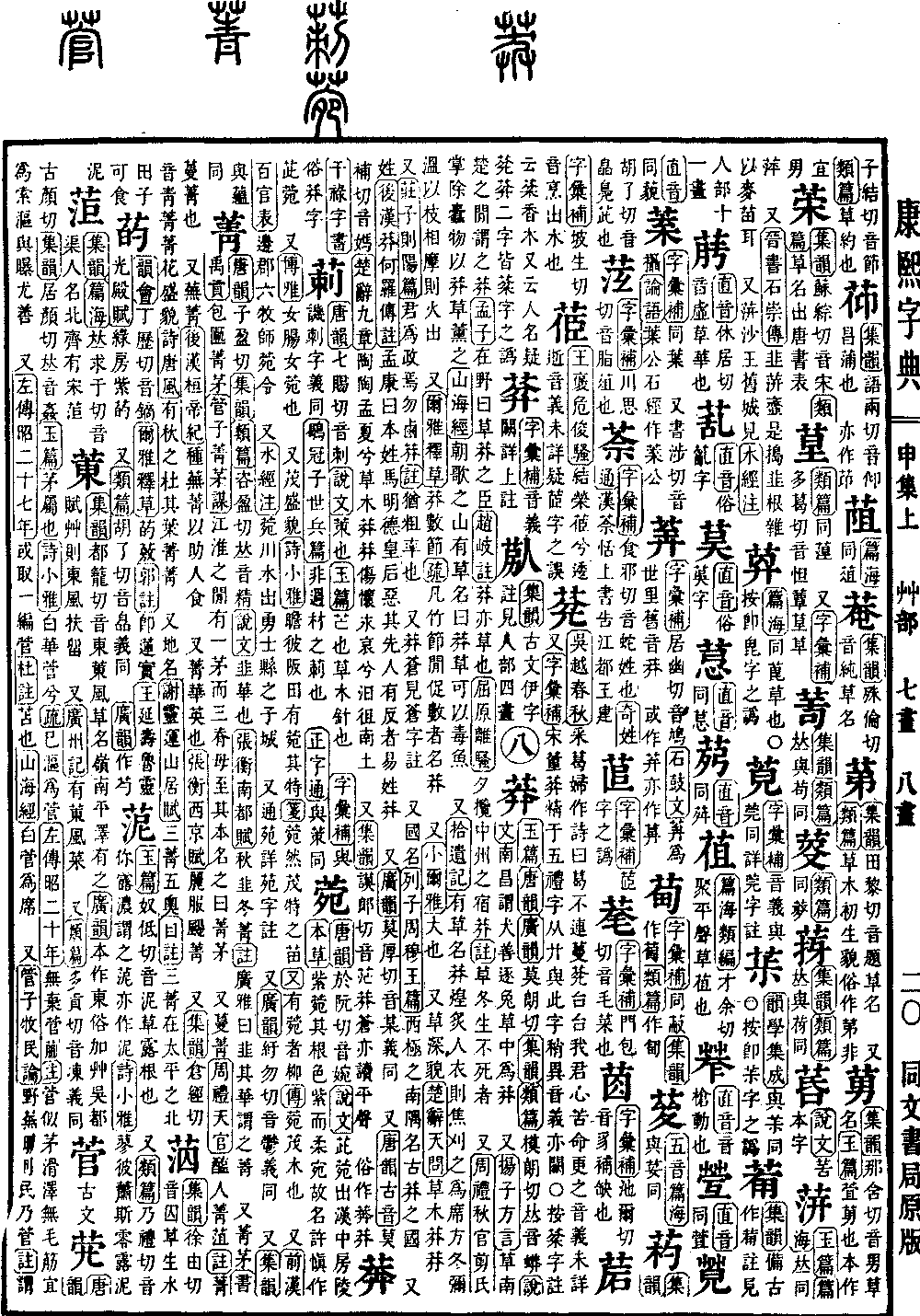
Shen Collection, Upper Volume
Radical: Grass (cǎo)
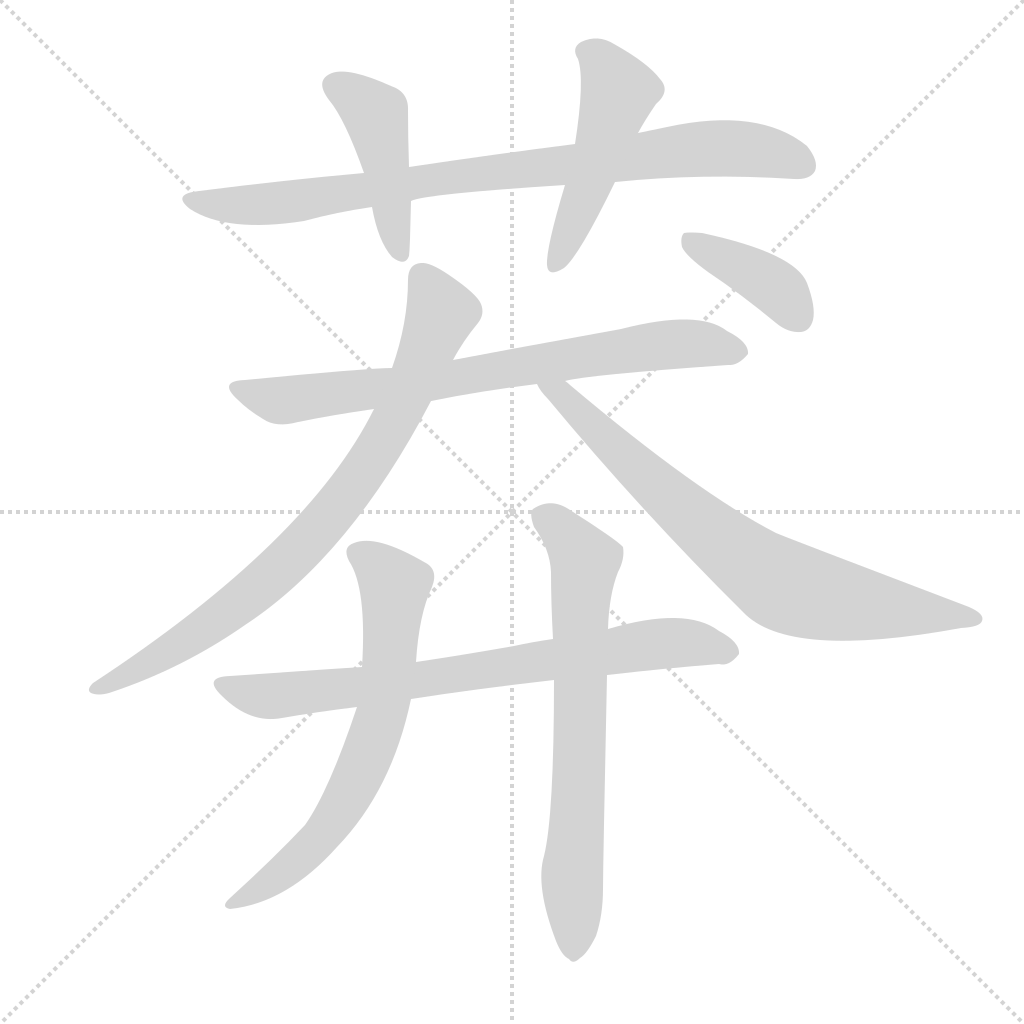
Mang; Kangxi strokes: 14; Page 1036, Entry 41
Jade Chapters (Yupian), Tang Rhymes (Tangyun), Broad Rhymes (Guangyun): Pronounced mang (rising tone). Collected Rhymes (Jiyun), Classified Chapters (Leipian): Pronounced mang (rising tone).
Explanations of Writing (Shuowen): In the Nanchang region, people call a dog that is skilled at chasing rabbits through the grass a mang.
Also, Yangzi's Regional Dialects (Fangyan): Grass is called mang in the southern Chu region.
Mencius (Mengzi): Referred to among the common people as subjects of the weeds and thickets.
Zhao Qi's Commentary: Mang also means grass.
Qu Yuan's Encountering Sorrow (Lisao): Gathering winter grass (sumang) on the islet at dusk.
Commentary: Sumang refers to grass that does not die in winter.
Also, Rites of Zhou (Zhouli), Autumn Official (Qiuguan), Scissors Official (Jianshi): Responsible for clearing wood-boring insects, using mang-grass (mangcao) to smoke them out.
Classic of Mountains and Seas (Shanhaijing): On Zhaoge Mountain, there is a type of grass called mang-grass (mangcao) which can be used to poison fish.
Also, Record of Miscellaneous Findings (Shiyiji): There is a grass called manghuang. If used to roast clothing, the fabric scorches; if cut to make mats, they are especially warm in winter; if the branches are rubbed against each other, they produce fire.
Also, Literary Expositor (Erya), Interpreting Grass: Mang refers to bamboo joints being dense.
Sub-commentary: Anything where the sections between bamboo joints are short and dense is called mang.
Also, Small Literary Expositor (Xiao Erya): Means large.
Also, describes the appearance of deep grass.
Songs of Chu (Chu Ci), Heavenly Questions (Tianwen): Grass and trees growing luxuriantly.
Also, Zhuangzi, Zeyang Chapter: A ruler should not be reckless (luman) in handling government affairs.
Commentary: Luman means crude and hasty.
Also, mangcang, see the entry for the character cang.
Also, name of a state.
Liezi, Zhou Mu Wang Chapter: At the furthest western southern corner, there is a state called Gumang.
Also, a surname.
History of the Former Han (Qian Hanshu), Annals of Emperor Wu, Commentary on Mang Heluo: Meng Kang states: Originally the surname was Ma. Empress Mingde despised the fact that his ancestors were rebels, so she changed the surname to Mang.
Also, Broad Rhymes (Guangyun): Pronounced mou (rising tone). Meaning is the same.
Also, Tang Rhymes Ancient Pronunciation: Pronounced ma (rising tone).
Songs of Chu (Chu Ci), Nine Declarations (Jiuzhang): Warmed by the early summer, grass and trees grow luxuriantly. With a heavy heart and prolonged grief, I hasten toward the southern lands.
Also, Collected Rhymes (Jiyun): Pronounced mang (level tone). Mangcang, also read with a level tone. Commonly written as mang.
Textual Research:
Qu Yuan's Encountering Sorrow (Lisao): Gathering winter grass (sumang) on the islet. Carefully deleted the character "zhong" according to the original text. Changed "zhou" to "izhou".
Later Han, Biography of Mang Heluo Commentary: Note that there is no biography of Mang Heluo in the History of the Later Han. Carefully corrected to History of the Former Han, Annals of Emperor Wu, Commentary on Mang Heluo according to the original book.