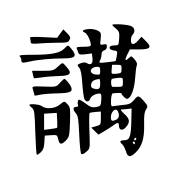
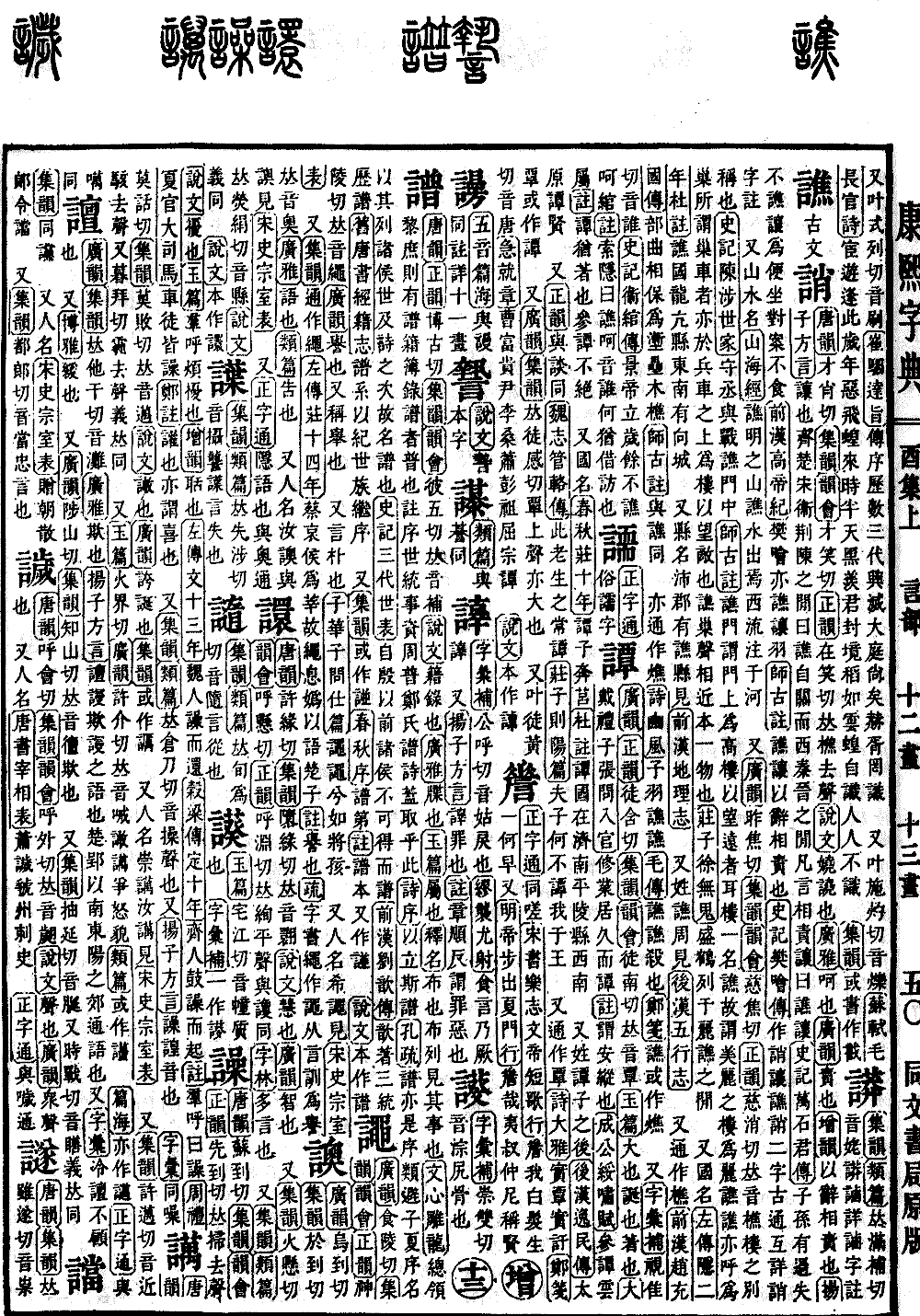
Pronounced mo (falling tone) according to "Tang Yun" (Tang Yun), and mo (falling tone) according to "Jiyun" (Jiyun), with the same pronunciation as "mai" (mai). "Shuowen Jiezi" (Shuowen Jiezi) explains it as meaning "kan" (kan). "Guangyun" (Guangyun) explains it as exaggerated and false speech. "Jiyun" (Jiyun) records this character as sometimes written as "".
It is also used in personal names. For example, Chong kan (Chong kan) and Ru kan (Ru kan), found in the "Table of Imperial Relatives" in the "History of Song" (Song Shi).
Also, "Jiyun" (Jiyun) records the pronunciation as xu (falling tone), close to the falling tone of "hai" (hai). It is also recorded as mu (falling tone), with the same pronunciation as the falling tone of "mai" (mai). The meaning is the same.
Furthermore, "Yupian" (Yupian) records the pronunciation as huo (falling tone), and "Guangyun" (Guangyun) records it as xu (falling tone), with the same pronunciation as "cheng" (cheng). It means "kan kan" (kan kan), describing the appearance of angry disputes. "Leipian" (Leipian) records it as sometimes written as "". "Pianhai" (Pianhai) also writes it as "". "Zhengzitong" (Zhengzitong) records it as the same as the character "lang" (lang).