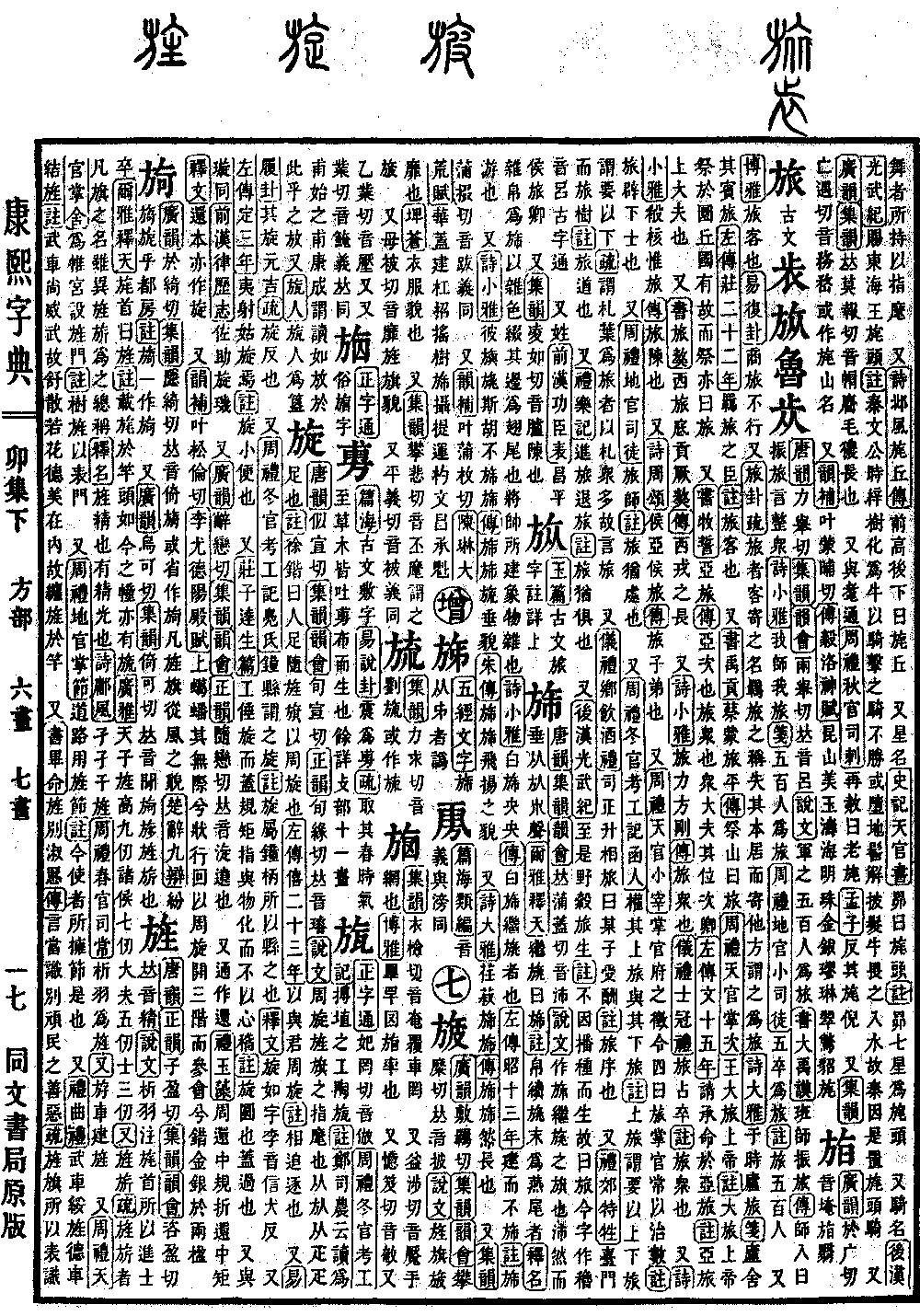
Mao Collection, Lower Volume
Radical: Square (fāng)
Kangxi Strokes: 10
Page 483, Entry 02
Ancient script for the character Lu.
Pronounced lu.
Shuowen Jiezi says that in the military, a unit of 500 men is called a lu.
Book of Documents (Shangshu): Organize the troops and conduct a review (zhen lu).
Commentary: When an army returns, it is called zhen lu, meaning to reorganize the troops.
Book of Odes (Shijing): Our armies, our units.
Annotation: 500 men constitute a lu.
Rites of Zhou (Zhouli): Five zuren units constitute a lu.
Annotation: Lu means 500 men.
Also, Guangya dictionary: Lu means a guest.
Book of Changes (Yijing): Merchants and travelers do not move about.
Also, Lü Hexagram Commentary: Lu is the term for living as a guest or staying in a foreign land. To leave one’s native place and dwell elsewhere is called lu.
Book of Odes (Shijing): There they built huts for travelers.
Annotation: Constructed dwellings to house guests and travelers.
Zuo Tradition (Zuozhuan): A minister who is a traveler in a foreign land.
Annotation: Lu means guest.
Also, Book of Documents (Shangshu): The mountains of Cai and Meng were leveled (lü ping).
Commentary: To perform sacrifices at mountains is called lu.
Rites of Zhou (Zhouli): The King performs the great sacrifice (lü) to the Supreme Deity.
Annotation: The great sacrifice to the Supreme Deity is performed at the round mound. When the state faces significant affairs, sacrifices performed are also called lu.
Also, Book of Documents (Shangshu): The junior officers (ya lu).
Commentary: Ya means second or subordinate. Lu means multitude. These are the various high-ranking officials whose positions are below the ministers.
Zuo Tradition (Zuozhuan): Request to accept orders from the high-ranking officials (ya lu).
Annotation: Ya lu refers to senior officials.
Also, Book of Documents (Shangshu): The Western Lu offered their hounds.
Commentary: The leader of the Western Rong tribes.
Also, Book of Odes (Shijing): The strength of the many (lü li) is just reaching its peak.
Commentary: Lu means many.
Book of Etiquette and Ceremonial (Yili): The group divination is finished.
Annotation: Lu means many.
Also, Book of Odes (Shijing): Side dishes and nuts were arranged in rows (lü).
Commentary: Lu means to display or arrange.
Also, Book of Odes (Shijing): Serving as subordinates, serving as the many.
Commentary: Lu refers to the sons and younger brothers.
Also, Rites of Zhou (Zhouli): Managing official summons and commands, the fourth is lu, managing the routine duties of officials to handle administrative numbers.
Annotation: Lu refers to the junior officials in charge of administrative tasks.
Also, Rites of Zhou (Zhouli): Officer of the army (lü shi).
Annotation: Lu is equivalent to the meaning of to dwell.
Also, Rites of Zhou (Zhouli): Weighing the upper section and the lower section.
Annotation: The upper lu refers to the part above the waist, and the lower lu refers to the part below the waist.
Commentary: The scales of armor are called lu because they are numerous, thus lu is used to describe them.
Also, Book of Etiquette and Ceremonial (Yili): The presiding officer ascends to assist in the sequence of toasts (lü), saying: So-and-so receives the return toast.
Annotation: Lu means order or sequence.
Also, Book of Rites (Liji): Erecting a screen and planting rows of trees (lü).
Annotation: Lu means the path or roadside.
Also, Book of Rites (Liji): Advancing together and retreating together.
Annotation: Lu is equivalent to the meaning of together.
Also, History of the Later Han (Hou Hanshu): By then, wild grains grew spontaneously (lü sheng).
Annotation: Grains that grow without being sown are called lü. Modern writing uses the character lü, pronounced lu. The ancient character is used interchangeably.
Also, a surname.
History of the Former Han (Hanshu): The Marquis of Changping, Lu Qing.
Also, Jiyun dictionary: Pronounced lu. Means to display or arrange.