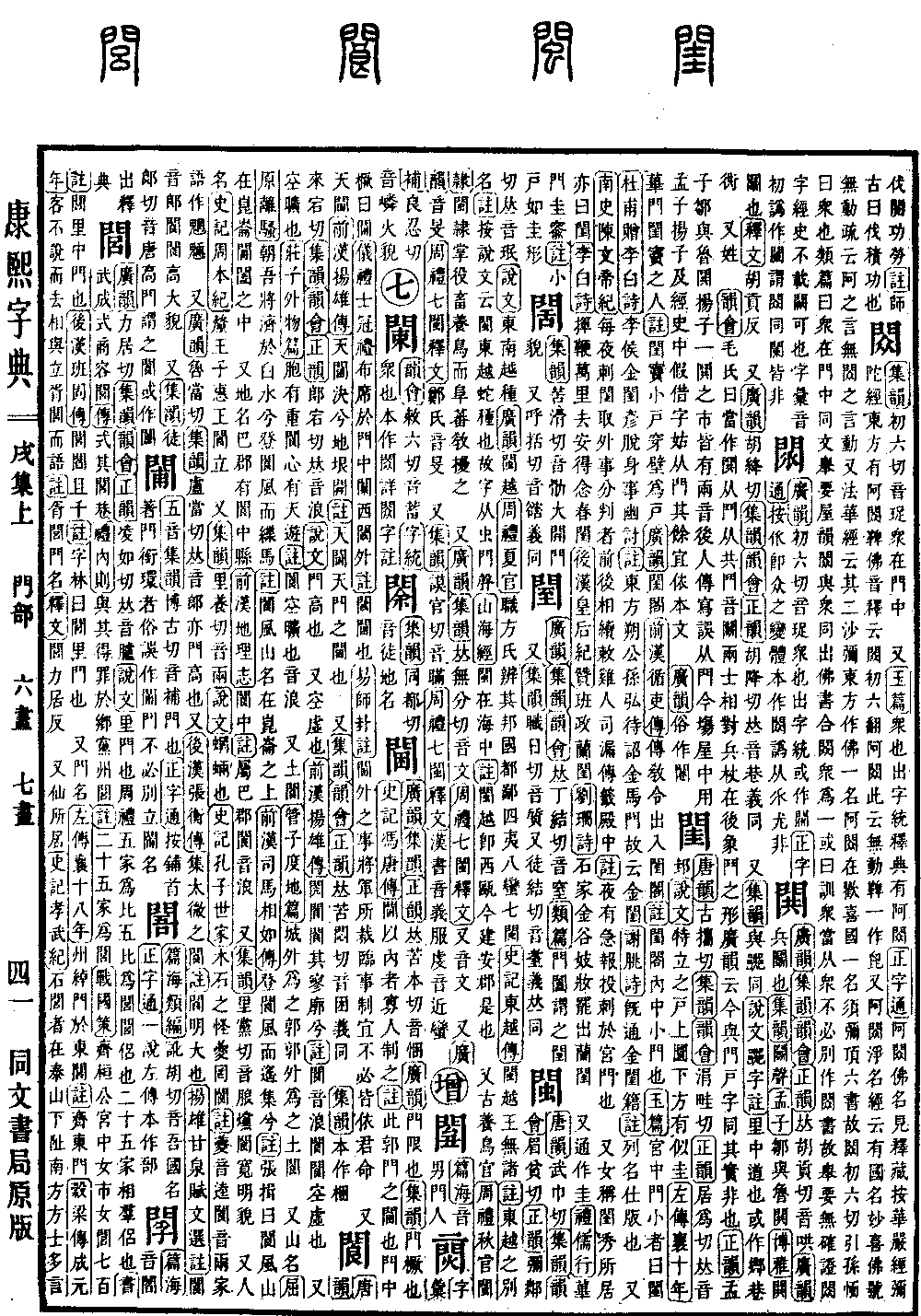
Xu Collection, Upper Volume
Radical: Gate (mén)
Page 1335, Entry 17
Guangyun: Pronounced lu
Jiyun, Yunhui, Zhengyun: Pronounced lu
Shuowen: The main gate of a neighborhood lane. The Rites of Zhou (Zhouli) mandates that five families constitute a bi; five bi constitute a lü. Lü implies companionship, where twenty-five families live together as companions.
Book of Documents (Shujing): Pay respect at the gate of the lane where Shang Rong resides. Commentary: To pay respect at the lane where he resides.
Book of Rites (Liji): And those who have offended the people of the local, party, state, and neighborhood (lü) districts. Commentary: Twenty-five families constitute a lü.
Strategies of the Warring States (Zhanguoce): During the time of Duke Huan of Qi, seven hundred women's markets and women's quarters (lü) were established within the palace. Commentary: Lü-li refers to the gate in between.
Biography of Ban Gu in the Book of the Later Han (Hou Hanshu): The gates and doors of the lanes were nearly one thousand in number. Commentary: Zilin says: Lü-li refers to the gate.
Also refers to the name of a gate.
Zuo Commentary (Zuo Zhuan): Zhou Chuo attacked the East Lü Gate. Commentary: The east gate of the State of Qi.
Guliang Commentary (Guliang Zhuan): Guests left displeased, standing by the Xu-lü Gate and speaking to one another. Commentary: Xu-lü is the name of a gate.
Shuowen Jingdian Shiwen: Pronounced lu
Also refers to the residence of immortals.
Records of the Grand Historian (Shiji): Shi-lü is located at the southern foot of Mount Tai; alchemists often claim this is the dwelling place of immortals.
Also refers to the name of a pavilion.
Spring and Autumn Annals (Chunqiu): Shuqi of the State of Zhu came to defect, bringing with him the territories of Qi and Lüqiu. Commentary: South of Gaoping, northwest of Pingyang County, there is the Xian-lü Pavilion.
Also refers to an ancient title.
Rites of Zhou (Zhouli): The Lü-xu officers each manage the conscriptions and orders within their own neighborhood (lü).
Preface to Li Sao: Qu Yuan was of the same surname as the royal family of the State of Chu; he served under King Huai of Chu, holding the office of San-lü Grand Master.
Commentary to the Biographies of Qu Yuan and Jia Yi in the Records of the Grand Historian (Shiji): The duties of the San-lü Grand Master were to manage the affairs of the three royal surnames: Zhao, Qu, and Jing.
Also refers to a type of stone.
Wuyin Jiyun: Weilu. Sima says: Lü means to gather; it is the place where waters converge, located east of Fusang, also called Wojiao. It is a stone, forty thousand li in circumference and forty thousand li in thickness; seawater flowing into it is inevitably scorched.
Also refers to a mountain.
Erya: Auspicious items of the East are produced in Mount Yiwulü, specifically the xunyao jade. Commentary: Yiwulü is a mountain name, currently located in Liaodong.
Also, Yang Xiong's Fangyan: The bow of a boat is called a he-lü. Commentary: Nowadays in Jiangdong, the structure on the bow of a boat is called a fei-lü.
Also refers to a type of sword.
Xunzi: Ganjiang, Moye, Juque, and Pilü are all excellent swords of antiquity. Commentary: Xin Xu states: Pilü and Juque are the finest swords under heaven.
Also, Wuyin Jiyun: A type of grass. Shaped like mugwort.
Former Han, Biography of Sima Xiangru: Yanlü and xuanyu. Commentary: Yanlü is a type of mugwort; its seeds can treat illness.
Also, Zhengyun: Lü, a name for a tree.
Records of the Grand Historian (Shiji): Renpin and binglü. Commentary: Both renpin and binglü are explained as palm trees. However, research indicates that palm bark is used to make ropes, so binglü should be palm, while renpin is betel nut.
Also, Jiyun: A type of wild beast. Resembles a donkey, single-horned, with cloven hooves.
Classic of Mountains and Seas (Shanhaijing): In Mount Xianyong, there are many lü and mi beasts. Commentary: Guo Pu states that lü is the same as yu, resembling a donkey but with cloven hooves and horns like an antelope; also called a mountain donkey.
Also refers to a beautiful woman.
Strategies of the Warring States (Zhanguoce): Even beautiful women like Lü Shu and Zi She cannot succeed without a matchmaker. Commentary: In Xunzi, Lü Shu is written as Lü Ju. Wei Zhao says: This refers to a beauty belonging to King Wei of Liang, Wei Di.
Also refers to a surname.
Zuo Commentary (Zuo Zhuan): Zongzi Yang and Lüqiu Ming encouraged one another.
Former Han, Treatise on Literature (Yiwenzhi): Lüqiu Zi, in thirteen chapters. Commentary: A man from the State of Wei.
Zhengzitong: Jianglü and lükui are both compound surnames. Tang Jun of the Han Dynasty mentioned a recluse named Lükui Ban.
Also refers to a personal name.
Records of the Grand Historian (Shiji): King Helü of Wu.
Former Han, Annals of Emperor Wu: The Yijun of the Eastern Yi, Nanlü, and others. Commentary: Nanlü is the personal name of the Yijun.
Records of the Grand Historian (Shiji): Marquis of Yülü.