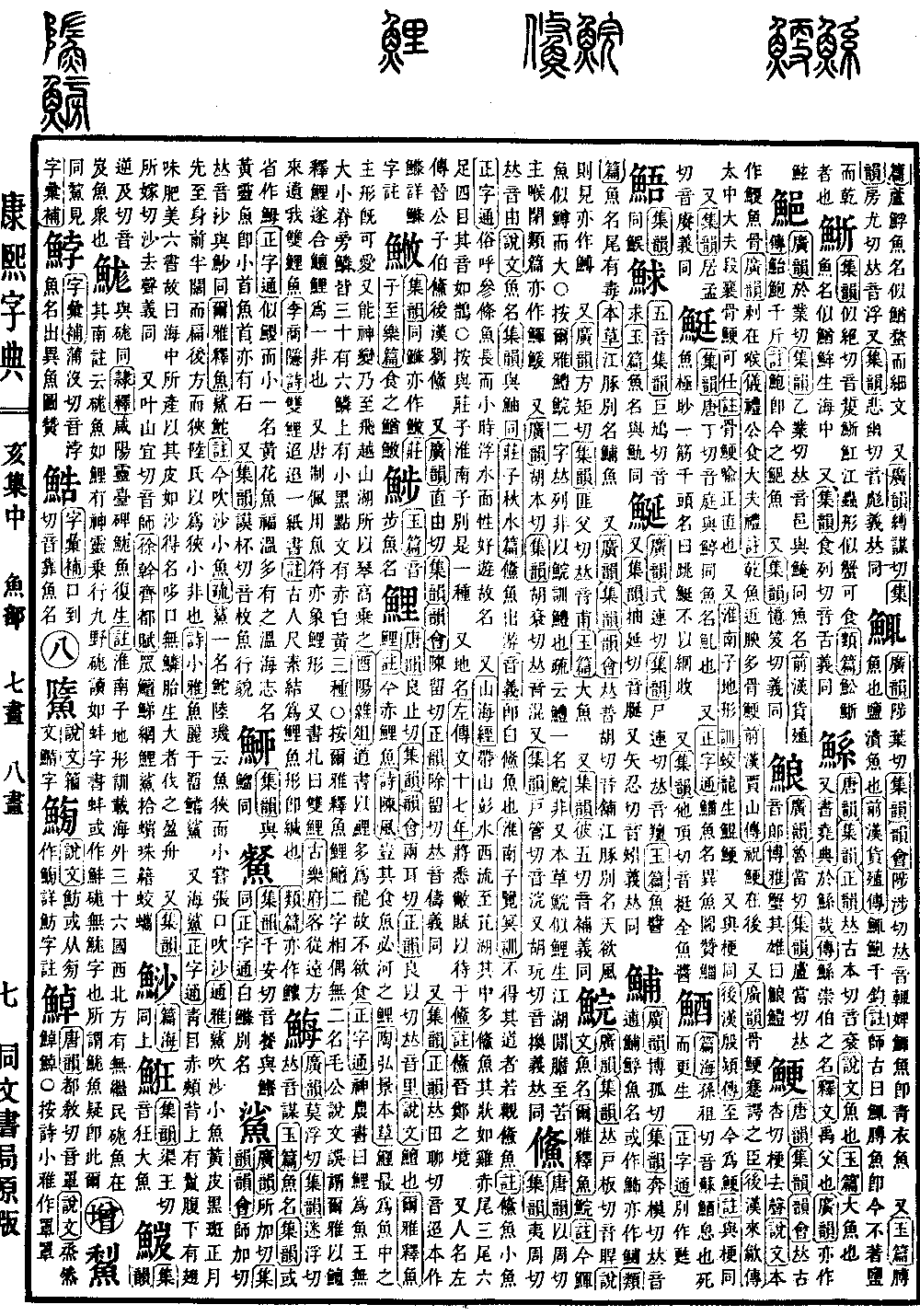
Hai Collection, Lower Volume
Radical: Fish (yú)
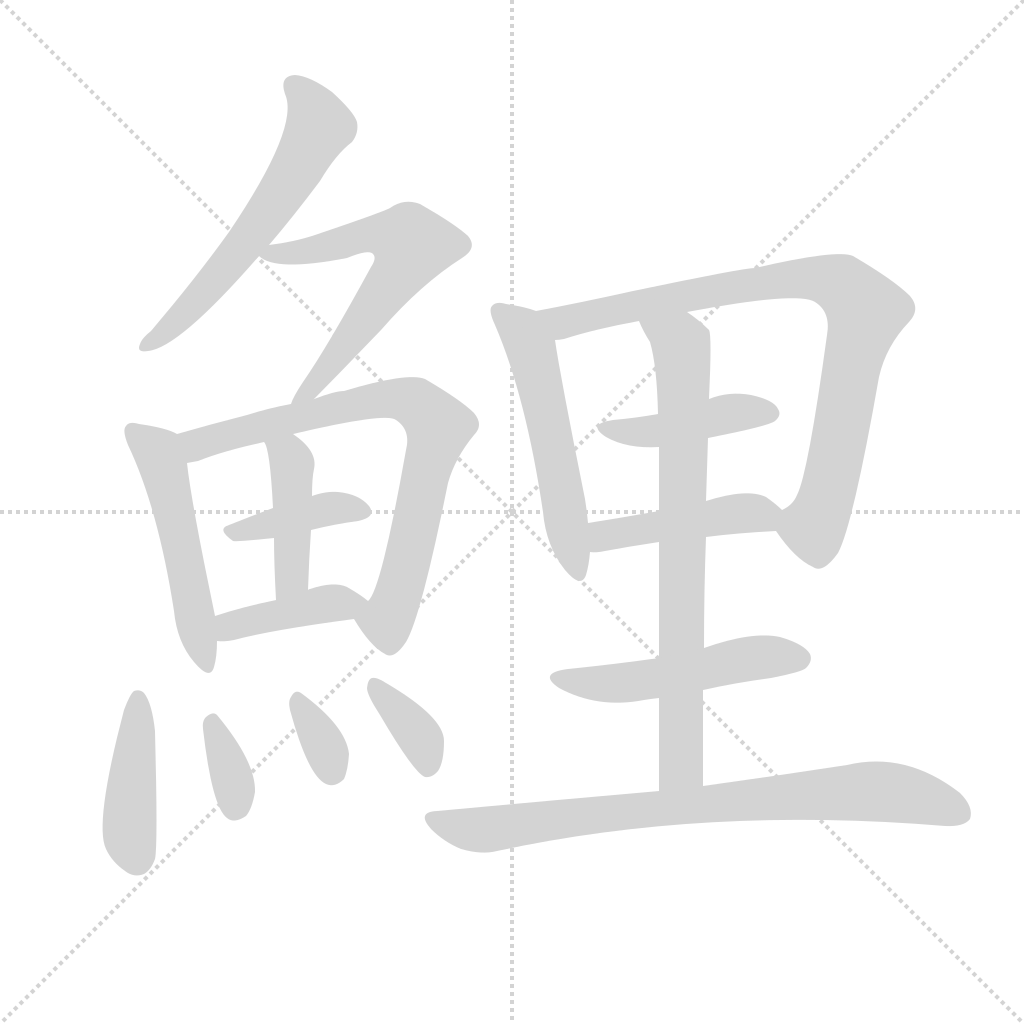
Character: Carp
Kangxi Stroke Count: 18
Page 1471, Entry 17
Pronounced li (rising tone)
Shuowen Jiezi (Explanation of Writing and Analysis of Characters) defines it as a sturgeon. Erya (Approaching Elegance) in the section Explaining Fish lists the carp. The commentary notes it refers to the red carp. In the Book of Odes (Shijing), it asks: When eating fish, must it be the carp from the Yellow River? Tao Hongjing in the Materia Medica (Bencao) states that the carp is the most important of all fish. It is elegant in appearance and possesses magical transformative powers, capable of leaping over mountains and lakes, which is why the immortal Qin Gao rode one. Miscellaneous Morsels from Youyang (Youyang Zazu) notes that Daoist texts claim many carp transform into dragons, which is why people avoid eating them. The Zhengzitong (Correction of Character Principles) records that the Shennong scripture states: The carp is the king of fish. Regardless of size, there are thirty-six scales along the side of its spine, each marked with a small black spot, and the patterns come in red, white, and yellow. Regarding the text of Erya in the section Explaining Fish, the characters for carp and sturgeon are listed side-by-side as distinct entries. Mao Gong’s commentary in Shuowen erroneously suggests that Erya uses sturgeon to define carp, effectively merging the two into a single species, which is incorrect. Furthermore, according to Tang Dynasty regulations, fish tallies used for official identification were fashioned in the shape of a carp. The term double carp is also used to refer to letters. The Ancient Music Bureau (Gu Yuefu) poems mention a guest arriving from afar, presenting a pair of carp. Li Shangyin’s poetry references a letter arriving from a long distance. The commentary explains that in ancient times, letters were folded into the shape of a carp, which functioned as an envelope. Lei Pian (Compendium of Characters) also records a variant form.