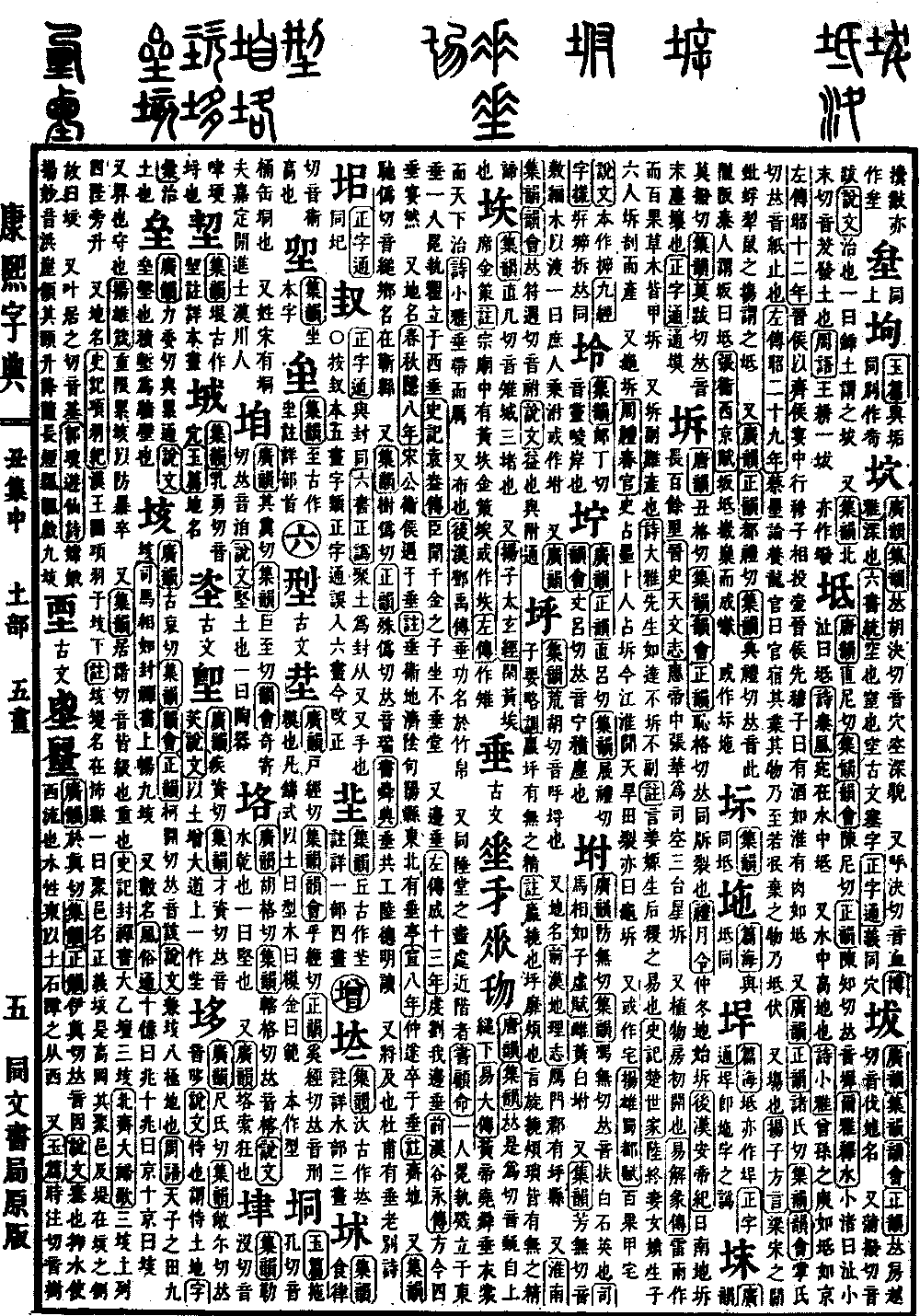
Chou Collection, Middle Volume. Radical: Earth (tǔ). 18 strokes. Page 227, Entry 39.
Pronounced lěi. Interchangeable with lěi. As stated in the Explaining Graphs and Analyzing Characters (Shuowen Jiezi), a lěi is a brick. It refers to piling up trenches to form walls.
Pronounced lěi. As stated in the Explaining Graphs and Analyzing Characters (Shuowen Jiezi), it refers to a military fort. According to the Book of Rites (Liji), in the chapter on the Summary of Propriety (Quli), when the four borders have many military forts, it is a humiliation for the high ministers and officials. According to the Rites of Zhou (Zhouli), in the Ministry of Summer (Xiaguan), the official in charge of measurements oversees the construction of military forts and barracks, and calculates the locations of markets, courts, districts, roads, and military altars.
Also the name of a star. According to the Records of the Grand Historian (Shiji), in the Treatise on the Celestial Offices (Tianguan Shu), the numerous stars south of the Emptiness (Xu) mansion are called the Heavenly Army of Yulin, and to the west of the army is the Fort (Lei).
Also the name of an official post. According to the History of the Former Han (Qianhan Shu), in the Table of Officials and Ministers, when Emperor Wu pacified Southern Yue, he added seven divisions, of which the Middle Fort (Zhonglei) was one.
Also a surname. During the Later Zhao period there was Lei Cheng; during the Jin dynasty there was Lei Xi, Governor of Zitong.
Pronounced fěi. Refers to the appearance of a mountain.
Pronounced léi. Refers to Weilei, a mountain name. According to the Zhuangzi, in the chapter Gengsangchu, one resides north of Mount Weilei.
Also Jade Fort (Yulei) Mountain, located west of Guan County; during the Zhenguan period of the Tang dynasty, a pass was established at its foot. As written in a poem by Cen Shen, looking at the Jade Fort (Yulei) mountain when the sky is clear, all other peaks feel low.
Also means layered or heavy. One interpretation is that it describes a robust appearance. According to the History of the Former Han (Qianhan Shu), in the biography of Bao Xuan, it refers to a robust man.
Also refers to tombs arranged in succession. According to Zhang Zai in the Seven Sorrows (Qiai), how layered the tombs are at the Northern邙 (Beimang) mountain.
Also interchangeable with lěi. According to the Xunzi, in the chapter on General Principles (Dalue), do not worry about being bound or restrained.
Also interchangeable with lěi. According to the History of the Former Han (Qianhan Shu), in the biography of Li Ling, to throw down stones (lěi).
Pronounced lǜ. Yulü, a name of a deity. According to the Comprehensive Customs (Fengsu Tong), in ancient times there were brothers named Shentu and Yulü who lived under a peach tree on Dushu Mountain in the East Sea. They inspected all ghosts; those who did not follow the laws were bound with reed ropes and fed to tigers. According to Zhang Heng in the Western Capital Rhapsody (Dongjing Fu), at Dushu, evil spirits are suppressed, guarded by Yulü. Shentu assists him, both holding ropes made of reeds. The tradition of peach wood charms during the year-end sacrificial festival originates from this. Shentu is pronounced shēnshū.