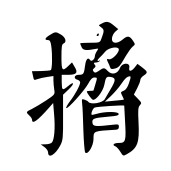
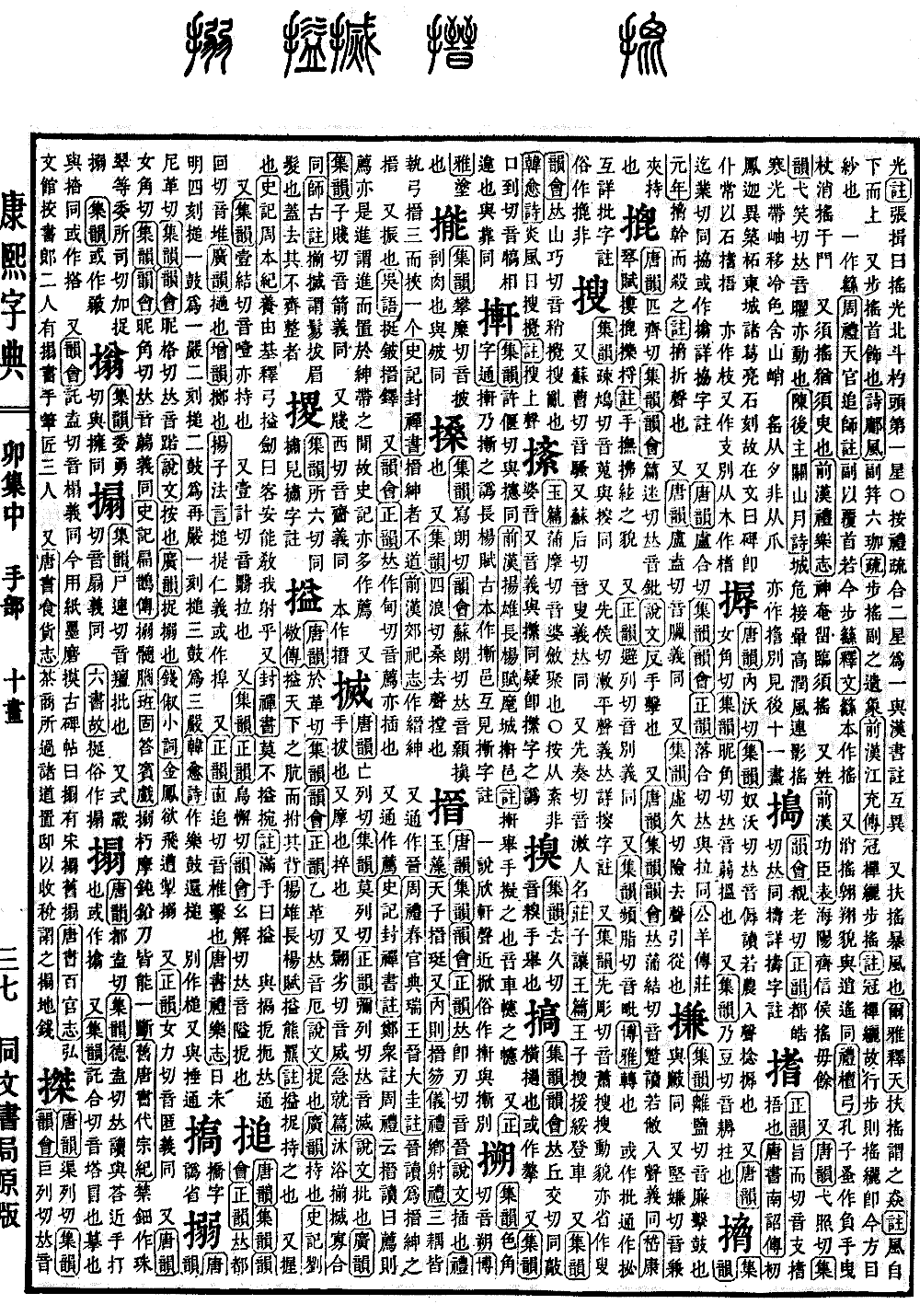
Mao Collection, Middle Volume. Radical: Hand (shǒu). Kangxi strokes: 14. Page 447, Entry 04.
According to the Sound Dictionary (Jiyun), it is pronounced ye. It is identical to the character for xie. Sometimes also written in a variant form (zhuan). Detailed explanations can be found in the annotations for the character xie.
Furthermore, according to the Tang Dynasty Pronunciation Dictionary (Tangyun), it is pronounced la. According to the Sound Dictionary (Jiyun), the Rhyme Collection (Yunhui), and the Correct Rhymes (Zhengyun), it is pronounced la, which is identical to the character for la. In the Commentary on the Spring and Autumn Annals (Gongyang Zhuan), written during the first year of Duke Zhuang, it is recorded that one broke the bones and killed him. The commentary explains that the character for la represents the sound of breaking.
Additionally, according to the Tang Dynasty Pronunciation Dictionary (Tangyun), it is pronounced la, with the same sound as the character for la. The meaning is the same.
Moreover, according to the Sound Dictionary (Jiyun), it is pronounced xian (falling-rising tone), which is phonetically similar to xian (falling tone). It means to pull, lead, or guide.