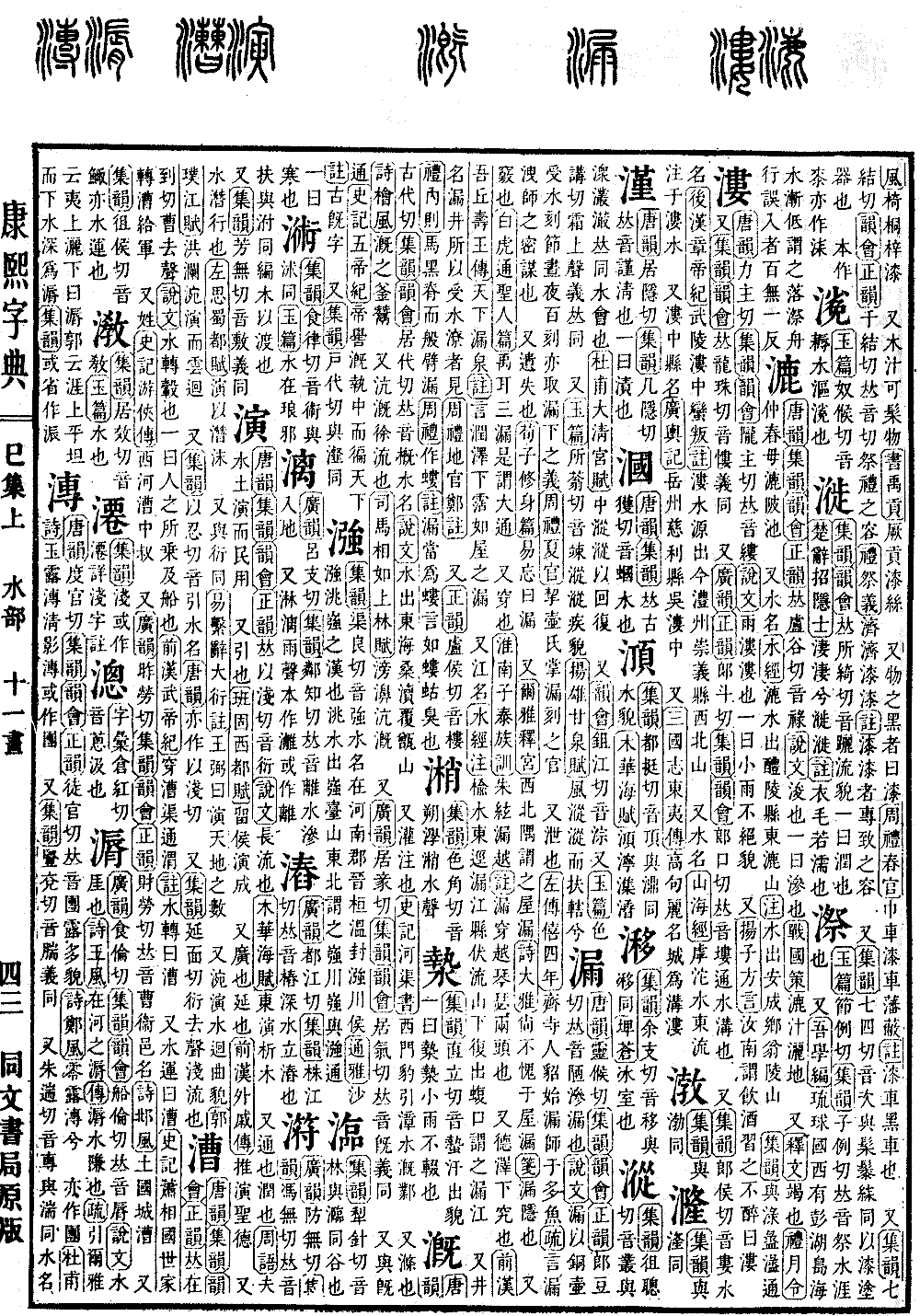
Si Collection, Upper Volume
Radical: Water (shuǐ)
Kangxi Strokes: 15
Page 645, Entry 13
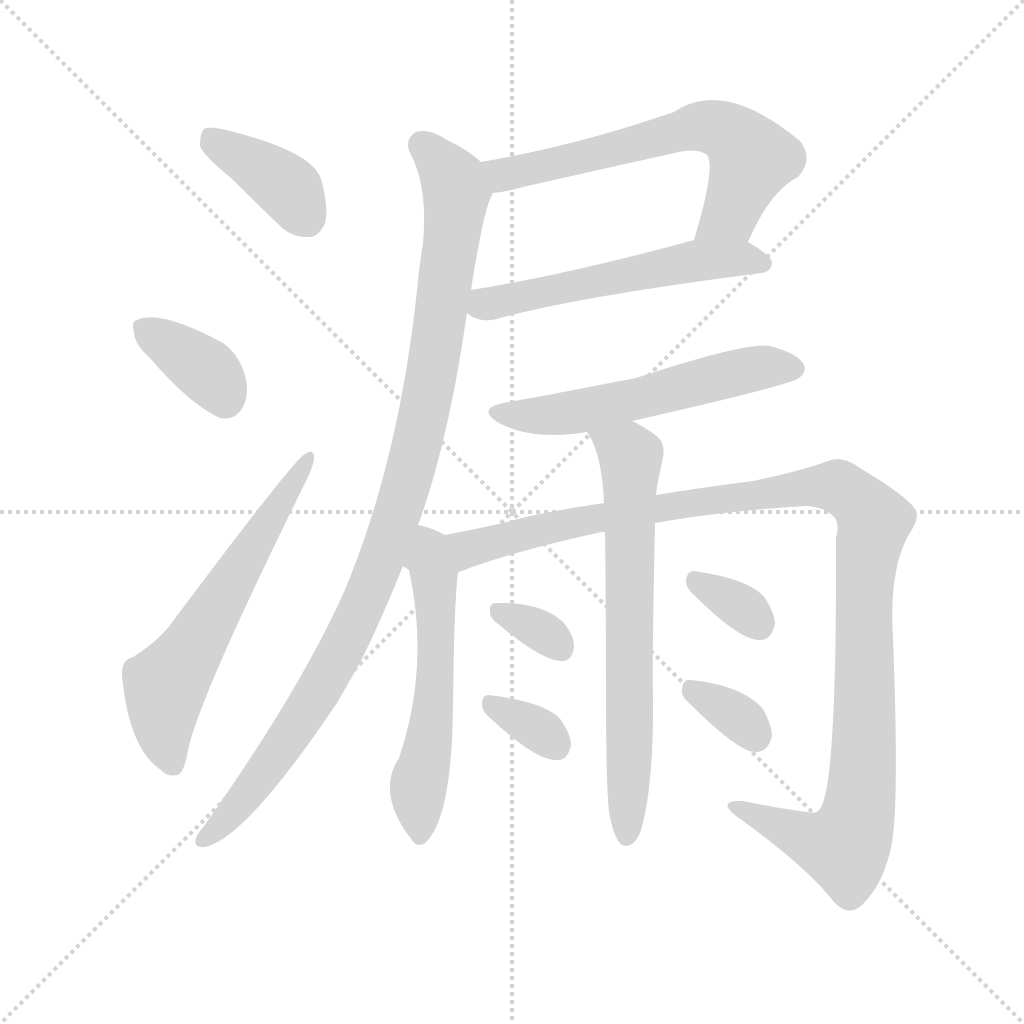
Pronounced lou. To seep or leak.
Shuowen Jiezi states that a clepsydra is a vessel made of copper used to hold water, marked with graduations to divide a day and night into one hundred segments. It is named for the dripping of water.
Book of Rites (Zhouli), Summer Offices: The master of the clepsydra is the official in charge of water-clock timekeeping.
Also refers to leaking information.
Zuo Commentary (Zuozhuan), Fourth Year of Duke Xi: The official Diao of the State of Qi began to leak military secrets regarding Duo Yu.
Commentary (Shu): This means to divulge the secret plans of an army.
Also refers to loss or forgetting.
Xunzi, Cultivation Chapter: To forget easily is called lou.
Also, Erya, Explanation of Buildings: The northwest corner of a room is called the house corner (lou).
Book of Odes (Shijing), Greater Odes: Even in the dark corner of the house, one feels no shame.
Commentary (Jian): Lou refers to a concealed or hidden place.
Also refers to an orifice or hole.
Comprehensive Discourses (Baihu Tong), Sage Chapter: Great Yu had three orifices in his ears, which is called Great Penetration.
Also refers to piercing or penetrating.
Huainanzi, Records of Supreme Customs: The red strings penetrate the bridge of the zither.
Commentary (Zhu): Louyue refers to the strings passing through the two ends of the zither.
Also refers to grace extending downward.
Book of Han (Qianhan), Biography of Wuqiu Shouwang: The grace of the world is like a leaking spring.
Commentary (Zhu): This means that grace and favor reach downward, just like water leaking from a roof.
Also refers to the name of a river.
Commentary on the Classic of Waterways (Shuijing Zhu): The Yu River flows eastward, passing beneath Fuliu Mountain in Loujiang County, then emerges from the mouth of a cave, known as the Lou River.
Also refers to the name of a well. A leaking well is a well used to collect rainwater. See the Zheng Commentary to the Earth Offices section of the Book of Rites (Zhouli).
Also pronounced lou.
Book of Rites (Liji), Inner Chapters: A horse with a black ridge and striped forelegs is called lou.
In the Book of Rites (Zhouli), it is written as lou (mole cricket).
Commentary (Zhu): The character lou should be written as mole cricket. It means to have a stench like that of a mole cricket.