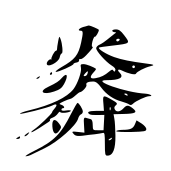
"Tang Yun" and "Lei Pian" indicate the pronunciation is the same as "lin" (falling tone). "Shuowen Jiezi" records that the blood of soldiers who die in battle, as well as that of cattle and horses, transforms into yan. Yan refers to ghost fire. The character is composed of "yan" and "chuan." "Bowuzhi" records that in places where wars have caused death, the blood of people and horses, over many years, transforms into yan. It adheres to the ground and vegetation like dew, imperceptible. Pedestrians who touch it will have it adhere to their bodies and glow. When wiped, it disperses into countless points of light, accompanied by a subtle sound like beans popping, and gradually disappears after a long period of stillness.
"Yupian" indicates the pronunciation is the same as "lin" (rising tone), and "Guangyun" indicates the pronunciation is the same as "lin" (entering tone). The meaning is the same. "Guangyun" and "Jiyun" write it as lin. It is the same as lin. "Jiyun" also writes it as .