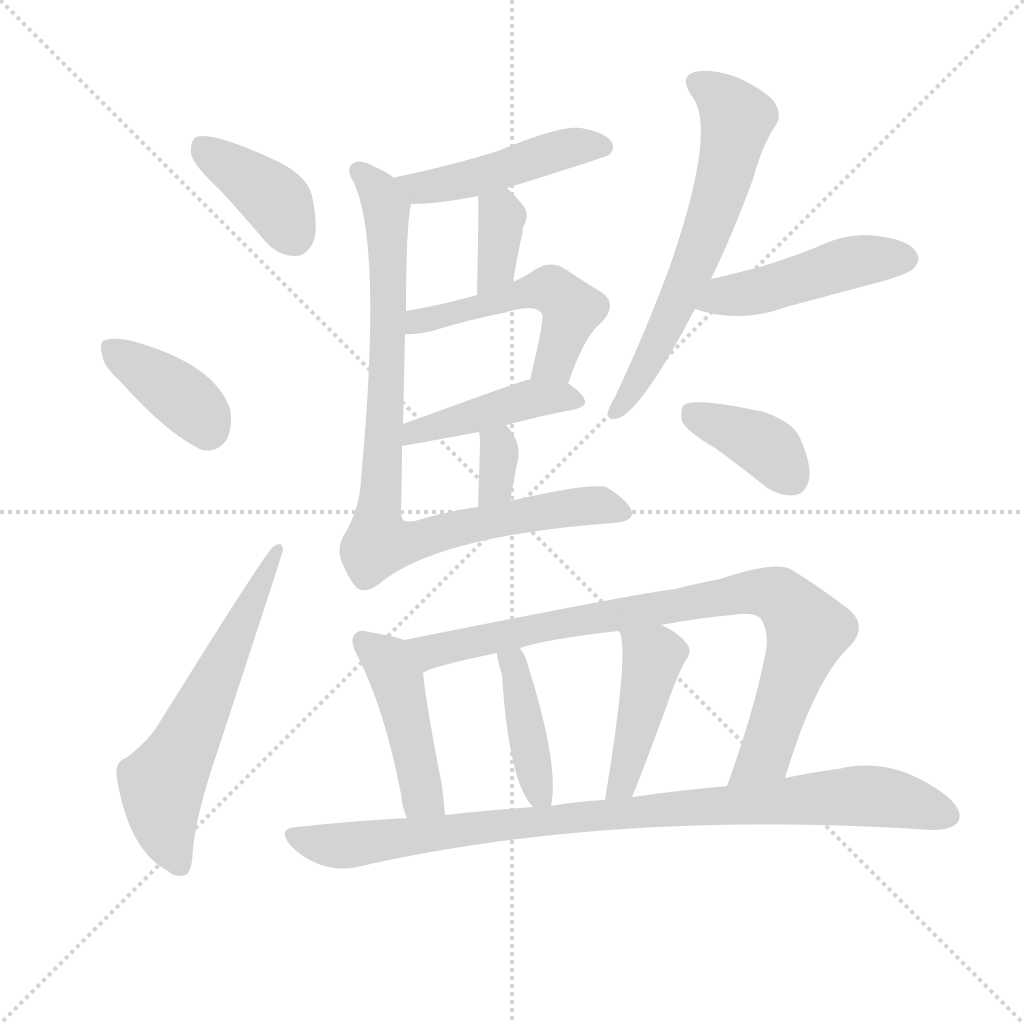
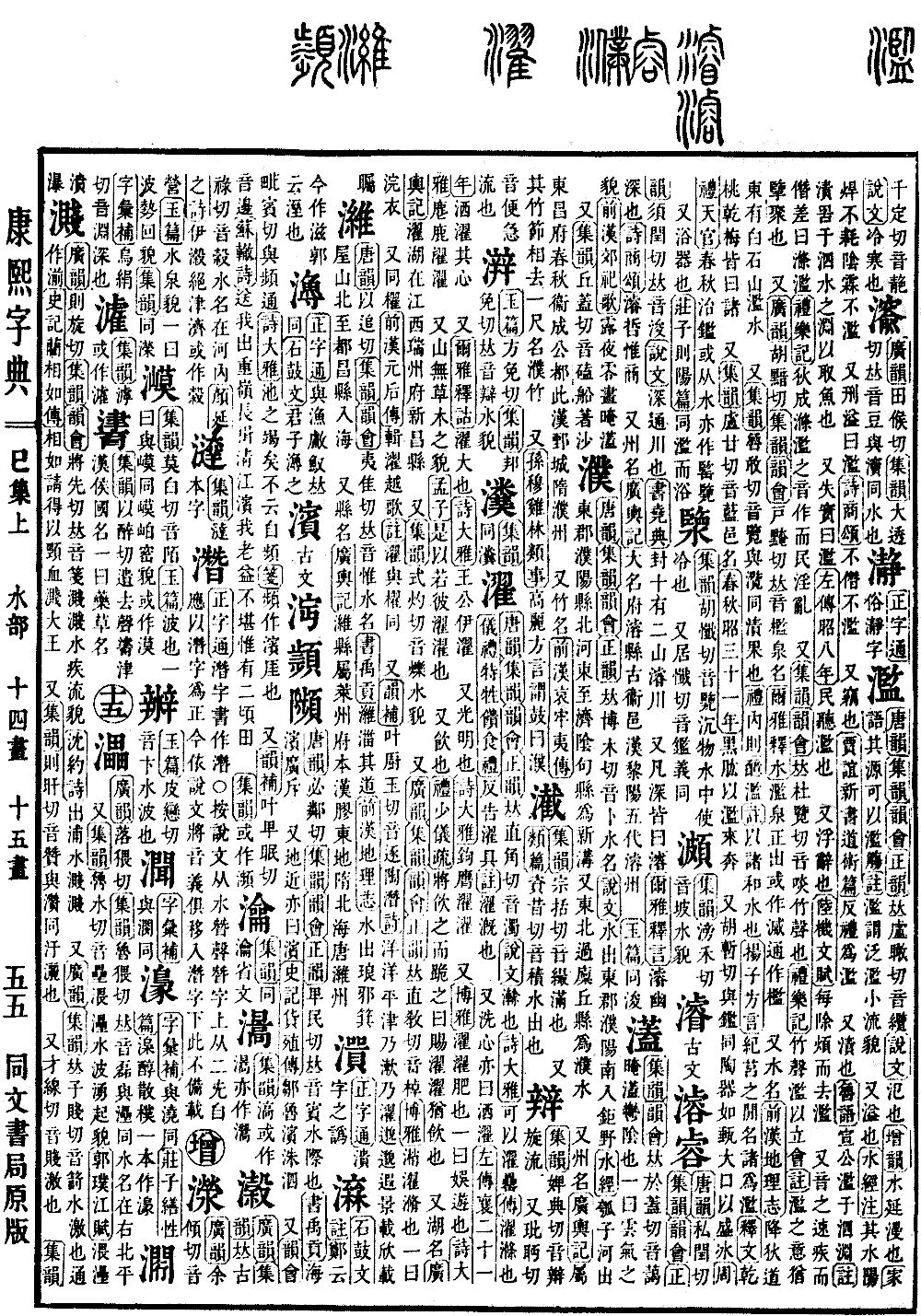
Si Collection, Upper Volume
Radical: Water (shuǐ)
Kangxi Strokes: 18
Page 657, Entry 03
Pronounced lan (falling tone).
Shuowen Jiezi (Explaining Single-component Characters and Analyzing Compound Characters): To overflow.
Zengyun (Additional Rhymes): Water spreading and extending.
Family Sayings of Confucius (Kongzi Jiayu): Its source can barely float a cup.
Annotation: Lan means to overflow, describing a small stream.
Also, to overflow.
Commentary on the Classic of Waterways (Shuijing Zhu): Its water does not decrease during a drought, and does not overflow during a rainstorm.
Also, to overflow is called lan.
Book of Odes (Shijing): Not excessive, not overflowing.
Also, to steal or usurp.
Jia Yi's New Book (Xinshu): Violating ritual is called lan.
Also, to soak or submerge.
Discourses of the States (Guoyu): Duke Xuan soaked his fishing nets in the pools of the Si River.
Annotation: Soaking fishing nets in the deep waters of the Si to catch fish.
Also, to be inaccurate or lacking factual basis is called lan.
Zuo Tradition (Zuo Zhuan): The people hear inaccurate reports.
Also, superficial or flowery language.
Lu Ji's Rhapsody on Literature (Wenfu): Every time one removes the trivial and discards the superficial.
Also, sounds that are rapid and irregular are called di lan.
Book of Rites (Liji): When the music of the Di people and the rapid, irregular sounds arise, the people become lewd and chaotic.
Also, pronounced dan (falling tone).
The sound of bamboo.
Book of Rites (Liji): Bamboo instruments sound with a resonance to establish the assembly.
Annotation: The meaning of lan is to gather together.
Also, pronounced kan (falling tone).
Name of a spring.
Erya (Approaching Elegance): The Lan spring flows directly out.
Sometimes written as a variant form. Frequently used interchangeably with kan.
Also, name of a river.
History of the Former Han Dynasty (Qianshan Shu): East of Di Dao, there is White Stone Mountain and the Lan River.
Also, pronounced lan (rising tone).
Identical to lan. To soak fruit.
Book of Rites (Liji): Flavored water and soaked fruit.
Zheng Xuan’s Annotation: Soaked with various mixtures of water. Between the states of Ji and Ju, these mixtures are called lan.
Explanation of Pronunciation (Shiwen): Dried peaches and dried plums are both called zhu.
Also, pronounced lan (level tone).
Name of a city.
Spring and Autumn Annals (Chunqiu): Heigong came to seek refuge with the territory of Lan.
Also, pronounced jian (falling tone).
Identical to jian. An earthenware vessel, large-mouthed like a jar, used for holding ice.
Rites of Zhou (Zhouli): In spring and autumn, manage the ice vessels.
Sometimes written with the water radical; also written as a variant form.
Also, a bathing vessel.
Zhuangzi: Bathing in the same basin.
Verification:
Book of Rites (Liji): Bamboo instruments sound with a resonance to establish the assembly. The word lan has been added in accordance with the original text.
Book of Rites (Liji): Flavored water and soaked fruit.
Annotation: Soaked with various mixtures of water. Between the states of Ji and Ju, these mixtures are called lan.
Note: The two clauses regarding the region of Ji and Ju originate from the annotations to the Rites of Zhou, not the Dialect (Fangyan). The text has been corrected to follow the original Rites of Zhou, including the annotation regarding flavored water and the region of Ji and Ju.