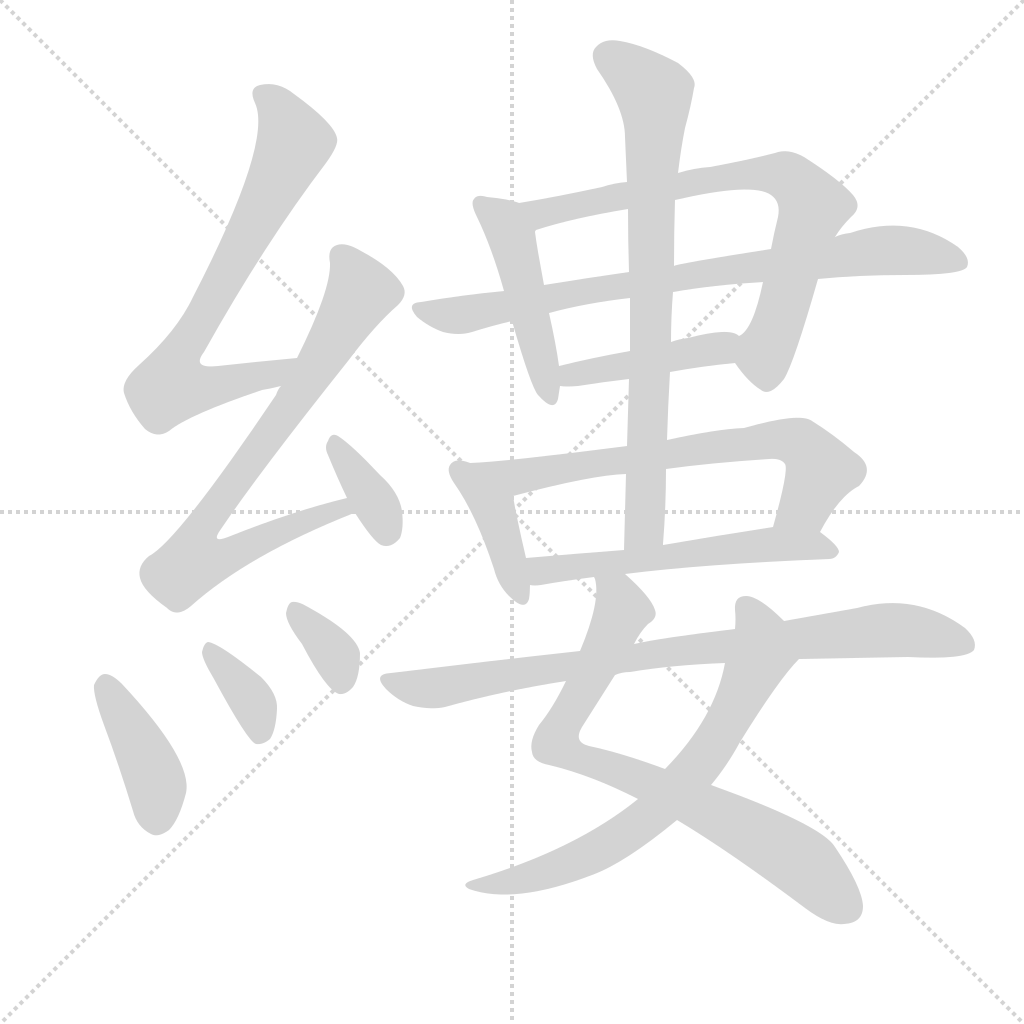
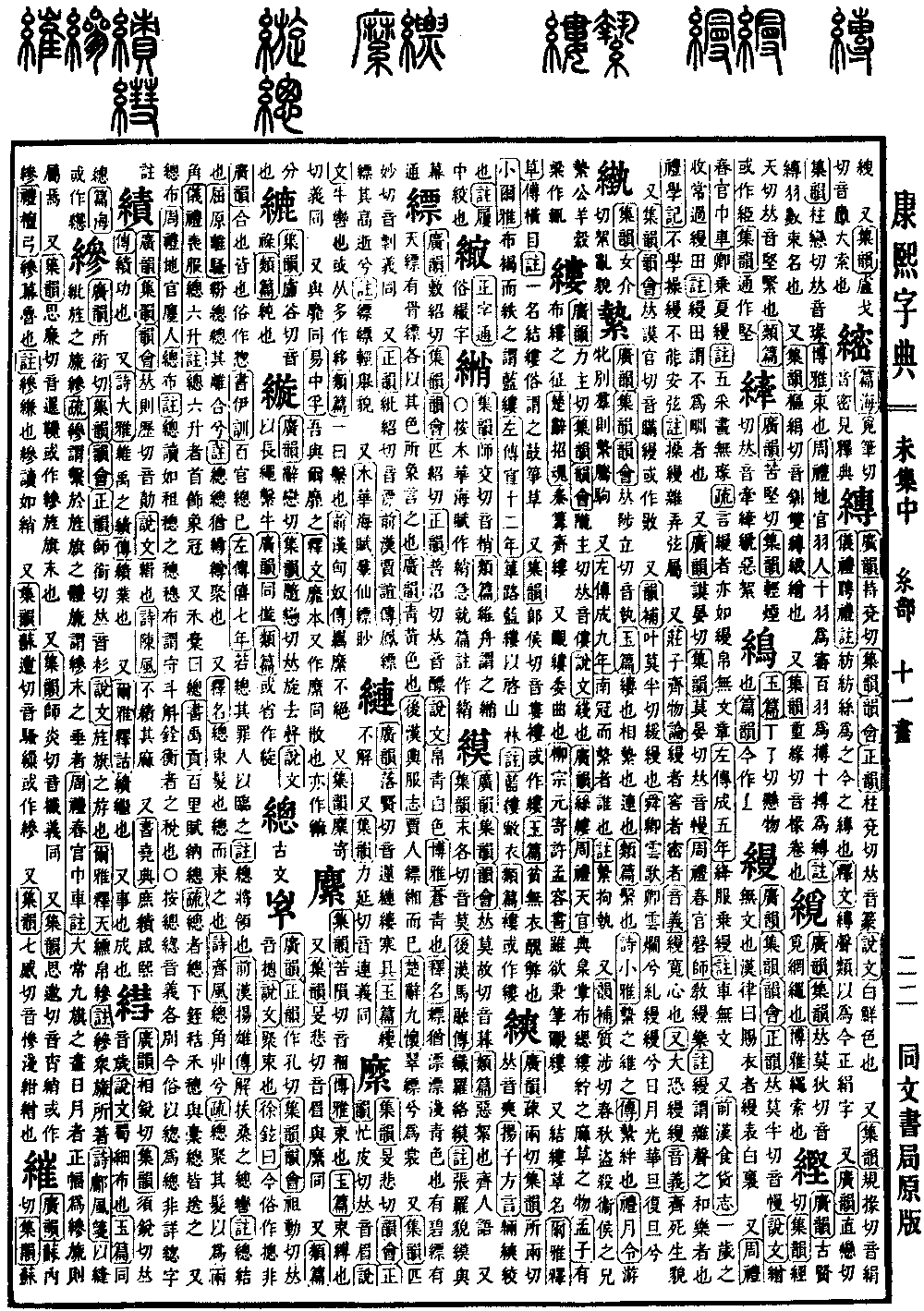
Wei Collection, Middle Volume. Radical: Silk (mì). Kangxi stroke count: 17. Page 936, Entry 10.
Pronounced lou (rising tone).
Defined in the Shuowen Jiezi (Shuowen) as threads. In the Guangyun (Guangyun), it is described as silk threads.
In the Rites of Zhou (Zhouli), under the Offices of Spring, the keeper of hemp stalks oversees the hemp, flax, and silk threads.
In the Mencius (Mengzi), there is mention of the tax on cloth and threads.
In the Songs of Chu (Chuci), specifically the Summoning of the Soul (Zhaohun), mention is made of Qin bamboo lamps and Qi threads.
Also, the term luolu refers to detailed or winding narration. In a letter by Liu Zongyuan to Xu Mengrong, he writes that he wishes to take up his brush and narrate the details.
Also, jielu is the name of a plant. In the Erya (Erya), it is noted that the plant is also called jielu, commonly referred to as drum-zither grass.
Also, pronounced lou. The character lou is sometimes written as this character. In the Yupian (Yupian), it describes the condition of being poor and without clothes, or shabby and tattered. In the Xiao Erya (Xiao Erya), coarse cloth garments that have been stitched are called lanlü. In the Zuo Tradition (Zuozhuan), under the twelfth year of Duke Xuan, it states that in primitive carts and tattered clothes, they cleared the mountains and forests. The commentary explains that lanlü refers to tattered clothing. In the Leipian (Leipian), the character lou is sometimes written as this character.