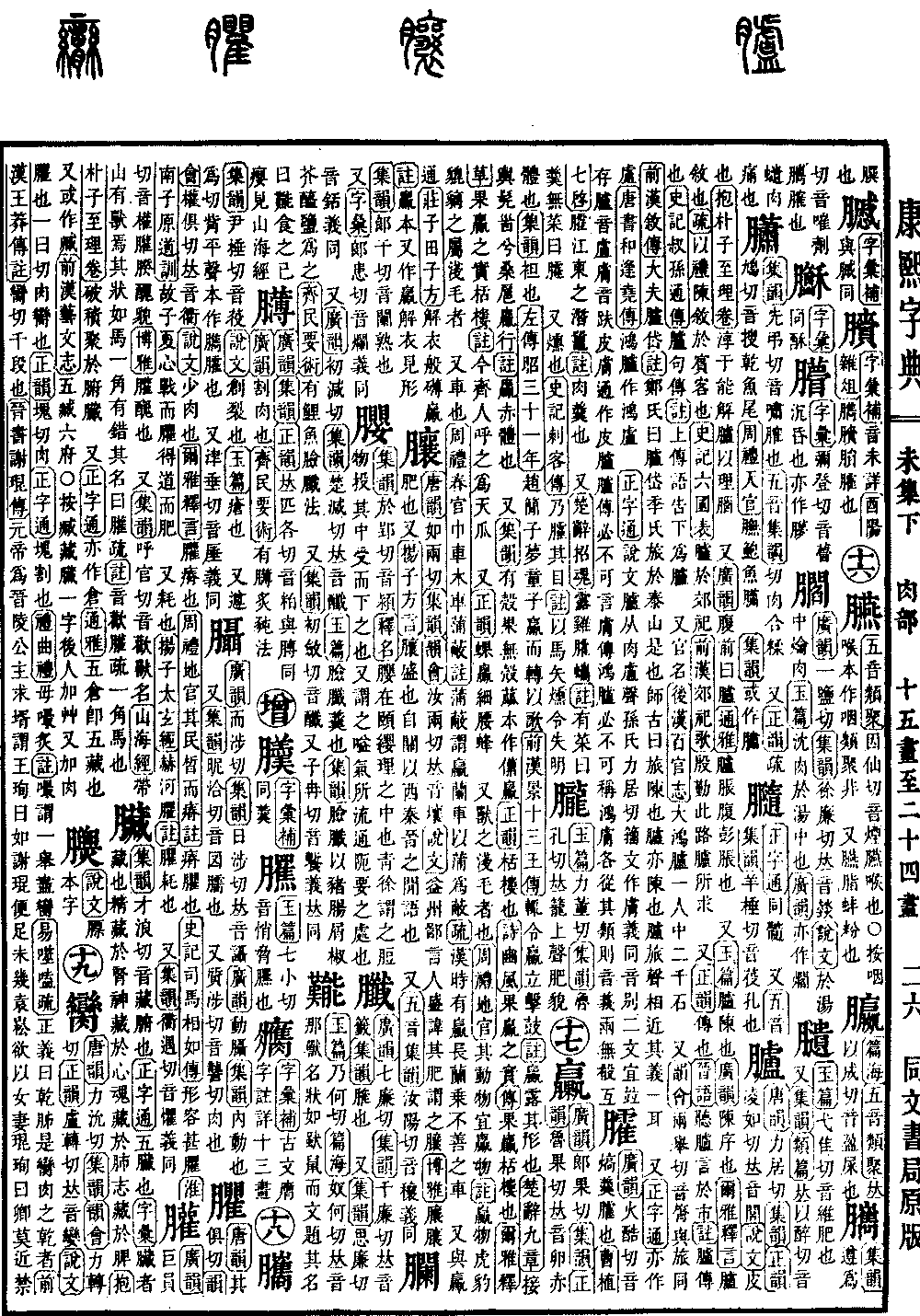
Wei Collection, Lower Volume
Radical: Meat (ròu)
Kangxi Strokes: 23
Page 998, Entry 15
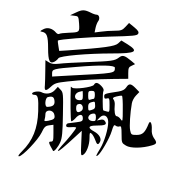
Pronounced luan (third tone). Naked or unclothed. In the Collected Rhymes (Guangyun), it means to bare the body. In the Zuo Tradition (Zuozhuan), it is recorded that Zhao Zi dreamed of a young boy spinning and singing while naked. In the History of the Former Han (Qianhan shu), the biography of the thirteen sons of Emperor Jing, it is recorded that he was ordered to stand naked and beat a drum. The commentary notes that this term refers to exposing the body. In the Songs of Chu (Chuci), it states that Jieyu shaved his head and Sanghu walked about naked. The commentary notes that this refers to being unclothed. Also, in the Collected Rhymes (Jiyun), it is noted that fruit with shells are called guo, while those without shells are called luo; it was originally written with this character. In the Rectified Rhymes (Zhengyun), it refers to the snake gourd. In the Book of Odes (Shijing), it mentions the fruit of the snake gourd. The commentary states that the snake gourd is the snake gourd plant. In the Erya (Er ya), it states that the fruit of the snake gourd is the snake gourd. The commentary notes that in the Qi region, it is currently called heaven melon. Also, in the Rectified Rhymes (Zhengyun), it refers to the potter wasp. It also refers to animals with short fur. In the Rites of Zhou (Zhouli), it mentions that the region is suitable for animals with short fur. The commentary notes that short-furred animals refer to creatures such as tigers, leopards, and brave beasts. It also refers to a type of carriage. In the Rites of Zhou (Zhouli), the commentary on the wooden carriage with rush screens mentions the luolan carriage, which uses rush grass as a screen. The sub-commentary notes that during the Han dynasty, there was a luochanglan carriage, which was considered an inferior vehicle. It is also interchangeable with the character meaning to win (ying). In the Zhuangzi (Zhuangzi), it describes someone loosening their clothes and sitting cross-legged in the nude. The commentary notes that some editions write this as the character meaning to win (ying), meaning to loosen one's clothes and expose the body.