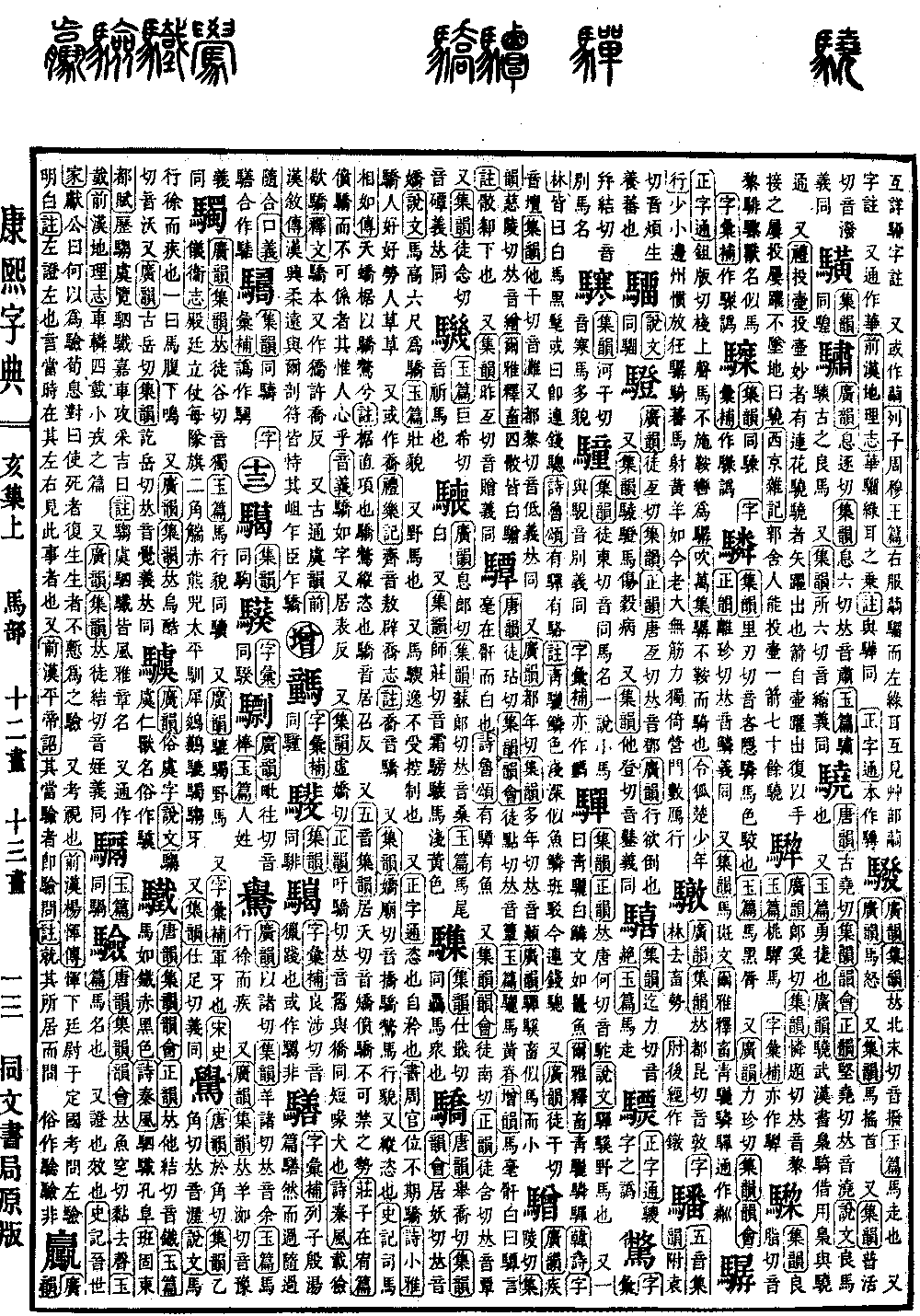
Hai Collection, Upper Volume
Radical: Horse (mǎ)
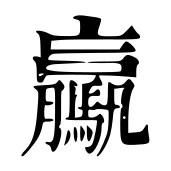
Entry: luó
Kangxi stroke count: 23
Page 1445, Entry 41
Pronounced luo (level tone). According to the Shuowen Jiezi (Explaining Graphs and Analyzing Characters), it is an animal born from the mating of a male donkey and a female horse. According to the Zhengzitong (Correct Meaning Thoroughfare), the luó resembles a donkey but is more robust; a donkey's strength is in its hindquarters, while a luó's strength is in its waist, and riders must follow the rhythm of its lumbar strength when moving forward or retreating.
In the Nine Laments (Jiutan) section of the Songs of Chu (Chuci): They rode together on inferior horses and luó.
In the Biography of Huo Qubing from the History of the Former Han (Qianhan Shu): The Shanyu then rode six luó, leading several hundred elite cavalry, and directly charged through the Han army ranks.
According to the Yupian (Jade Compendium), it is also written in a variant form. According to the Liushu Zheng'e (Rectification of the Six Writings), it is commonly written as luó. The Zhengzitong states that it originally included the component, but the Dictionary (Zihui) simplified it by using the component, which is incorrect.
Correction: In the Biography of Huo Qubing from the History of the Former Han, the text states the Shanyu rode six luó, leading several hundred mounted soldiers, directly crushing the Han state forces. Based on the original text, the term mounted soldiers has been corrected to elite cavalry.