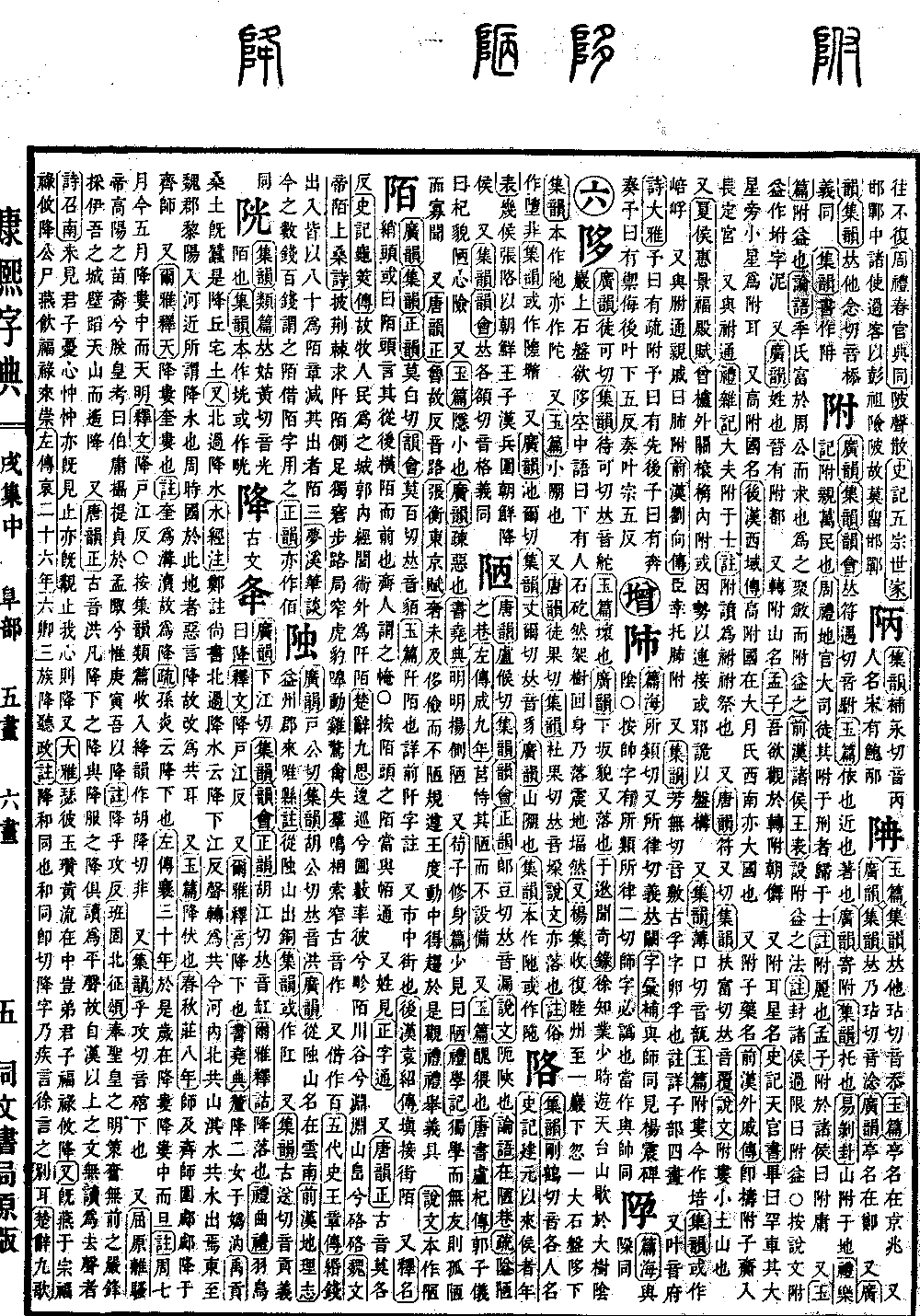
Xu Collection, Middle Volume. Radical: Mound (fù). Character: lòu. Kangxi stroke count: 14. Page 1349, number 08.
According to the Tang Rhymes (Tangyun), the pronunciation is derived from lú and hòu. According to the Collected Rhymes (Jiyun), Rhyme Summary (Yunhui), and Correct Rhymes (Zhengyun), the pronunciation is derived from láng and dòu. The pronunciation is the same as the character for leak (lòu).
Explaining the Writing of Characters (Shuowen Jiezi) defines the character as narrow or confined. In the Analects (Lunyu), the phrase "living in a narrow alley" is explained in the Commentary (Shu) as referring to a narrow and simple alleyway. The Zuo Commentary (Zuozhuan), ninth year of Duke Cheng, records that the State of Ju relied on its remote and secluded location and thus did not prepare its defenses.
The Jade Chapters (Yupian) defines it as ugly or vulgar. The Book of Tang (Tangshu), Biography of Lu Qi, records that Guo Ziyi evaluated Lu Qi as having an ugly appearance and a wicked heart.
The Jade Chapters also defines it as obscure or minute.
The Broad Rhymes (Guangyun) defines it as coarse or of poor quality.
In the Book of Documents (Shangshu), Canon of Yao (Yaodian), the phrase "clearly promote those from humble backgrounds" refers to recommending those of low social status who possess talent and virtue.
The Xunzi, Chapter on Cultivating Oneself (Xunzi Xiushen), states that having limited knowledge is called being lòu. The Record of Ritual (Liji), Record on Education (Xueji), states that studying alone without friends for exchange results in shallow knowledge and narrow experiences.
The Corrected Tang Rhymes (Tangyun Zheng) gives the pronunciation as lǔ and gù, sounding the same as the character for road (lù). In the Rhapsody on the Eastern Capital (Dongjing Fu) by Zhang Heng: Lavish without reaching extravagance, frugal without appearing crude. Following the regulations of the former kings, movements align with the proper pace. Thus when observing the ceremony, the rites are fully prepared.
Explaining the Writing of Characters originally wrote the character in a variant form pronounced lòu.
Textual research: In the Rhapsody on the Eastern Capital by Zhang Heng, for the passage "following the royal measures, movements hitting the mark; thus observing the ceremony, the rites are justly prepared," the original text suggests that the term for justly (yìjù) should be corrected to ceremoniously (yíjù) to mean the rites are fully prepared.