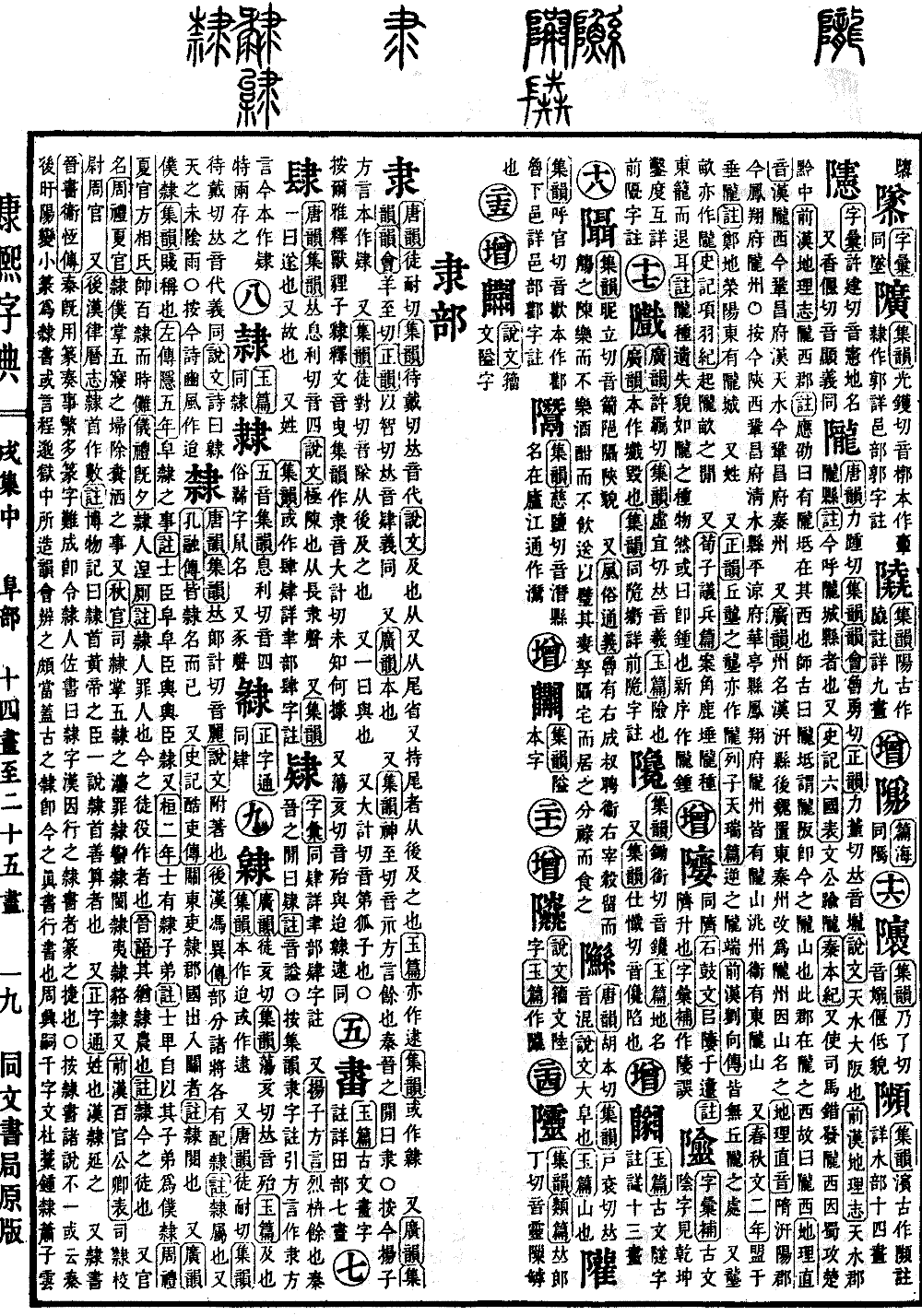
Xu Collection, Middle Volume
Radical: Mound (fù)
Long
Kangxi strokes: 24
Page 1363, entry 08
Tang Rhyme: li zhong qie
Jiyun, Yunhui: lu yong qie
Zhengyun: li dong qie
Pronunciation: long
Shuowen (Shuowen Jiezi): A large mountain in Tianshui.
Geography Monograph of the Former Han (Qian Han Dizhi): Tianshui Commandery, Long County. Commentary: This is what is now called Longcheng County.
Also, Records of the Grand Historian (Shiji), Table of the Six States: "Duke Wen crossed Long."
Annals of Qin: "Also sent Sima Cuo to mobilize Longxi, and by way of Shu attacked Chu's Qianzhong."
Geography Monograph of the Former Han: Longxi Commandery. Commentary: Ying Shao said: "There is Longdi, which is to its west." Shi Gu said: "Longdi refers to Longban, which is the present-day Long Mountain. This commandery is to the west of Long, hence it is called Longxi."
Dili Zhiyīn (Dili Zhiyīn): Han's Longxi is now Gongchang Prefecture. Han's Tianshui is now Gongchang Prefecture's Qin Prefecture.
Also, Guangyun (Guangyun): A prefecture name. Han's Qian County. Later Wei established Dongqin Prefecture, which was renamed Long Prefecture, named after the mountain.
Dili Zhiyīn: Sui's Qinyang Commandery is now Fengxiang Prefecture's Long Prefecture. According to observations, present-day Qingshui County in Shaanxi's Gongchang Prefecture, Huating County in Pingliang Prefecture, and Long Prefecture in Fengxiang Prefecture all have Long Mountain. Taozhou Guard has East Long Mountain.
Also, Spring and Autumn Annals (Chunqiu), Duke Wen, Year 2: "Formed an alliance at Chuilong." Commentary: A place in Zheng, Longcheng is to the east of Xingyang.
Also a surname.
Also, Zhengyun (Zhengyun): The character long for "mound" or "tumulus" is also written as 隴.
Liezi (Liezi), Chapter Tianrui: "Reversed at the edge of the mound."
Biography of Liu Xiang in the Former Han (Qian Han Liu Xiang Zhuan): "All without a place for mounds."
Also, longmu (furrowed field) is also written as 隴.
Annals of Xiang Yu in the Records of the Grand Historian: "Rose from among the furrows."
Also, Xunzi (Xunzi), Discourse on Military Affairs: "They press their horns against the deer-like clods, and longzhong scatter and retreat." Commentary: Longzhong describes a lost or abandoned appearance, like objects planted in a furrow. Some say it is equivalent to longzhong (stumbling, tottering). Xinxu (Xinxu) writes it as longzhong.
Correction: In Xunzi, Discourse on Military Affairs, commentary: Longzhong describes a lost or abandoned appearance, like objects planted in a furrow. Some say it is equivalent to zhong (bell). The original text "即钟也" has been carefully corrected to longzhong.