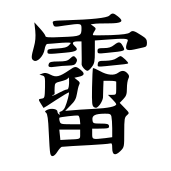
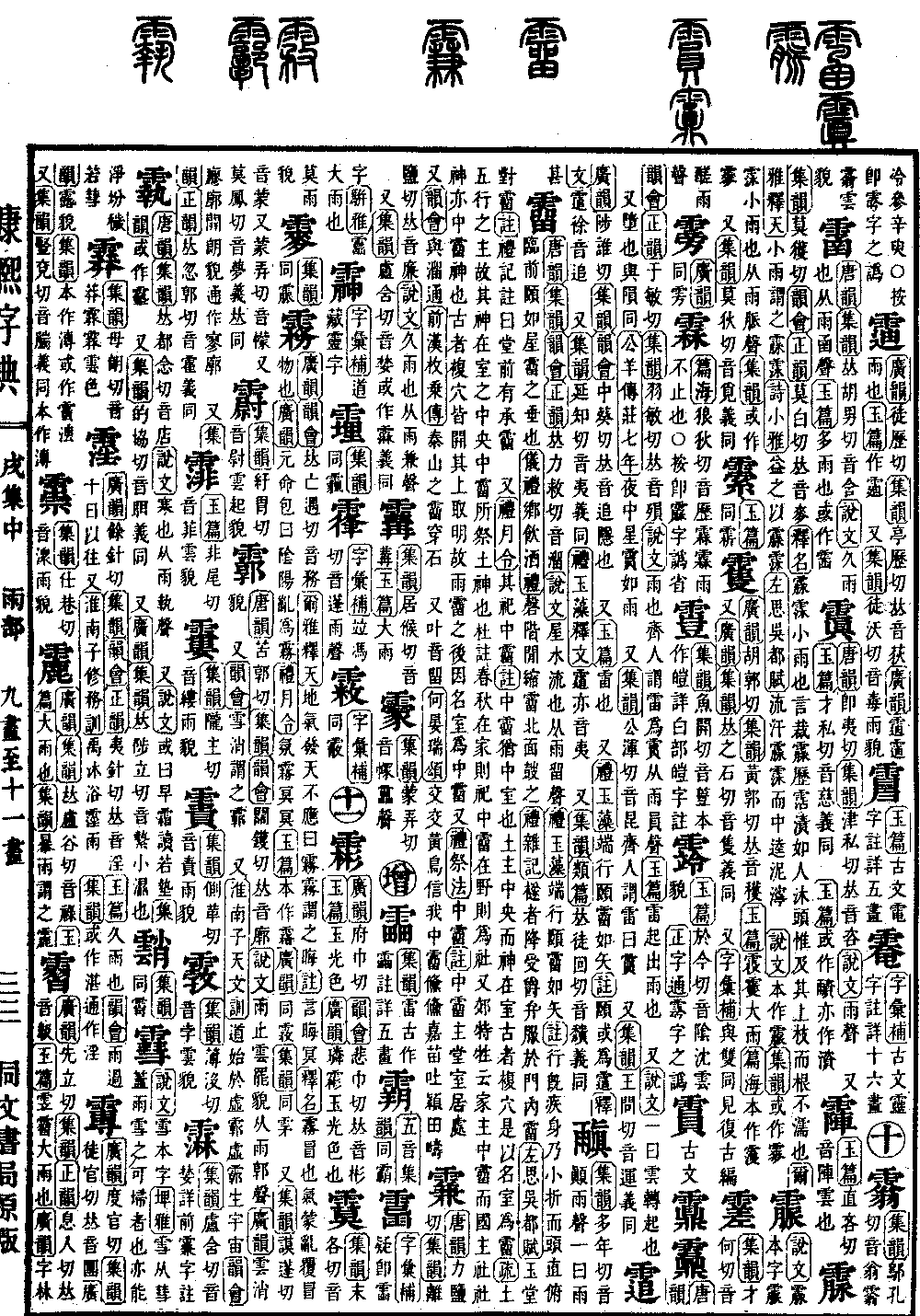
Xu Collection, Middle Volume. Radical: Rain (yǔ). Kangxi strokes: 18. Page 1377, Entry 22.
Tang Rhyme (Tangyun), Collection Rhyme (Jiyun), Rhyme Compilation (Yunhui), Correct Rhymes (Zhengyun): Pronounced liu (falling tone), same pronunciation as the character for dripping water.
Shuowen Jiezi explains this as water dripping from the eaves of a house. The character is formed by the Rain radical and the character for remain (liu), which indicates the sound.
Book of Rites (Liji), Jade Pattern (Yuzao): When walking with correct posture, the chin should hang straight down like water dripping from the eaves. The commentary explains: When walking quickly, the body should tilt slightly forward, the head should be held straight and low, and the chin should hang as if it were water dripping from the eaves.
Book of Etiquette and Ceremonial (Yili), Village Drinking Ritual (Xiangyinjiuli): The musical instrument known as the qing should be placed between the steps in the direction of the water dripping from the eaves, facing north.
Book of Rites (Liji), Miscellaneous Records (Zaji): A person in mourning descends the hall to receive a cup of wine and puts on ceremonial robes under the eaves inside the gate.
Zuo Si, Rhapsody on the Capital of Wu (Wudufu): The jade hall faces the eaves. The commentary cites the Book of Rites commentary, stating there is a device in front of the hall to catch water dripping from the eaves.
Also, Book of Rites (Liji), Monthly Ordinances (Yueling): Sacrifice to the deity of the central dwelling (zhongliu). The commentary explains: The central dwelling is like the center of the house. The earth deity governs the center, and the shrine is located in the center of the house. Ancient dwellings had double-layered caves for light, hence the term for the center of the house. The sub-commentary explains: Earth is the master of the five elements, so its shrine is in the center of the house. The central dwelling is the earth deity that is sacrificed to. Du Yu, in his commentary on the Spring and Autumn Annals (Chunqiu), states: One sacrifices to the central dwelling deity at home, and to the earth deity (she) in the wild.
Also, Book of Rites (Liji), Suburban Rituals (Jiaotesheng): The head of a household sacrifices to the central dwelling deity, and the ruler of a state sacrifices to the earth deity. The earth deity is the same as the central dwelling deity. Ancient times featured double-layered caves with holes at the top for light, so rain would flow down, leading to the term central dwelling for the center of the house.
Also, Book of Rites (Liji), Rules of Sacrifice (Jifa): Sacrifice to the central dwelling deity. The commentary explains: The central dwelling deity governs the hall and the residence.
Also, Rhyme Compilation (Yunhui): Interchangeable with the character for drip. History of the Former Han (Qian Hanshu), Biography of Mei Cheng: Water dripping from the eaves of Mount Tai can pierce stone.
Also, rhymed as liu. He Yan, Eulogy on Auspicious Omens (Ruisong): Singing yellow birds trust in the central dwelling deity of my house. Lush sprouts grow ears of grain in the fields.