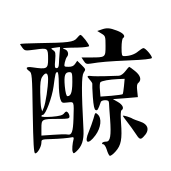
Pronounced li (falling tone) and niang (falling tone) in the "Tang Yun" and li (falling tone) and rang (rising tone) in the "Jiyun," with the same pronunciation as "liang" (rising tone). "Shuowen Jiezi" explains it as a mixed flavor. "Jiyun" also states that clear liquid is called yuan. "Boyao" records that yuan is liquid. The "Rites of Zhou - Official of the Heavens - Chef - Drinking Six Clear Liquids Note" mentions that the six clear liquids include: water, liquid, sweet wine, yuan, and sweetened wine.
Additionally, in "Jiyun" and "Yunhui," the pronunciation is lu (rising tone) and zhang (rising tone), with the same pronunciation as "liang" (rising tone). The meaning is the same.
Furthermore, "Jiyun" states it can be used interchangeably with "liang." The "Rites of Zhou - Official of the Heavens - Liquid Maker Note" says liang is wine mixed with water. Zheng Kangcheng explains it as equivalent to current cold porridge, or a mixture of toasted rice flour and toasted flour with water. "Book of Rites - Inner Regulations" mentions liquid water, jiu, and lan. The note says lan is liang. Water is taken temporarily, while liang is mixed when needed. Examination: "Book of Rites - Inner Regulations" has lan but not liang. It is corrected to liquid water, jiu, lan according to the original text.