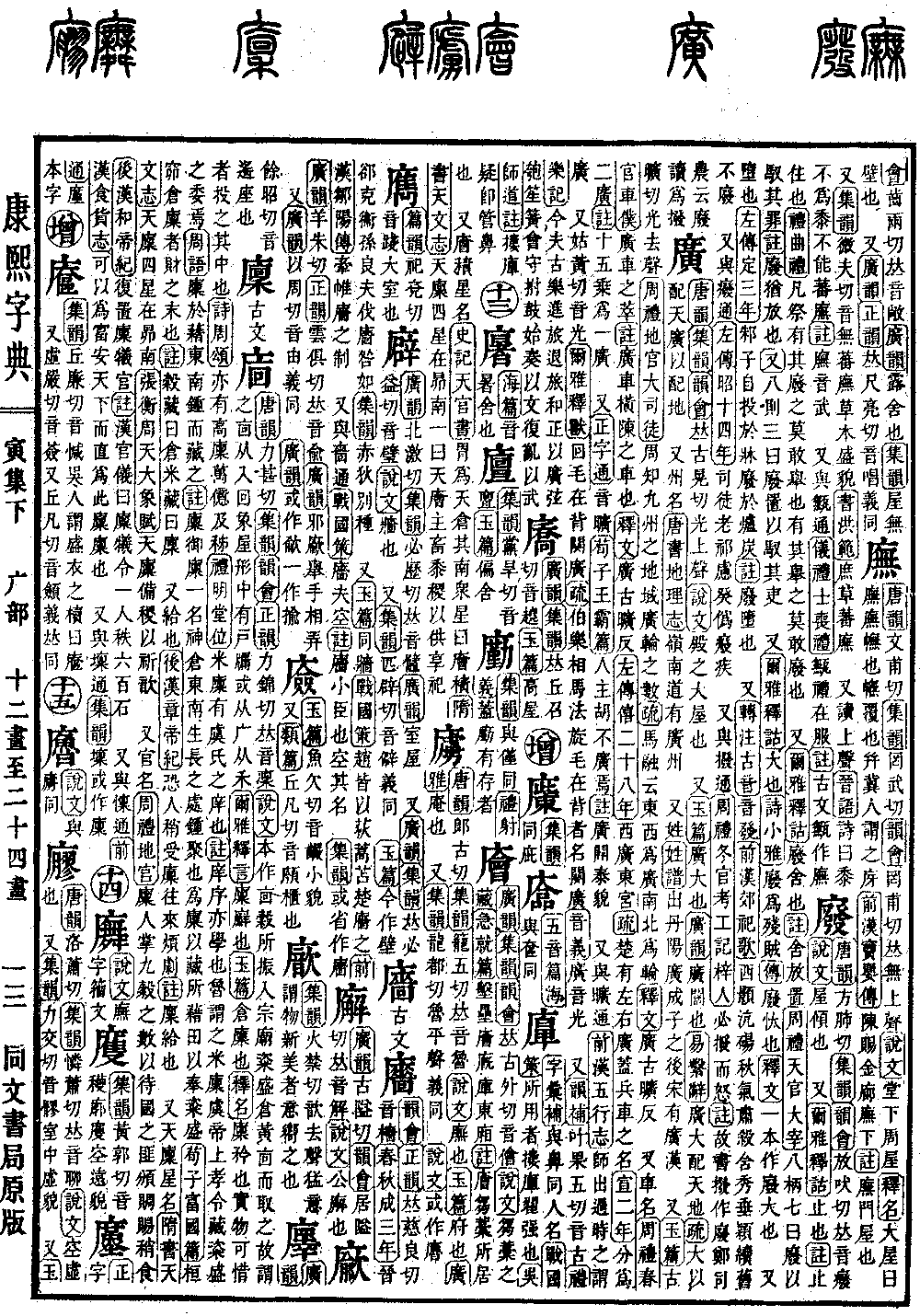
Yin Collection, Lower Volume
Radical: Broad (guǎng)
Kangxi Strokes: 16
Page 351, Entry 22
Ancient form. Tang Rhymes (Tangyun): Pronounced lin (falling tone). Collected Rhymes (Jiyun), Rhymes Compilation (Yunhui), and Orthodox Rhymes (Zhengyun): Pronounced lin (rising tone).
Explaining Graphs and Analyzing Characters (Shuowen Jiezi): Originally written as a different form. It refers to grain being brought in, grain used for ancestral temple sacrifices, or grain collected in a rush, hence the name. Composed of the radicals for enter and return, shaped like a building with doors and windows. Some variants are written with the components for measure and grain.
Approaching Elegance (Erya): A granary is a storehouse.
Comprehensive Dictionary (Yupian): A place for storing grain.
Explanation of Names (Shiming): A granary implies careful preservation. Objects of value are kept within.
Book of Odes (Shijing): There are tall granaries, storing ten thousand billion and zǐ units of grain.
Book of Rites (Liji): A rice granary was a school during the time of the Yu dynasty. Commentary: Schools were also known as xiang and xu. The State of Lu called them rice granaries; Emperor Yu prioritized filial piety and ordered that grain for sacrifices be stored there.
Discourses of the States (Guoyu): Build a granary to the southeast of the ceremonial fields to gather and store grain. Commentary: A granary refers to the imperial storehouse. It is also called the divine granary, representing the southeast, the direction of the growth of all things. Zhong means to gather. Granaries are built to store grain from the ceremonial fields for sacrificial use.
Xunzi: Enclosures, pits, storehouses, and granaries are the secondary aspects of wealth. Commentary: A place for storing grain is called a storehouse, and a place for storing rice is called a granary.
It also refers to provision. Book of the Later Han (Hou Hanshu): Fearing that the people might receive provision too easily, causing excessive coming and going. Commentary: Granary means provision.
It also refers to the Heavenly Granary, a constellation. Book of Sui (Suishu): The Heavenly Granary consists of four stars located south of the Mao constellation. Zhang Heng: Heavenly Granary stars prepare for the grain deity to enjoy the offerings.
It also refers to an official title. Rites of Zhou (Zhouli): The Granary Official manages the quantity of the nine grains to provide for national distribution, rewards, and salaries. Book of the Later Han (Hou Hanshu): Re-established the Granary and Sacrificial Animal officials. Commentary: Han Official Rituals states: One Granary and Sacrificial Animal Prefect, with a salary of six hundred shi.
Also interchangeable with lin (fear). Book of the Former Han (Hanshu): It could have made the world wealthy and stable, yet it ended up in this fearful situation.
Also interchangeable with another variant. Collected Rhymes (Jiyun): Sometimes written as a variant form.
Correction: In Xunzi, the original text for the wall and pit reference has been corrected.