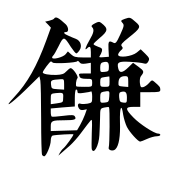
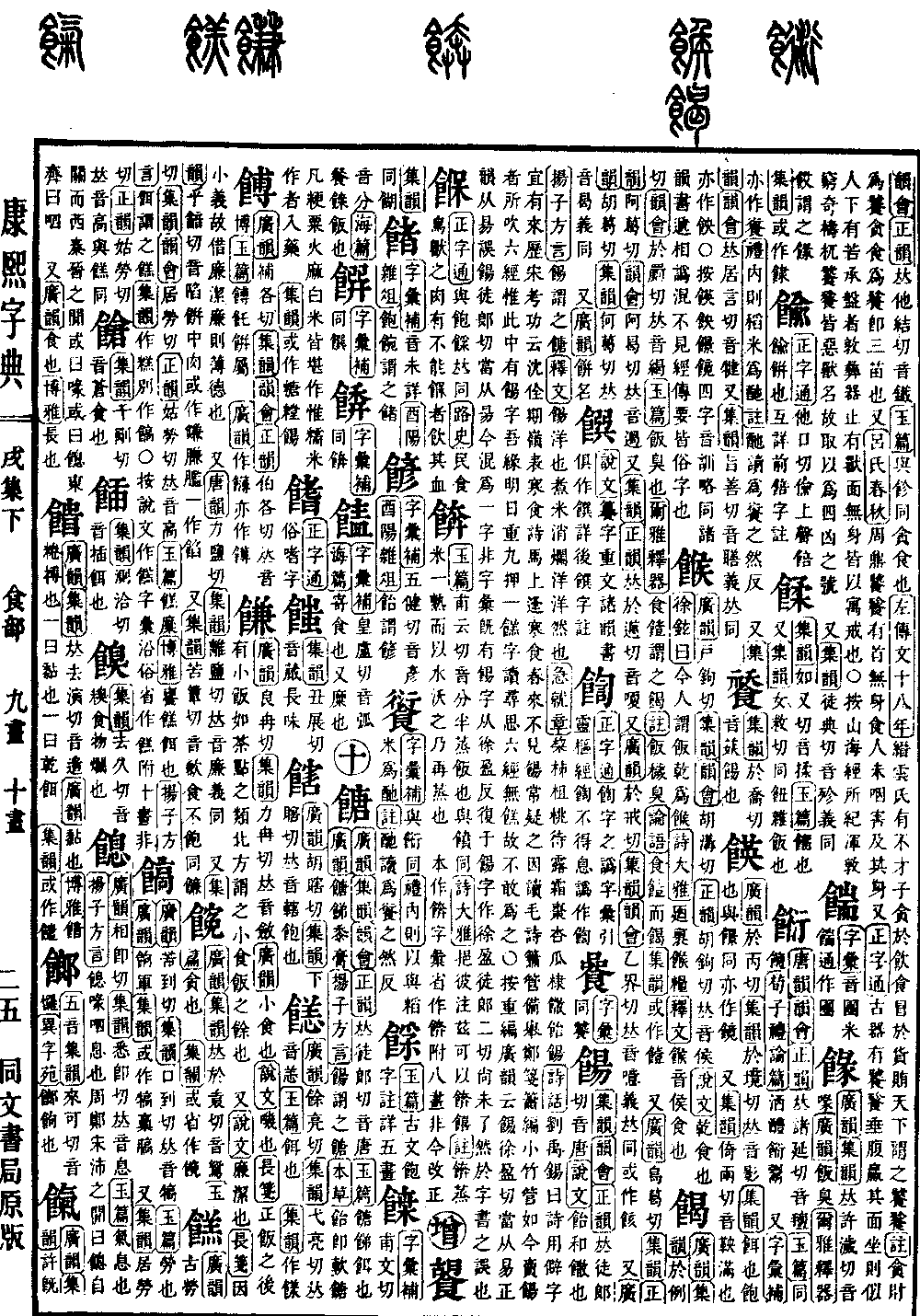
Pronounced liáng rǎn qiè in "Guangyun" and lì rǎn qiè in "Jiyun," with the same pronunciation as "liǎn." In "Guangyun," it is explained as a small meal. "Shuowen Jiezi" explains it as "jī" (referring to a small meal). "Changjian" states: A small meal taken after the main meal, similar to tea snacks. In the north, it is called a "xiaoshi" and serves as a supplement to the main meal.
Furthermore, "Shuowen Jiezi" explains it as incorruptible. "Changjian" states: Because it carries the meaning of being small (few), it is borrowed to refer to incorruptibility, which is characterized by frugality in virtue.
Also, pronounced lì yán qiè in "Tangyun" and lí yán qiè in "Jiyun," with the same pronunciation as "lián." The meaning is the same.
Furthermore, pronounced hū àn qiè in "Jiyun," with the same pronunciation as "xiàn." It refers to the meat filling inside a cake. It may also be written as "liǎn" or "xiàn."
Furthermore, pronounced kǔ diàn qiè in "Jiyun," with the same pronunciation as "qiàn." It refers to not having eaten enough. It is the same as the character "tūn."