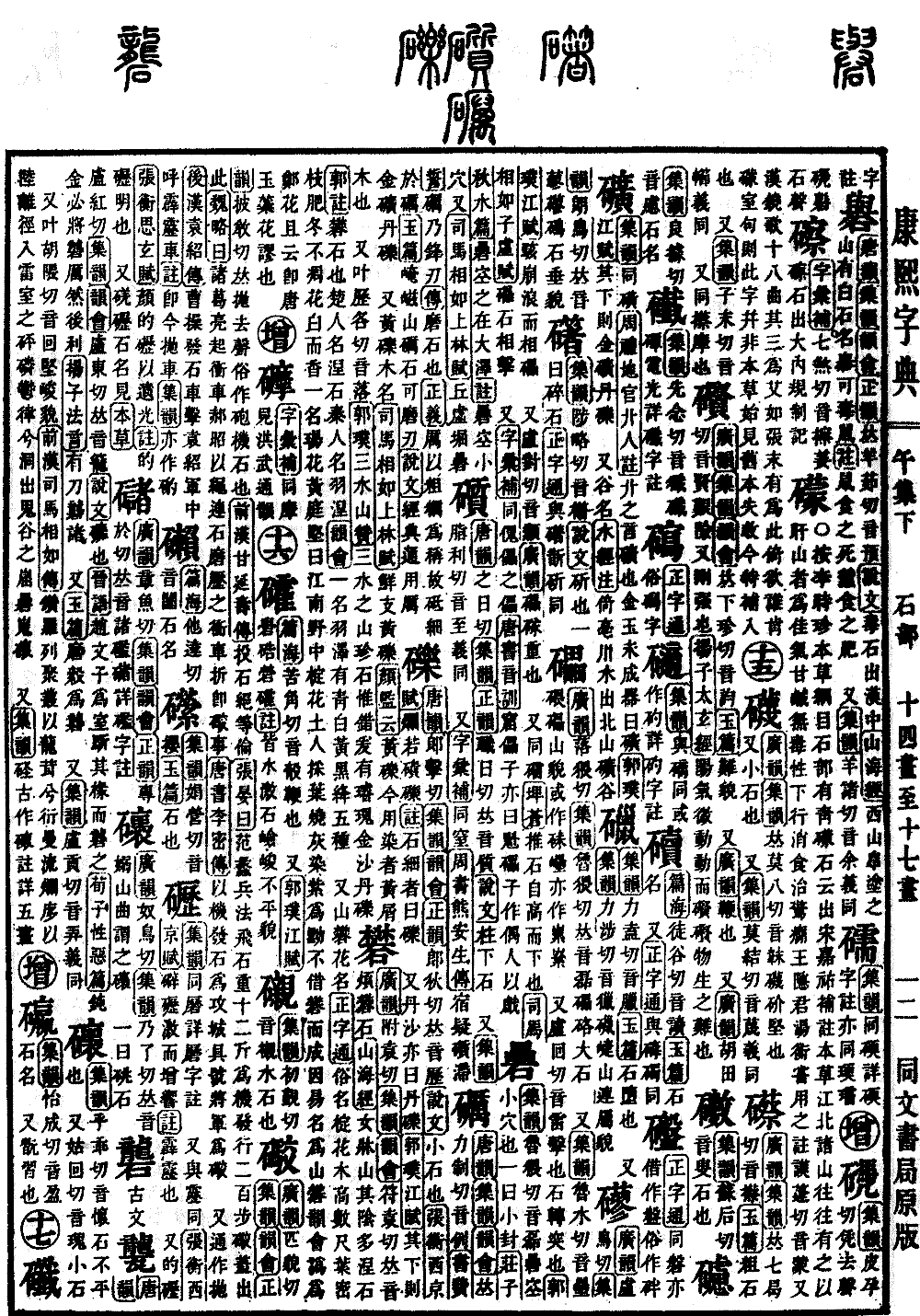
Wu Collection, Lower Volume
Radical: Stone (shí)
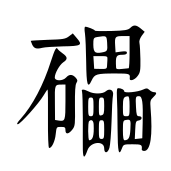
Lei
Kangxi stroke count: 20
Page 838, Entry 20
According to the Broad Rhymes (Guangyun), pronounced lei (third tone). According to the Collection of Rhymes (Jiyun), pronounced lei (third tone). Lei-ge refers to large stones.
Also, according to the Collection of Rhymes (Jiyun), pronounced lei (third tone). Wei-lei describes the appearance of a mountain. Sometimes written in a variant form. Also written in a variant form.
Also, pronounced lei (second tone). To strike. To roll stones until they protrude. In the River Rhapsody (Jiangfu) by Guo Pu, it is written: The crashing waves strike against one another.
Also, pronounced lei (fourth tone). According to the Broad Rhymes (Guangyun), lei means heavy. Also the same as lei (third tone).
According to the Dictionary of Symbols (Picang), it means pushing stones from a high place to a low place. In the Rhapsody of Sir Fantasy (Zixufu) by Sima Xiangru, it is written: Stones were pushed and struck one another.
Also, according to the Supplement to the Dictionary of Characters (Zihuibu), the same as lei (third tone) in the term for puppets. In the Sound and Meaning of the History of Tang (Tangshu Yinxun), it is noted that the term ku-lei-zi, also called kui-lei-zi, refers to wooden figures used for entertainment.