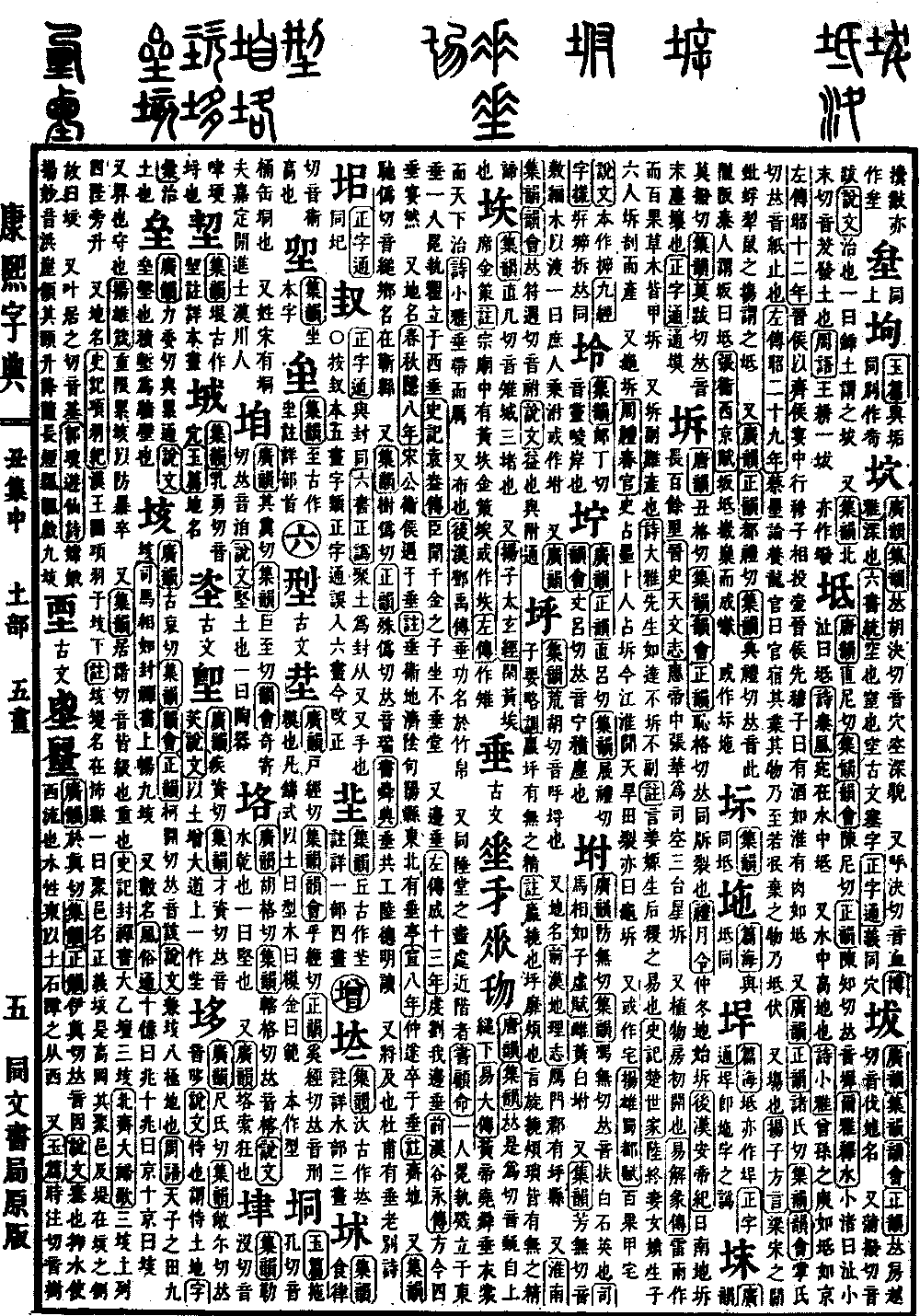
Chou Collection, Middle Volume. Radical: Earth (tǔ). Kangxi brush strokes: 18. Page 227, Entry 02.
Pronounced lei (falling tone). From the Shuo Wen Jie Zi: A military fortification. From the Book of Rites (Liji): If the four suburbs have many fortifications, it is a disgrace to the ministers and high officials. From the Rites of Zhou (Zhouli): The measuring official is in charge of planning the fortifications and quarters for the army, measuring the locations for markets, courts, residential districts, and altars.
Also a star name. From the Records of the Grand Historian (Shiji): The many stars south of the Emptiness star are called the Heavenly Army; to the west of the army is the Fortification.
Also an official title. From the Book of Han (Hanshu): Emperor Wu pacified Nanyue and added seven schools, one of which was the Central Fortification.
Also a surname. Examples include Lei Cheng of the Later Zhao, and Lei Xi, Prefect of Zitong during the Jin dynasty.
Pronounced fei (falling tone). The appearance of a mountain.
Pronounced lei (rising tone). Weilei, a mountain name. From the Zhuangzi: Living in the north at Mount Weilei. Also, Mount Yulei, located west of Guan County; during the Zhenguan era of the Tang dynasty, a pass was established at its foot. From a poem by Cen Shen: Looking from Mount Yulei when the sky is clear, all other peaks appear low.
Also, heavy or piled up. Another definition is a robust appearance. From the Book of Han (Hanshu): A man of heroic and robust character.
Also, mounds in succession. From Zhang Zai: How piled up are the graves at Beimang.
Also, synonymous with lei (to bind). From the Xunzi: Do not worry about being bound or tied.
Also, synonymous with lei (rocky). From the Book of Han (Hanshu): Rolling down rocks.
Pronounced lü (falling tone). Yulei, a name of a deity. From the Fengsu Tongyi: In ancient times, there were two brothers named Shentu and Yulei who lived under a peach tree on Dushuo Mountain in the Eastern Sea. They inspected the hundred ghosts, and those who did not follow the laws were bound with reed ropes and fed to tigers. From the Eastern Capital Rhapsody (Dongjing Fu) by Zhang Heng: At Dushuo they made preparations, guarded by Yulei; Shentu assisted him, both holding reed ropes. The practice of hanging peach-wood charms on the eve of the winter sacrifice originated from this. Shentu is pronounced shen shu (level tone).