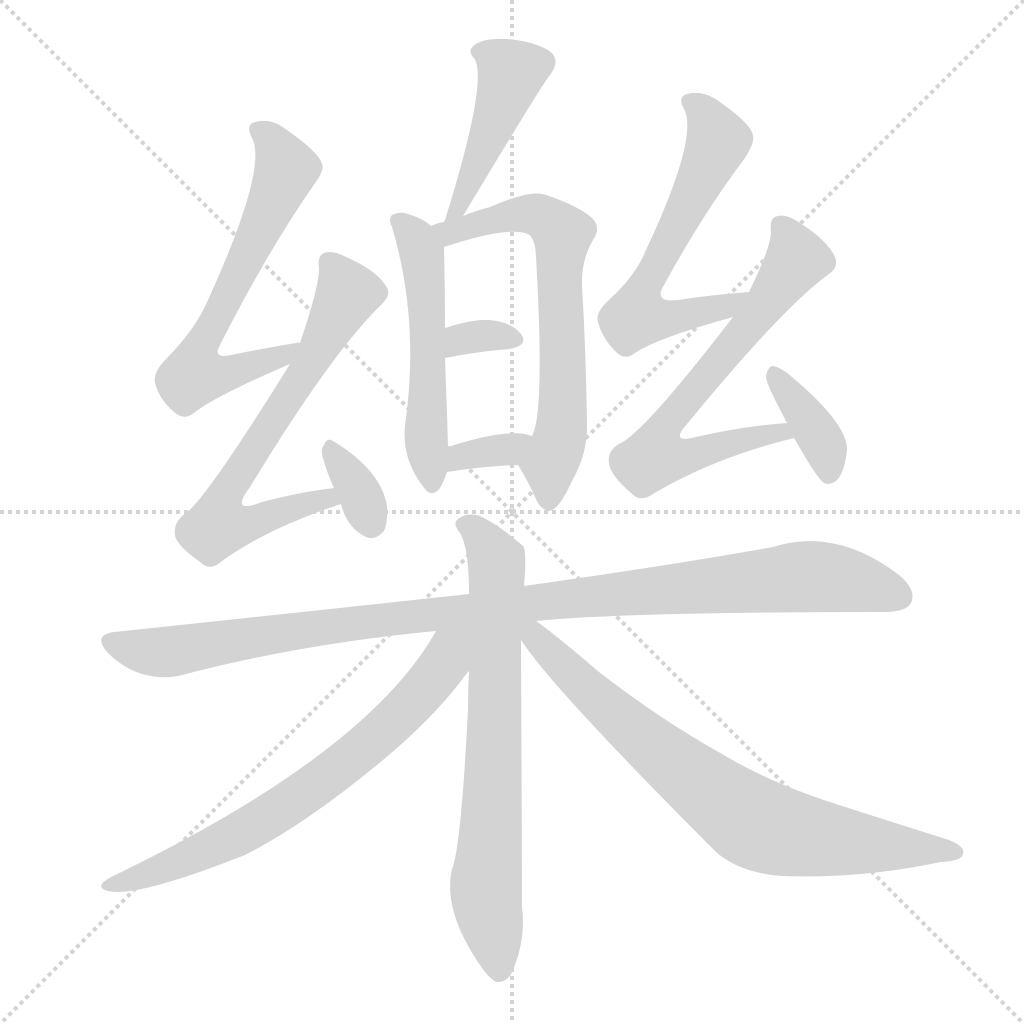
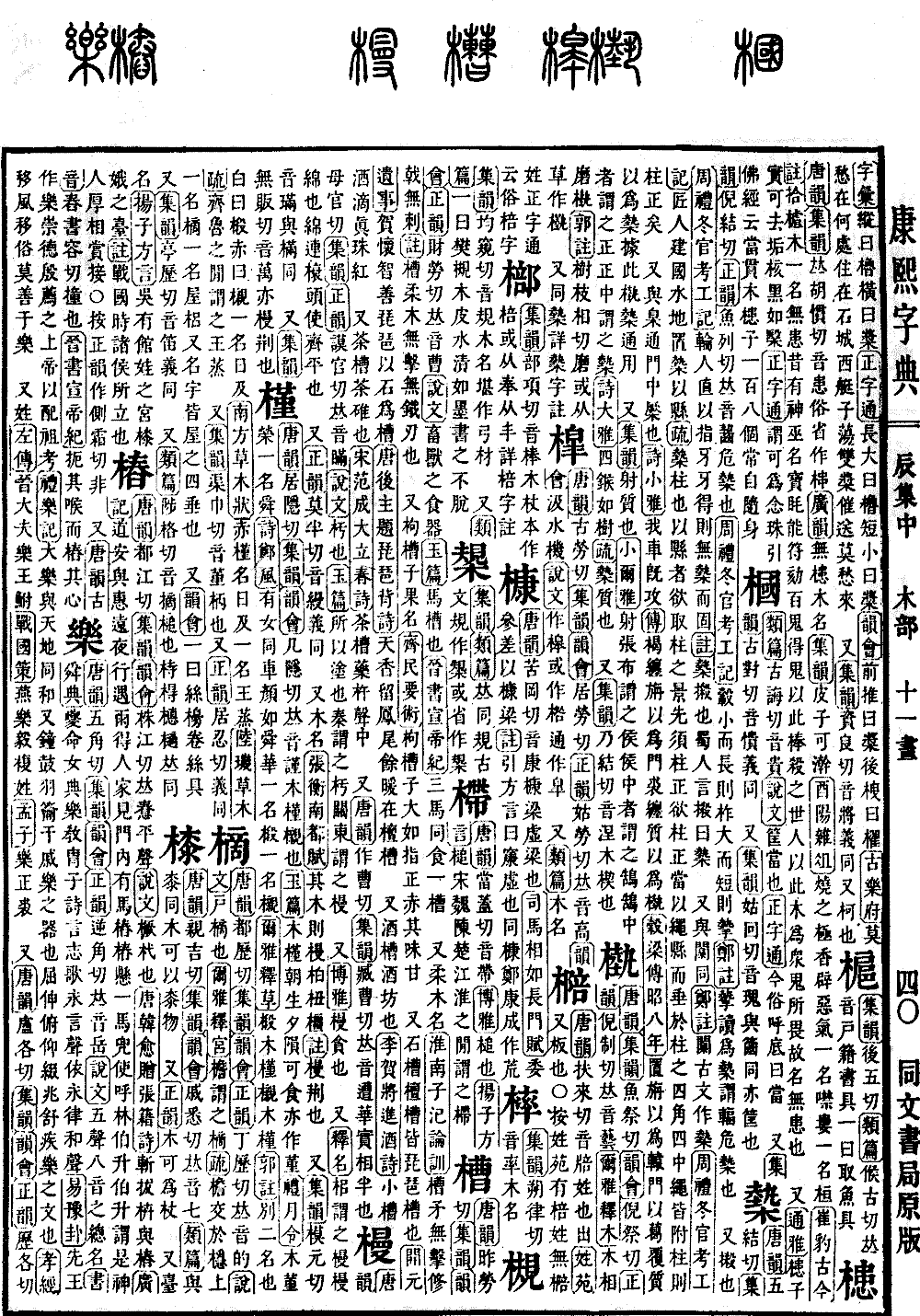
Chen Collection, Middle Volume. Radical: Tree (mù). Kangxi strokes: 15. Page 548, Entry 20.
Pronounced yue.
As defined in the Shuowen Jiezi, the general term for the five sounds and eight tones.
In the Book of Documents (Shujing), the Emperor Shun says: Kui, I command you to oversee music, and teach the scions of the nobility. Poetry expresses intent, songs extend these words, sounds rely upon this extension, and pitch pipes harmonize the sounds.
In the Book of Changes (Yijing), it is said: The former kings composed music to exalt virtue, presenting it with great ceremony to the Supreme Deity, so as to match the virtues of their ancestors.
In the Record of Music (Yueji) of the Book of Rites (Liji), it is written: Great music is in harmony with the universe. Bells, drums, feather-plumed flutes, shields, and battle-axes are the instruments of music. Bending, stretching, looking down, looking up, the arrangement of dancers, and the rhythm of movement are the refinement of music.
In the Classic of Filial Piety (Xiaojing), it is stated: To transform customs and improve habits, nothing is better than music.
Also a surname. In the Zuo Tradition (Zuo Zhuan), there is the Jin official Yue Wangfu. In the Strategies of the Warring States (Zhan Guo Ce), there is Yue Yi of Yan. Also a compound surname. In the Book of Mencius (Mengzi), there is Yue Zhengqiu.
Also pronounced luo. Refers to happiness or joy. According to the Tonglun, joy originates in the heart, and happiness is something that permeates everything.
In the Book of Changes (Yijing), it says: Finding happiness in Heaven and knowing one's destiny.
In the Book of Mencius (Mengzi), it says: Sharing happiness with the people.
Also pronounced liao. In the Book of Odes (Shijing), it says: One may find joy in the face of hunger. Mao reads this as luo, while Zheng reads this as liao.
Also pronounced yao. In the Analects (Lunyu), it says: The wise find pleasure in mountains. Also, there are three types of pleasures that are beneficial.
Also pronounced lu. In the Taigong Shanglue, it says: When the four classes of people are left empty-handed, the state has no reserves; when the four classes of people are satisfied, the state is peaceful and happy.
In the Eastern Capital Rhapsody (Dongdu Fu) by Ban Gu, it says: During the sacrificial meal, the Grand Music Master performs music, arranging the metal and stone instruments, and laying out the string and wind instruments.
Also pronounced lao. In the Guangyun, it is defined as Bo Le who judges horses. It is also written as Bo Lao.