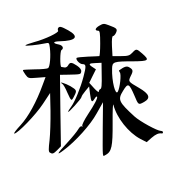
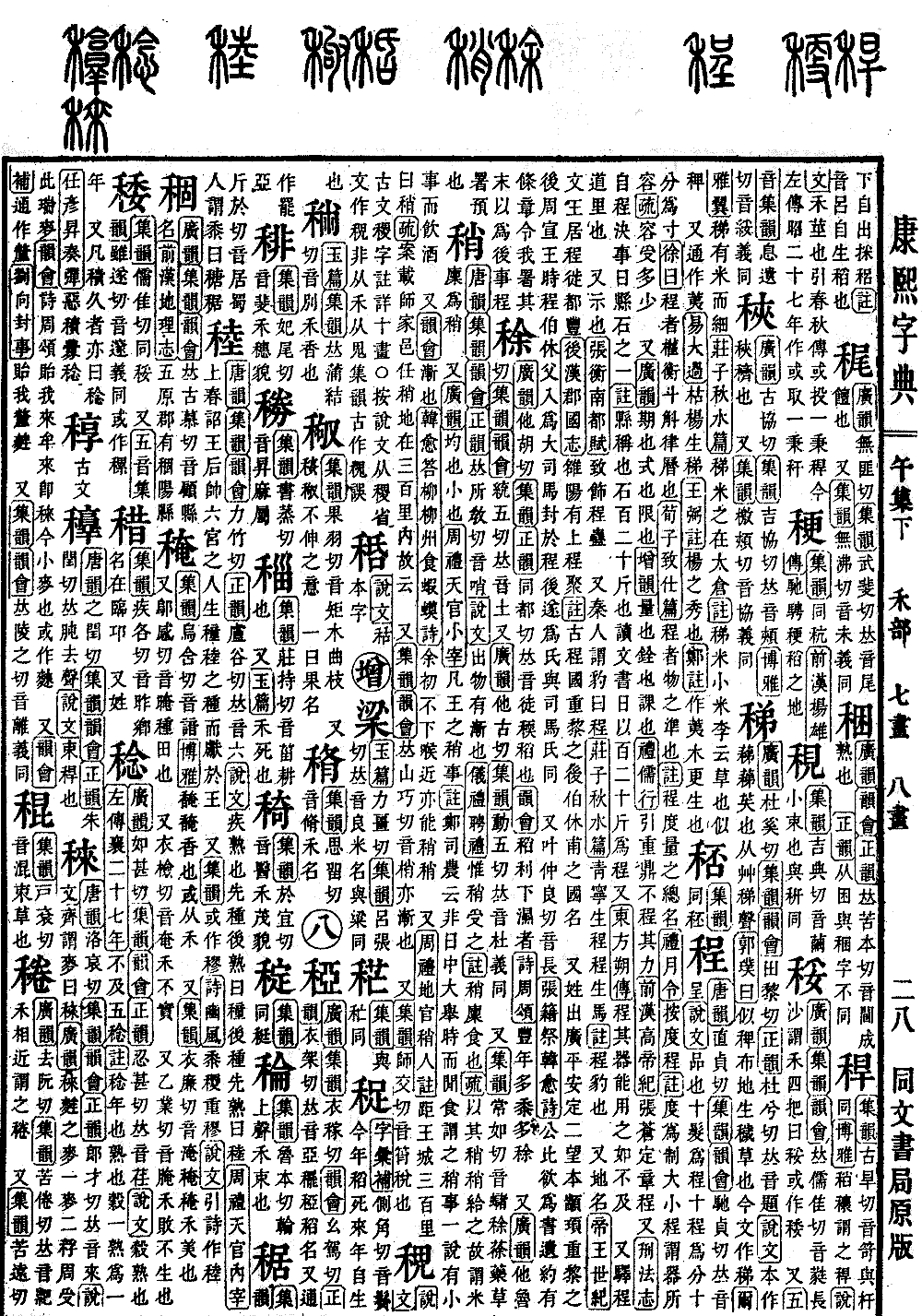
Zi Collection, Upper Volume, Page 22, Entry 07
Radical: Grass (cǎo)
Pronounced lai (falling tone)
The "Tang Yun" (Tang Yun) annotates the pronunciation as luo ai qie. The "Ji Yun" (Ji Yun), "Yun Hui" (Yun Hui), and "Zheng Yun" (Zheng Yun) annotate the pronunciation as lang cai qie, with the same pronunciation as "lai." The "Shuo Wen Jie Zi" (Shuo Wen Jie Zi) records that people in the Qi region called wheat "nai." The "Guang Yun" (Guang Yun) states that "nai mai" is a type of wheat with two husks per grain, and that this auspicious wheat was obtained during the Zhou Dynasty. The "Yun Hui" (Yun Hui) quotes a line from the "Book of Odes" (Shijing), "Zhou Song" (Zhou Song): "Yi wo lai mou." Here, "lai" refers to "nai," which is present-day wheat. It is sometimes written as "mai."
Furthermore, according to the "Yun Hui Bu" (Yun Hui Bu), this character is interchangeable with "li." In "Liu Xiang - Feng Shi" (Liu Xiang - Feng Shi), it is written as "yi wo li mai."
The "Ji Yun" (Ji Yun) and "Yun Hui" (Yun Hui) annotate the pronunciation as ling zhi qie, with the same pronunciation as "li." The meaning is the same as previously described.