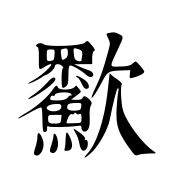
"Yùpiān" (玉篇) provides the pronunciation as gōng wēn fǎn qiè. "Tángyùn" (唐韻) provides the pronunciation as gǔ hùn fǎn qiè. "Jíyùn" (集韻) provides the pronunciation as gōng hùn fǎn qiè, with the reading kūn. "Shuōwén Jiězì" (說文解字) explains it as "kūnyú" (昆于), meaning unknowable. "Tōngyǎ" (通雅) states that "kūnyú" (昆于) is the same as "kūnwú" (昆吾). "Shuōwén Jiězì" (說文解字) describes "kūnwú" (昆吾) as a round object. From this, it can be inferred that "kūnwú" (昆吾) and "kūnlún" (昆仑) were ancient general terms for round and cohesive things. Therefore, mountains with round and cohesive shapes were called "kūnlún" (昆仑), referring to their indistinct and chaotic appearance, akin to the state of chaos. "Kūnwú" (昆吾) is described as cone-shaped. The pronunciation of "wú" (吾) is interchangeable with "yú" (于). In ancient times, "wǒ" (我) was also called "wú" (吾) or "yú" (余). "Shuōwén Jiézì" (說文解字) explains the character "hùn" (㱎) as likely referring to a cone-like, indistinct shape, and unknowable. "Liùshū Suǒyǐn" (六书索隐) states that "hùn" (㱎) is the name of Yu's father. The current writings 鯀, , and 鮌 are incorrect. Note: This explanation lacks evidence and borders on forced interpretation, thus it is not credible.