Wu Collection, Lower Volume
Radical: Cave (xué)
Kangxi Strokes: 8
Page 863, Entry 01
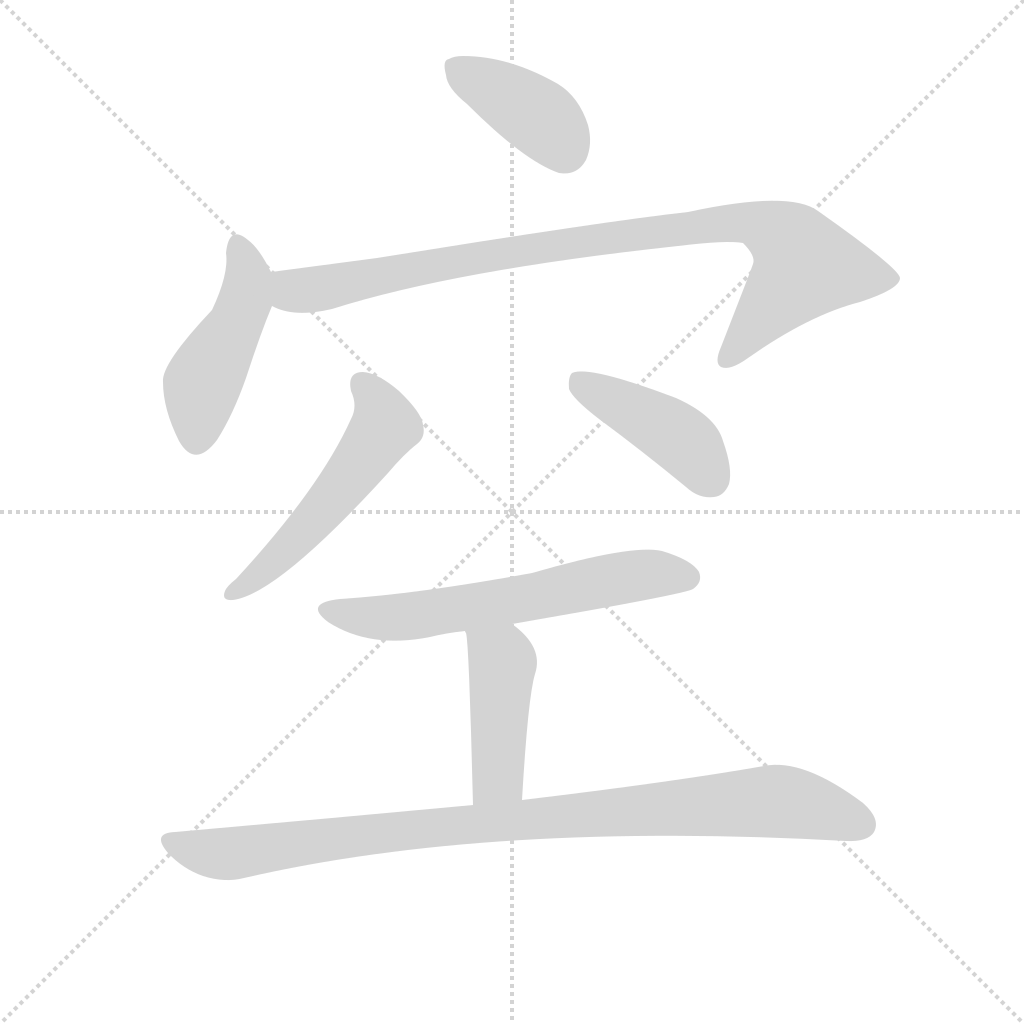
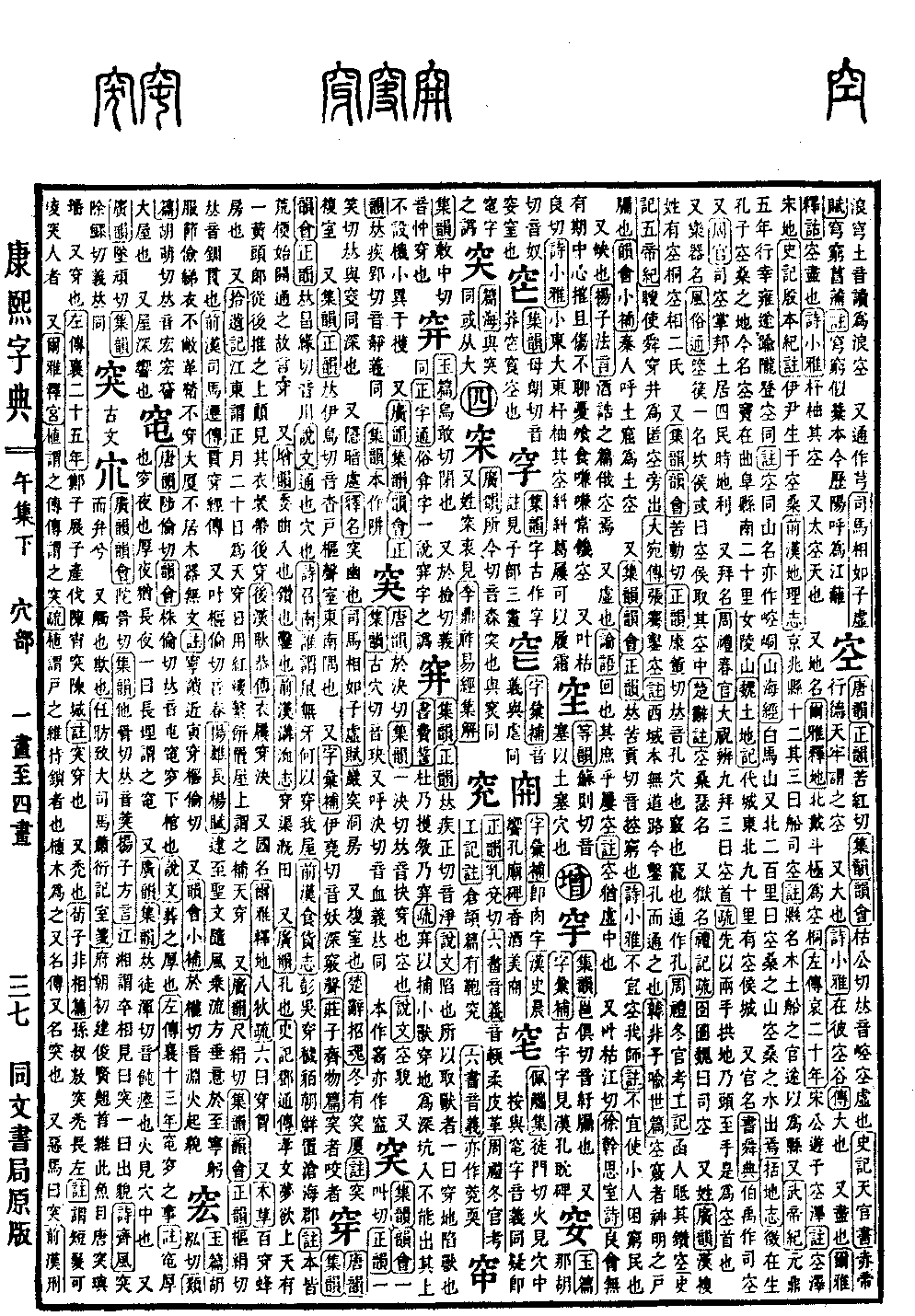
Pronounced kong. Emptiness. Records of the Grand Historian (Shiji), Treatise on the Celestial Offices: When the Red Emperor carries out virtue in the Celestial Prison, this is called kong. It also means large. Book of Odes (Shijing), Lesser Odes: In that large valley. Commentary: Large. It also means exhausted. Erya, Explanation of Ancient Words: Kong means exhausted. Book of Odes (Shijing), Lesser Odes: The shuttles and reeds are exhausted. It also refers to the great void, the sky. It also refers to a place name. Erya, Explanation of Places: The northern range touching the North Star is called Kongtong. Zuo Tradition (Zuo Zhuan), 20th Year of Duke Ai: Duke of Song traveled in the Kong Marsh. Commentary: Kong Marsh is a place in the State of Song. Records of the Grand Historian (Shiji), Annals of Yin, Commentary: Yi Yin was born at Kongsang. Book of Han (Qianhan Shu), Treatise on Geography: There are twelve counties in Jingzhao, the third of which is Chuansikong. Commentary: A county name. Originally the official in charge of boats, it subsequently became a county name. Also, in the Annals of Emperor Wu: In the fifth year of the Yuanding era, the Emperor toured Yong, crossed the Long range, and climbed Kongtong. Commentary: Kongtong is a mountain name. Also written as Kongtong (with mountain radical). Classic of Mountains and Seas (Shanhaijing): Two hundred li north of White Horse Mountain is the mountain of Kongsang, from which the Kongsang River flows. Kuodizhi: Zheng Zai gave birth to Confucius in the land of Kongsang, now called Kongdou, located twenty li south of Qufu County at Nuling Mountain. Records of Wei Lands: Ninety li northeast of Dai City is Konghou City. It also refers to an official title. Book of Documents (Shu Jing), Canon of Shun: Yu the Great acted as Minister of Works (Sikong). Also, the Rites of Zhou (Zhou Guan): The Minister of Works manages the land of the state, resides among the four classes of people, and regulates land advantages. It also refers to a form of obeisance. Rites of Zhou (Zhou Li), Spring Officials: The Grand Invoker distinguishes nine types of obeisance; the third is called kongshou (empty head bow). Commentary: First bow with both hands together on the ground, then lower the head to the hands; this is called kongshou. It also refers to a musical instrument. Customs and Mores (Fengsu Tong): The konghou is also called kanhou. Some say it is called konghou because it is hollow inside. Chu Ci Commentary: Kongsang is the name of a zither. It also refers to a prison. Book of Rites (Li Ji), Commentary: A jail is called sikong in the State of Wei. It also refers to a surname. Broad Rhymes (Guangyun): During the Han dynasty, there were the double-character surnames Kongtong and Kongxiang.
Pronounced kong (rising tone). A cave, a hole, a cavity. Often written as kong (hole). Rites of Zhou (Zhou Li), Winter Officials, Record of Tradesmen: The armorer examines its drilled hole. Records of the Grand Historian (Shiji), Annals of the Five Emperors: The blind man (Shun's father) had Shun dig a well and secretly made a hole to escape from the side. Biography of Dayuan: Zhang Qian tunneled through. Commentary: There were originally no roads in the Western Regions; he tunneled a hole to make them passable. Han Feizi, Explaining Difficulties: A hole or cavity is the door and window of the human spirit. Supplementary Notes to the Rhyme Compendium (Yunhui Xiaobu): People of Qin call an earth cave an earth kong.
Pronounced kong (falling tone). To be exhausted or impoverished. Book of Odes (Shijing), Lesser Odes: One should not impoverish my army. Commentary: One should not cause the common people to be distressed and impoverished. It also means lacking or a gap. Yangzi, Model Sayings: The chapter on the Wine Proclamation is missing sections. It also means void. Analects of Confucius (Lunyu): Yan Hui is close to perfection, yet he is often void. Commentary: Kong means to be empty within.
Also pronounced ku (falling tone). Xu Gan, Poem on Longing for the Chamber: Good meetings have no appointed time, the heart is destroyed and injured. I do not care to eat my evening meal, hungry and empty as I always am.
Also pronounced ku (falling tone). Book of Odes (Shijing), Lesser Odes: To the small east and great east, their shuttles and reeds are empty. With coarse hempen sandals, one can tread on the frost.