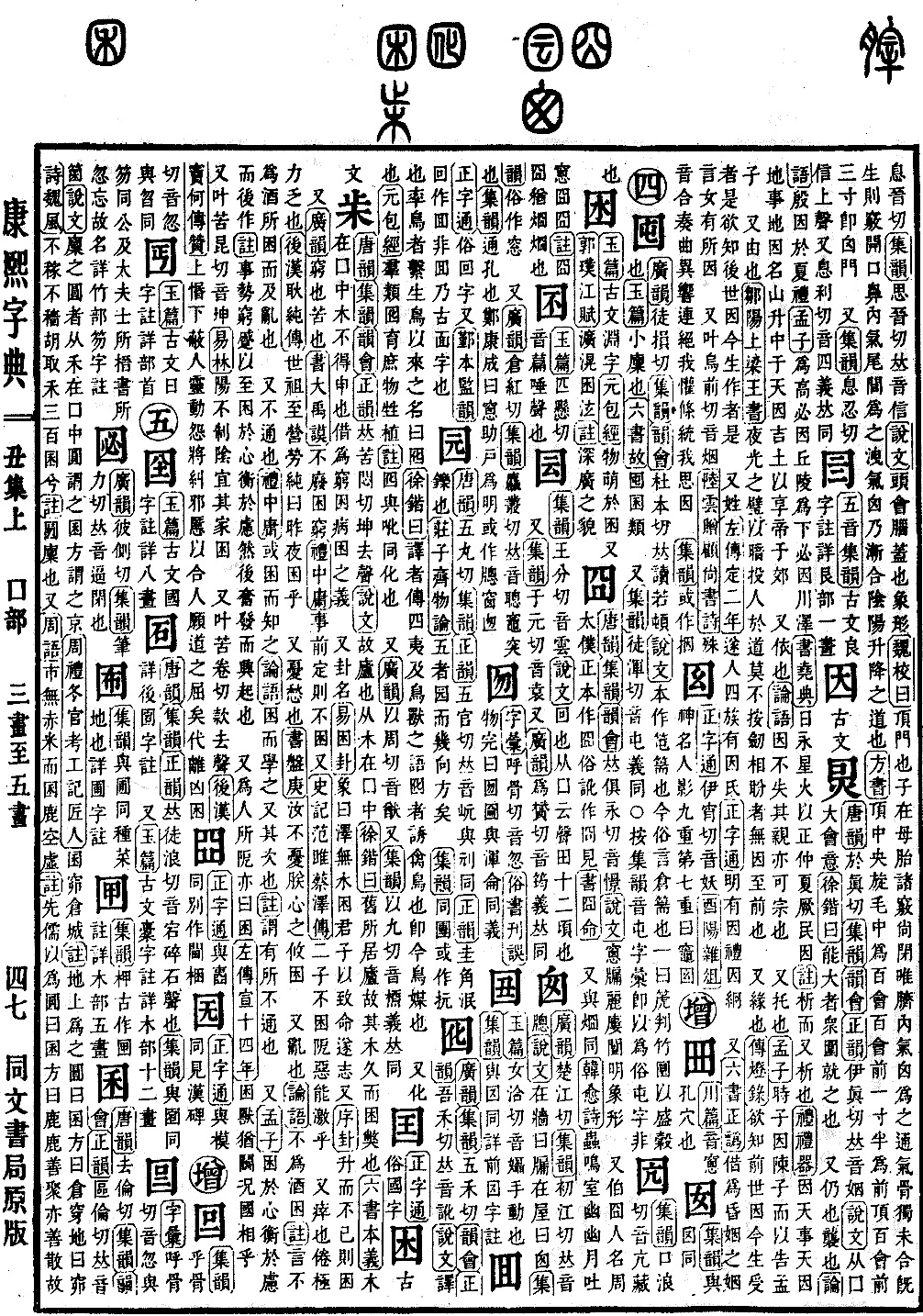
Chou Collection, Upper Volume
Radical: Enclosure (wéi)
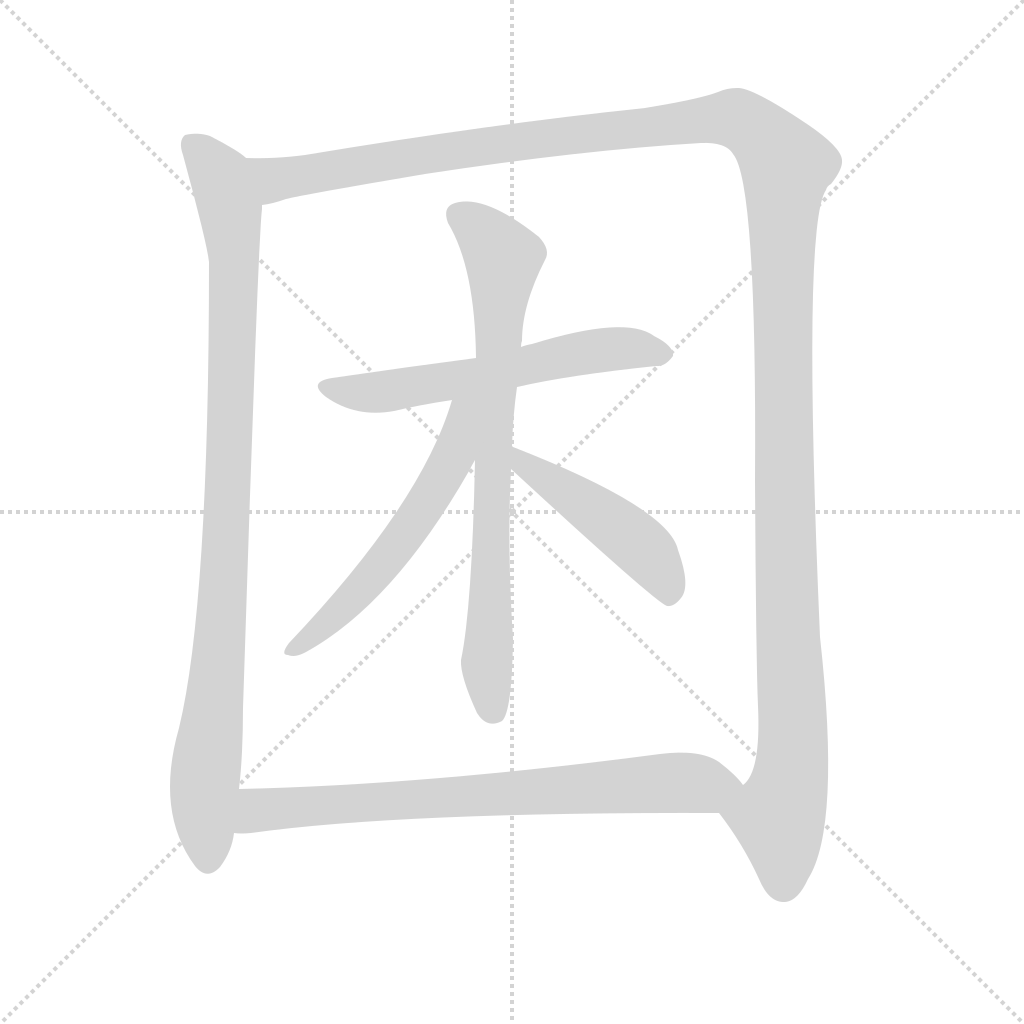
Character: Kun
Kangxi stroke count: 7
Page 217, Entry 20
Old form. Pronounced kun (falling tone).
Shuowen Jiezi (Explanation of Graphs and Analysis of Characters) states it refers to an old cottage. It is composed of the character for tree, positioned within the character for enclosure. Xu Kai says that because it is an old dwelling, the wood is aged and dilapidated. The Benyi (Essential Meaning of the Six Writings) states that wood within an enclosure cannot grow, and the term is borrowed to signify being impoverished or afflicted by illness.
Also the name of a hexagram. The Book of Changes (Yijing), Hexagram of Hardship (Kun) states: The image says, a marsh without water is hardship; the noble man uses this to determine his fate and fulfill his aspirations. The Order of Hexagrams states: If one rises without end, one encounters hardship.
Also from Guangyun (Broad Rhymes): to be impoverished, to suffer. The Book of Documents (Shujing), Counsels of the Great Yu states: Do not neglect those who are impoverished. The Book of Rites (Liji), Doctrine of the Mean (Zhongyong) states: If affairs are determined in advance, there will be no hardship.
Also from Records of the Grand Historian (Shiji), Biography of Fan Sui and Cai Ze: If these two men had not been in dire straits, how could they have been spurred to action?
Also to be weary, to be exhausted to the point of lacking strength. Book of the Later Han (Hou Hanshu), Biography of Geng Chun states: The Emperor reached the camp and asked Chun with concern: Were you exhausted last night?
Also to be sorrowful. The Book of Documents (Shujing), Announcement of Pan Geng states: You do not worry about that which causes my heart to be distressed.
Also to be chaotic. The Analects (Lunyu) states: Do not let yourself be confused by wine. The commentary says: This means not to be overcome by wine to the point of falling into disorder.
Also to lack understanding. The Book of Rites (Liji), Doctrine of the Mean (Zhongyong) states: Some learn through hardship. The Analects (Lunyu) states: To learn through hardship is the next level. The commentary says: This refers to things that are not yet understood.
Also from the Works of Mencius (Mengzi): When one is hindered in mind and perplexed in thought, only then can one arise. The commentary says: When circumstances are desperate and one is hindered in mind and perplexed in thought, only then can one rouse oneself and flourish.
Also to be obstructed by others. The Zuo Commentary (Zuozhuan), 14th Year of Duke Xuan states: A trapped beast still fights; how much more so should a minister of a state?
Also rhymes with kun (level tone). The Yilin (Forest of Changes) states: If the yang does not control the yin, it is fitting that the family suffers hardship.
Also rhymes with kuan (falling tone). Book of the Later Han (Hou Hanshu), Eulogy for the Biographies of Dou and He states: The ruler is befuddled and those below are obscured, the people's spirits are stirred with resentment; they wish to rectify evil and wickedness to fulfill the wishes of the people. The path is constrained, and the generation encounters this grave hardship.