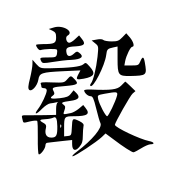
In the "Guangyun" (Guangyun), the pronunciation is noted as ku hou qie, with the same pronunciation as "kou" (kou). "Shuowen Jiezi" (Shuowen Jiezi) explains it as unbaked pottery. The pronunciation is similar to "yong fu" (yong fu).
Furthermore, in the "Guangyun" (Guangyun), the pronunciation is noted as kong gu qie, with the same pronunciation as "ku" (ku). The meaning is the same.
Note: This character is written as "䍍" (mì) in the "Guangyun" (Guangyun) and also as "䍍" (mì) in the "Jiyun" (Jiyun), with the same pronunciation and meaning. However, in the "Jiyun" (Jiyun), the character "kou" (kou) has another pronunciation, its form includes "瑴" (guó), and it is also categorized under the level tone (ping sheng), with the pronunciation fang wu qie, the same as "fu" (fu). This pronunciation is not recorded in the "Guangyun" (Guangyun). It is suspected that it was originally the same character, and an error occurred during transcription. Also, its exclusion from the level tone (ping sheng) is an accidental omission by the "Guangyun" (Guangyun). Based on the "Zhengzitong" (Zhengzitong), only the character "䍍" (mì) is retained.