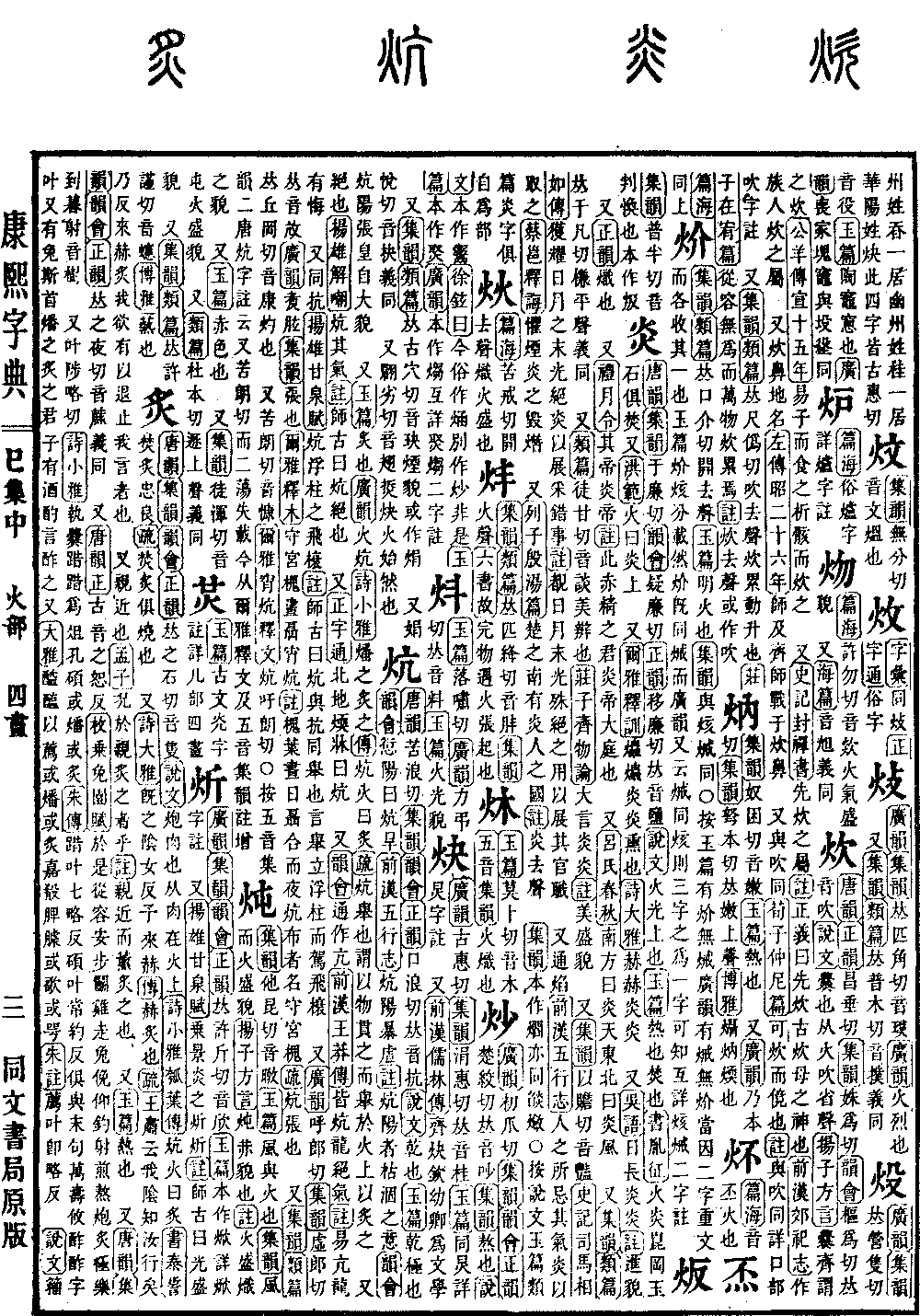
Si Collection, Middle Volume
Radical: Fire (huǒ)
Kangxi Strokes: 8
Page 667, Entry 20
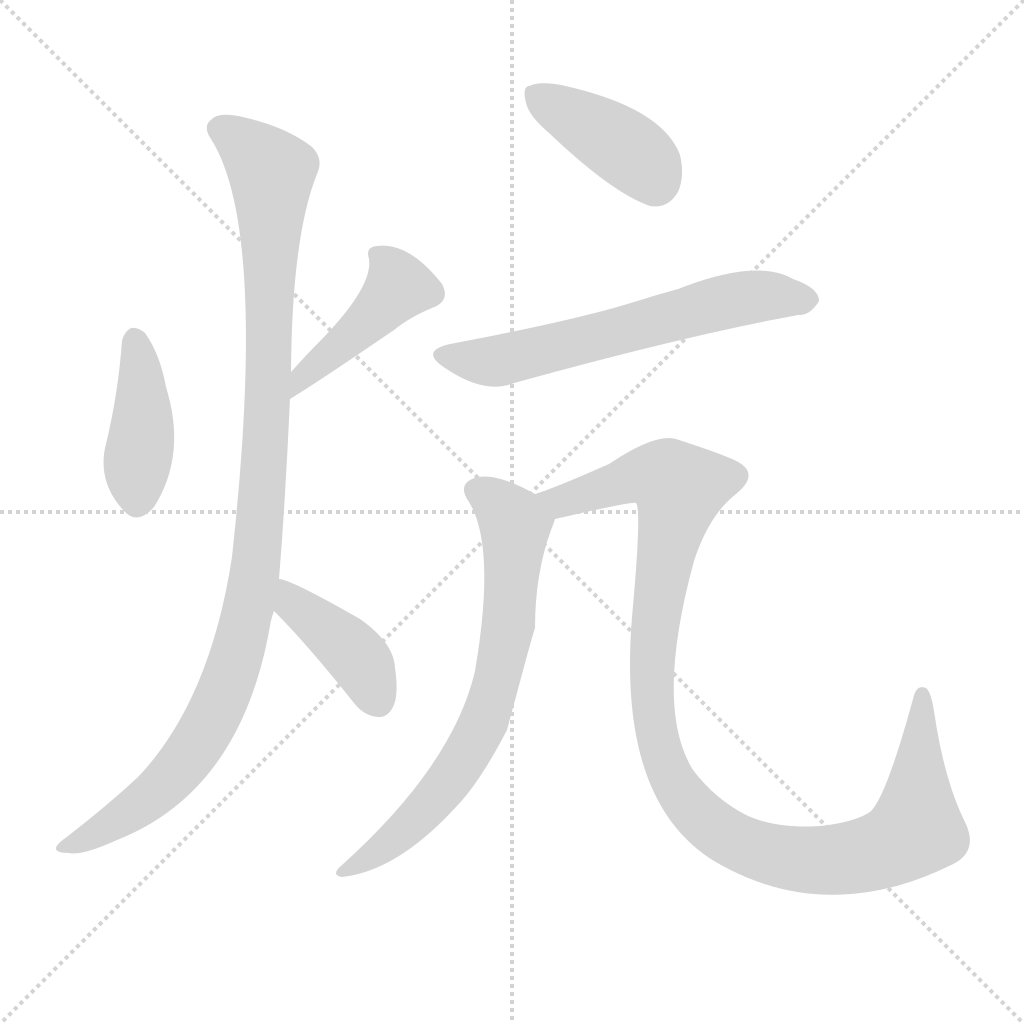
Pronounced kàng.
Shuowen Jiezi (Explanation of Writing and Analysis of Characters): To dry.
Yupian (Jade Chapters): To dry to the extreme.
Yunhui (Collection of Rhymes): Excessive yang energy leading to drought is called kanghan (drought).
History of the Former Han (Qian Hanshu): The Five Elements Treatises: The kangyang (excessive heat) is violent and oppressive.
Commentary: Kangyang refers to becoming withered and dried up.
Yunhui: Kangyang describes an arrogant and pretentious manner.
Also, Yupian: To roast.
Guangyun (Broad Rhymes): Fire kang (hearth/roasting fire).
Book of Odes (Shijing): Xiaoya: Roast it and toast it.
Commentary: Using a kang fire to toast is called zhi (roasting).
Sub-commentary: Kang means to lift. It refers to using a utensil to pierce and lift it to roast over a fire.
Also, to sever or cut off.
Yang Xiong: Jiezhao (Discourse on Ridicule): To sever his spirit.
Commentary: Shigu says: Kang means to sever.
Also, Zhengzitong (Correction of Characters): In the north, a heated bed is called a kang.
Also, Yunhui: Interchangable with kang (excessive/high).
History of the Former Han (Qian Hanshu): Biography of Wang Mang: Both were kanglong (arrogant dragon) and cut off the spirit.
Commentary: The Book of Changes (Yijing) mentions the arrogant dragon has cause for regret.
Also, the same as kang (to resist/lift).
Yang Xiong: Ganquan Fu (Rhapsody on the Sweet Springs): To lift the floating pillars and flying rafters.
Commentary: Shigu says: Kang is the same as kang (to resist). It means to lift high, referring to erecting floating pillars to support the flying eaves.
Also, pronounced hāng.
Guangyun (Broad Rhymes): To boil the stomach of livestock.
Jiyun (Collection of Rhymes): To open up.
Erya (Approaching Elegance): Shimu (Explanation of Trees): The shougong (chameleon) tree, the acacia leaves fold during the day and open at night, which is called shougong huai.
Commentary: The acacia tree leaves fold during the day and open at night, this is called shougong huai.
Sub-commentary: Kang means to open.
Also, Jiyun (Collection of Rhymes), Leipian (Classified Chapters): Pronounced kāng. To scorch or burn.
Also, pronounced kǎng.
Erya (Approaching Elegance): Xiaokang Shiwen: Kang is pronounced xu-lǎng. Note: The Wuyin Jiyun (Collection of Rhymes by Five Sounds), under the tang rhyme section, says the character kang also has the reading ku-lǎng, though it is not recorded in the dang rhyme section. It is now supplemented based on the Erya Shiwen and the Wuyin Jiyun. The character was originally incorrectly written with the radical for kang and the radical for strike.