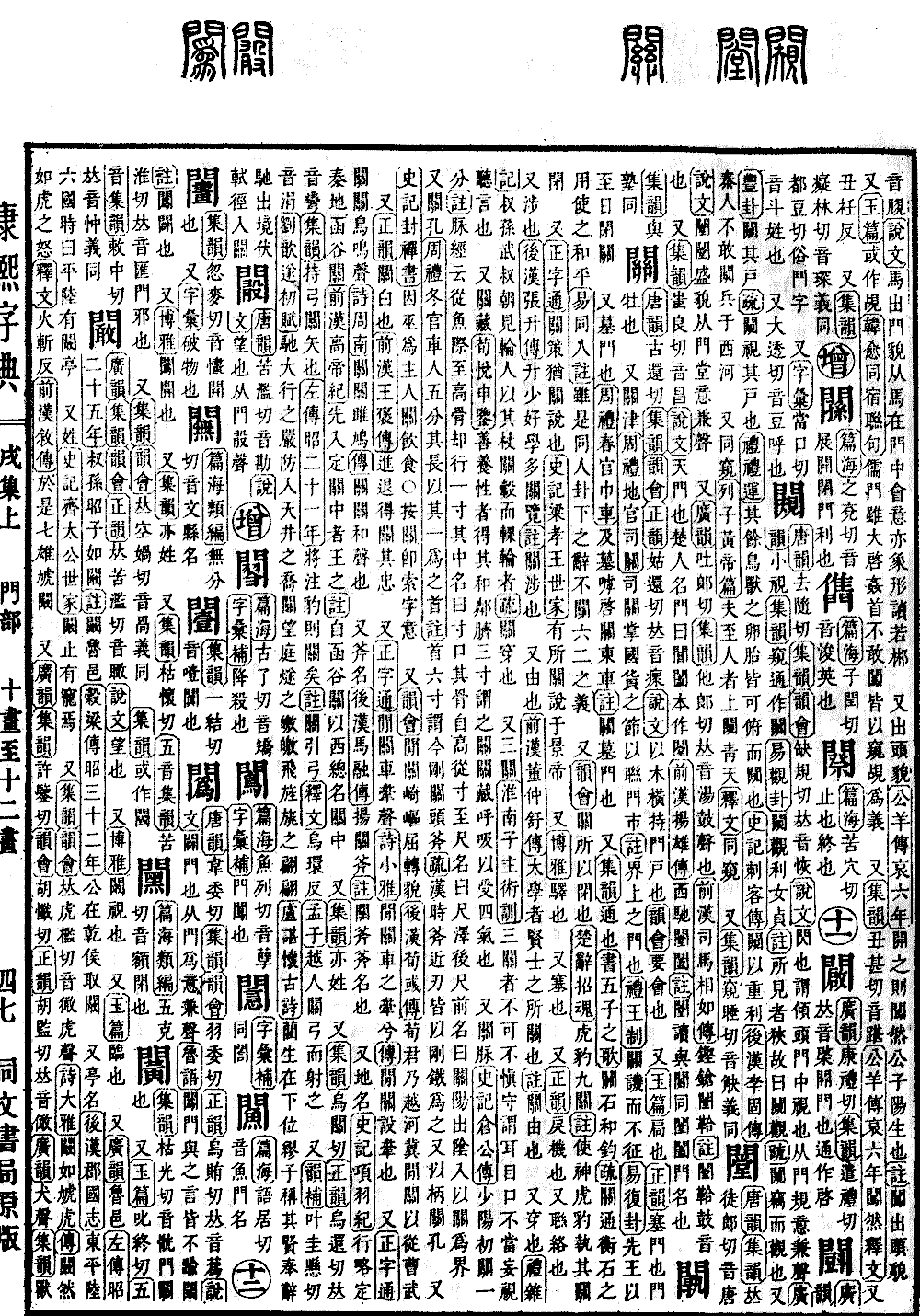
Xu Collection, Upper Volume
Radical: Gate (mén)
Kan
Kangxi stroke count: 20
Page 1341, Entry 21
According to Broad Rhymes (Guangyun), Collected Rhymes (Jiyun), Rhyme Compendium (Yunhui), and Correct Rhymes (Zhengyun), the pronunciation is kan (falling tone).
In Explaining Graphs and Analyzing Characters (Shuowen), it means to look or gaze.
In Broad Appreciation (Boya), kan means to look.
In Jade Compendium (Yupian), it means to overlook or approach.
It is the name of a town in the state of Lu, as recorded in the Broad Rhymes (Guangyun).
In the Zuo Tradition (Zuo Zhuan), twenty-fifth year of Duke Zhao, Shusun Zhaozhi went to Kan. The commentary notes that Kan is a town in Lu.
In the Guliang Tradition (Guliang Zhuan), thirty-second year of Duke Zhao, the Duke was at Qianhou and captured Kan.
It is the name of a pavilion. In the Geography Treatise of the Later Han (Hou Hanshu Junuozhi), Dongping Lu was called Pinglu during the Warring States period; it contains Kan Pavilion.
It is a surname. In the Records of the Grand Historian (Shiji), House of Duke Tai of Qi, Kan Zhi was a favored official.
According to Collected Rhymes (Jiyun) and Rhyme Compendium (Yunhui), the pronunciation is han (rising tone). It refers to the sound of a tiger.
In the Book of Odes (Shijing), Greater Odes, it says, Kan like a roaring tiger.
The commentary explains it as the appearance of a tiger in a rage.
The Explication of Text (Shiwen) records the pronunciation as huo zhan (falling tone).
In the History of the Former Han (Qianhan Shu), Preface, it states, Then the seven states roared and growled.
According to Broad Rhymes (Guangyun) and Collected Rhymes (Jiyun), the pronunciation is xian (falling tone). According to Rhyme Compendium (Yunhui), the pronunciation is xian (falling tone). According to Correct Rhymes (Zhengyun), the pronunciation is xian (falling tone).
Broad Rhymes (Guangyun) defines this as the sound of a dog. Collected Rhymes (Jiyun) defines it as the sound of an animal in a rage.
According to Collected Rhymes (Jiyun), Rhyme Compendium (Yunhui), and Correct Rhymes (Zhengyun), the pronunciation is han (falling tone). The meaning is the same as above.