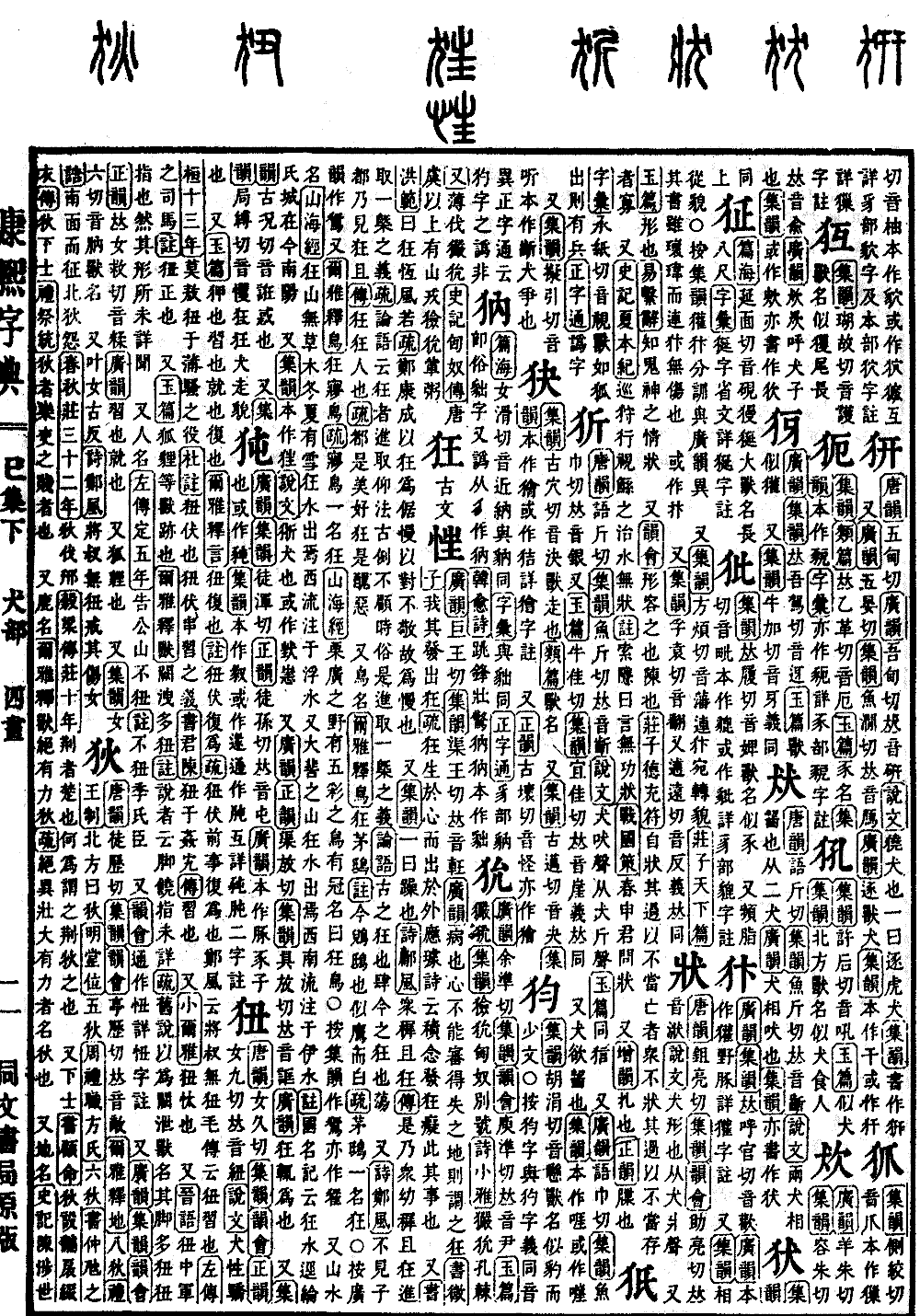
Si Collection, Lower Volume
Radical: Dog (quǎn)
Page 707, Entry 20
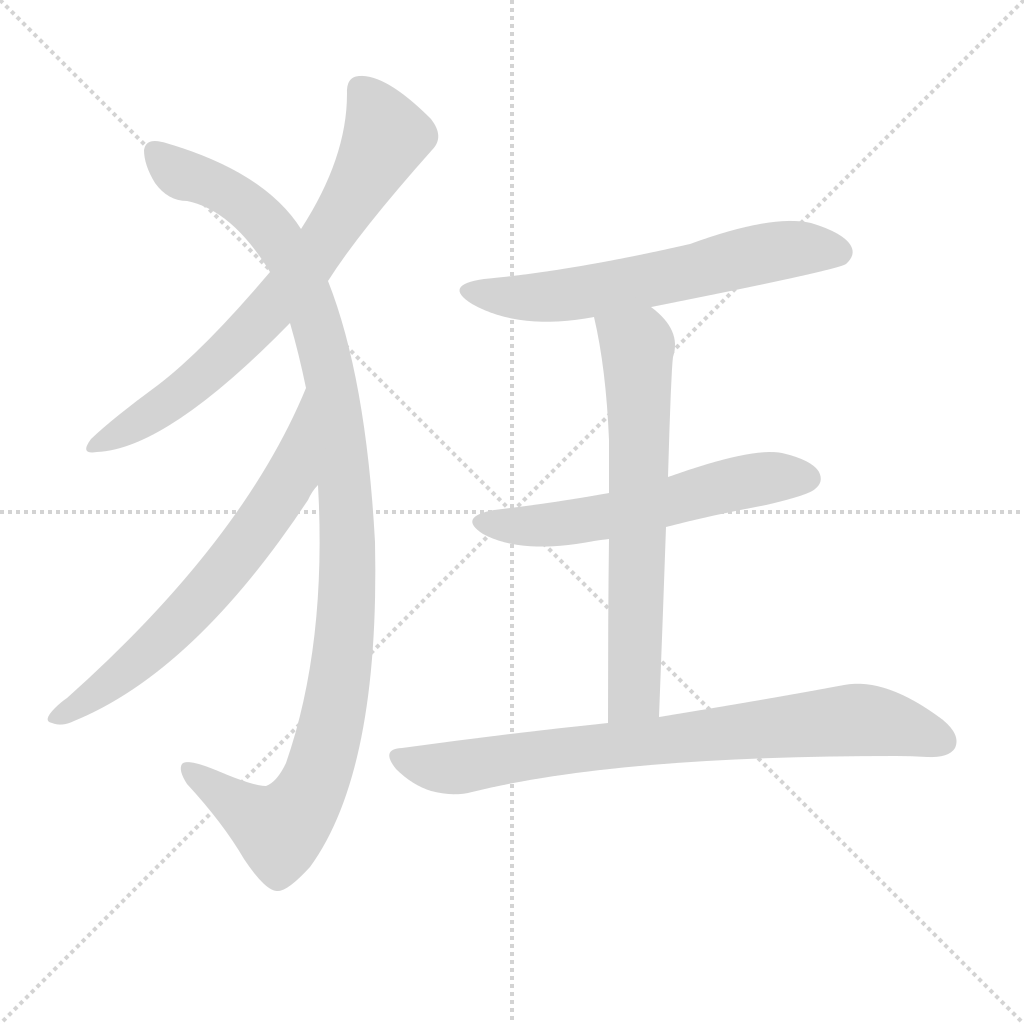
In ancient texts. According to Expanded Rhymes (Guangyun) and Collected Rhymes (Jiyun), pronounced kuang (rising tone).
Expanded Rhymes (Guangyun): Illness. When the heart cannot discern between gain and loss, it is called kuang (mad/wild).
Book of Documents (Shujing), Micro-zi chapter: I will utter wild words. Commentary: Madness originates in the heart and manifests outwardly. Ying Qu's poem states: Accumulated thoughts lead to madness and folly; this refers to such a situation.
Also, Book of Documents (Shujing), Great Plan (Hongfan) chapter: If madness is constant, the winds will follow. Commentary: Zheng Kangcheng considers madness to be arrogance, paired with disrespect; hence it implies sluggishness.
Also, Collected Rhymes (Jiyun): Another meaning is impetuous. Book of Odes (Shijing), Odes of Yong: The crowd is young and wild. Commentary: This means the crowd is young and wild; they are progressive and eager in their pursuits. Commentary: The Analects (Lunyu) states: The wild are progressive and eager. They look to the laws of the ancients and ignore contemporary customs; this is the meaning of progressive and eager. The Analects (Lunyu): The wild of ancient times were unrestrained; the wild of today are loose.
Also, Book of Odes (Shijing), Odes of Zheng: Not seeing Zi Du, but seeing a wild fellow. Commentary: Kuang refers to a madman. Commentary: Du represents beauty, while kuang represents ugliness.
Also, a type of bird. Literary Expositor (Erya), Interpretation of Birds: The kuang is the mao-chi (a type of owl). Commentary: It is now the yi-chi (osprey/owl). It resembles a hawk but is white. Commentary: The mao-chi is also named kuang. According to Expanded Rhymes (Guangyun), it is written as kuang (variant character for bird of prey).
Also, Literary Expositor (Erya), Interpretation of Birds: A bird named kuang. Commentary: A bird is also named kuang. Classic of Mountains and Seas (Shanhaijing): In the wilderness of Li-guang, there is a five-colored bird with a crest, named the kuang bird. According to Collected Rhymes (Jiyun), it is written as kuang (variant character for bird of prey). Also written in a variant form (variant character).
Also, the name of a mountain and a river. Classic of Mountains and Seas (Shanhaijing): Kuang Mountain is devoid of grass and trees; it has snow in both winter and summer. The Kuang River rises there, flows west, and empties into the Fu River. Also, in the mountain of Da-zhi, the Kuang River rises there, flows southwest, and empties into the Yi River. Commentary: The Records of States (Guomingji) states: The Kuang River passes the city of Lun-shi, located in present-day Nanyang.
Also, Collected Rhymes (Jiyun): Originally written as (variant character). Explanations of Characters (Shuowen): A mad dog. Sometimes also written in a variant form (variant character).
Also, Expanded Rhymes (Guangyun) and Corrected Rhymes (Zhengyun): Pronounced kuang (falling tone). Expanded Rhymes (Guangyun): Kuang, to act impulsively.
Also, Collected Rhymes (Jiyun): Pronounced kuang (falling tone). To delude.
Also, Collected Rhymes (Jiyun): Pronounced ju (falling tone). Kuang-kuang, the appearance of a dog running.