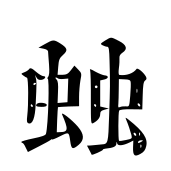
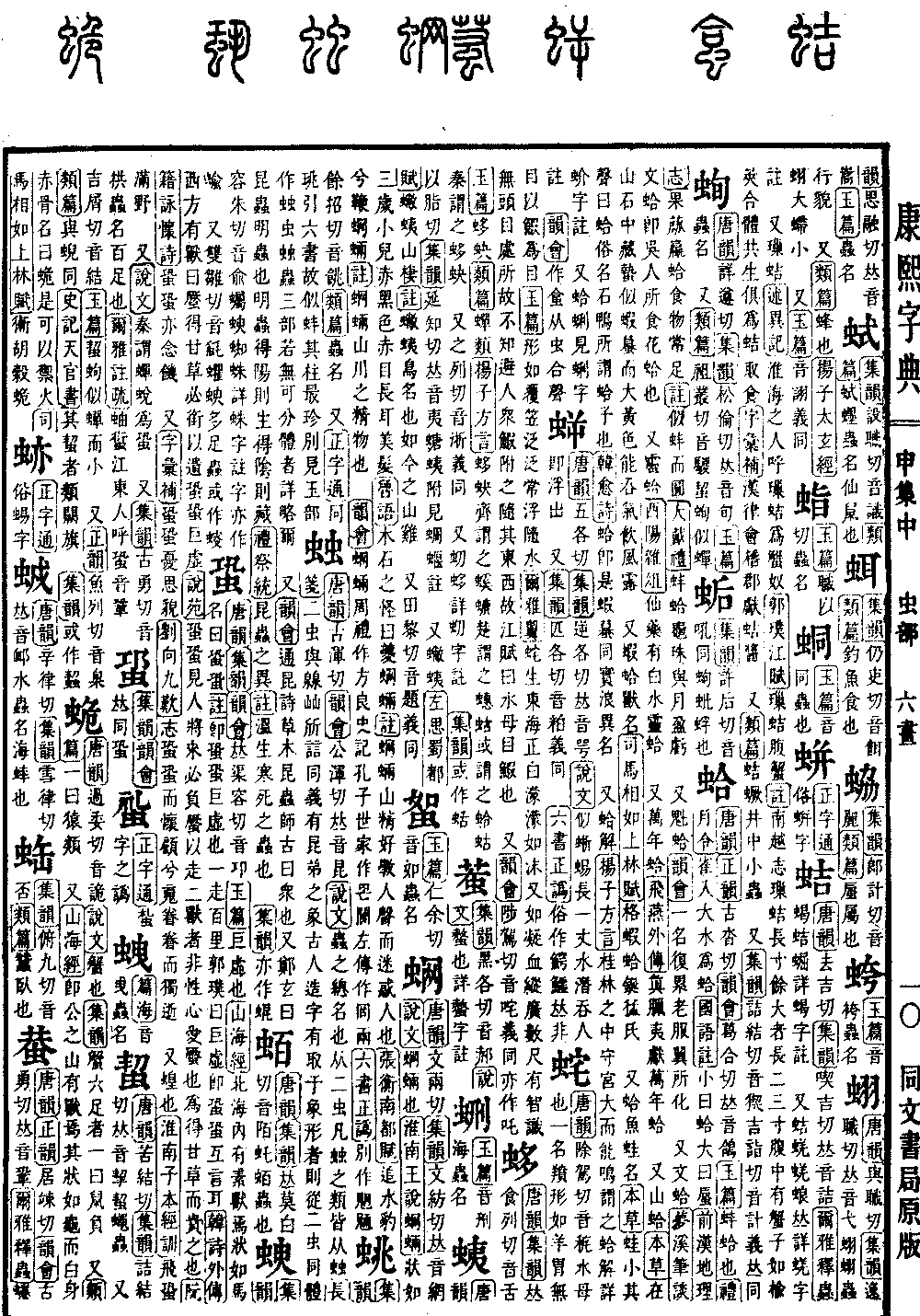
"Tang Yun" (Tang Yun) qie, "Yun Hui" (Yun Hui) gong hun qie, pronounced kun. "Shuowen" (Shuowen): a general term for insects, composed of two insect characters; all characters of the class 䖵 take 䖵 as their phonetic component. "Chang Jian" (Chang Jian): the two insect characters, like 沝, 屾, 斦, and 誩, have the same meaning and symbolize brotherhood. Ancient people, when creating characters, sometimes used pictographs, and thus wrote 䖵 with two identical insect components. The sections for 虫, 䖵, and 虫 seem to have no separate divisions. They only differ in detail.
Also, "Yun Hui" (Yun Hui) is a variant of kun. "Book of Odes" (Shijing): grass and insects. Shigu explains: it means numerous. Zheng Xuan also explains: Kun insects are those that are born from yang energy and hide when encountering yin energy. "Record of Rites: Treatise on Sacrifices" (Liji: Jitong): the differences of kun insects. Commentary: insects born in warmth and dying in cold. "Ji Yun" (Ji Yun) also writes it as 蜫. The character 沝 originally came from two springs. Also 灥.