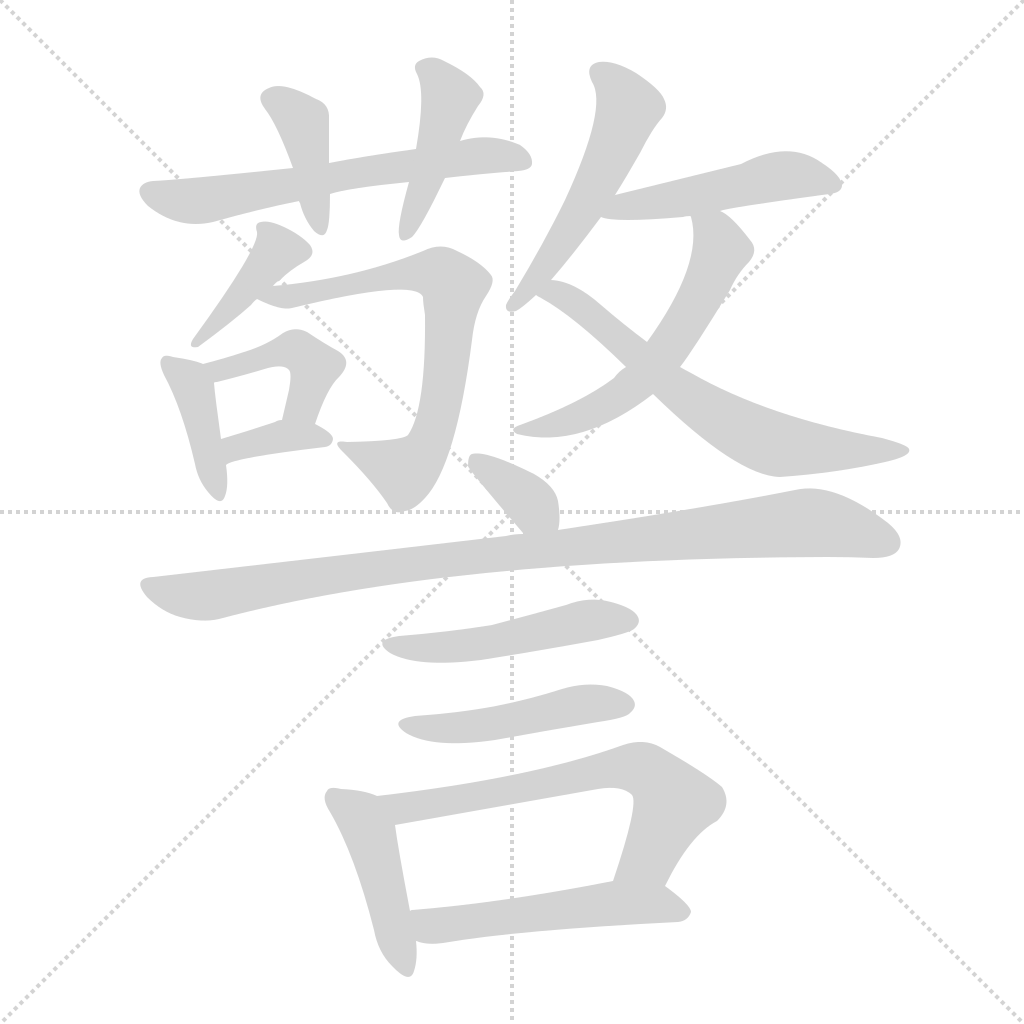
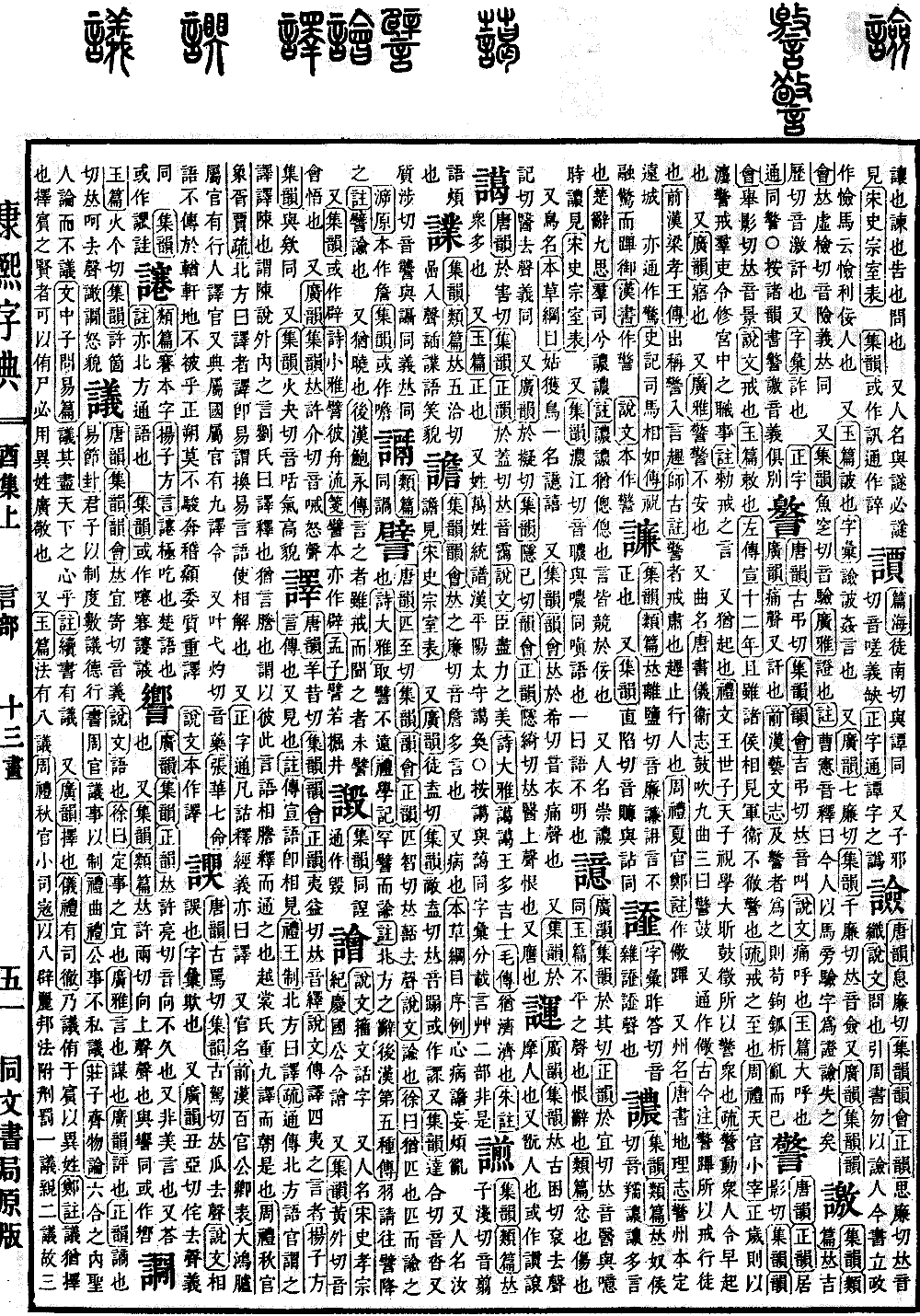
You Collection, Upper Volume
Radical: Speech (yán)
Kangxi Strokes: 20
Page 1183, Entry 05
Pronounced jing.
Shuowen Jiezi (Shuowen): To warn.
Yupian: To command.
Zuo Zhuan (Zuo Zhuan), 12th year of Duke Xuan: Even if the feudal lords meet, the military guards are not removed, which is a state of alert.
Sub-commentary: The utmost degree of caution.
Rites of Zhou (Zhouli), Office of Heaven, Lesser Steward: At the beginning of the year, use the laws to warn the various officials, ordering them to cultivate their duties within the palace.
Annotation: Words of command and caution.
Also, it means to awaken.
Book of Rites (Liji), Hereditary Princes of King Wen: When the Son of Heaven observes the school, he beats the drums at early dawn, which is how he alerts the crowd.
Sub-commentary: To stir and alert the crowd, causing them to rise early.
Also, from Guangyun: To wake up.
Also, from Guangya: Jingjing, to be uneasy.
Also, a song title.
Book of Tang (Tangshu), Treatise on Ceremonial Guards: There are nine songs for the drums and blowers, the third of which is the alert drum.
Also commonly written as jing (to warn).
Gujin Zhu: The alert and the stop are for warning travelers.
Book of Han (Hanshu), Biography of Prince Xiao of Liang: When departing, shout the alert; upon entering, command the stop.
Shigu Annotation: The alert is to command discipline; the stop is to halt pedestrians.
Rites of Zhou (Zhouli), Office of Summer, Zheng Annotation: Written as jing (to warn) and bi (to stop).
Also the name of a prefecture.
Book of Tang (Tangshu), Treatise on Geography: Jing Prefecture, originally Dingyuan City.
Also commonly written as jing (to startle).
Records of the Grand Historian (Shiji), Biography of Sima Xiangru: Zhurong was startled and cleared the path for the imperial carriage.
Book of Han (Hanshu) uses the character jing (alert).
Shuowen Jiezi (Shuowen): Originally written as jing (alert). The character jing (alert) is written with the radical for to strike (pu).