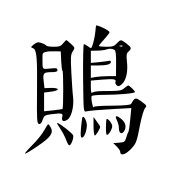
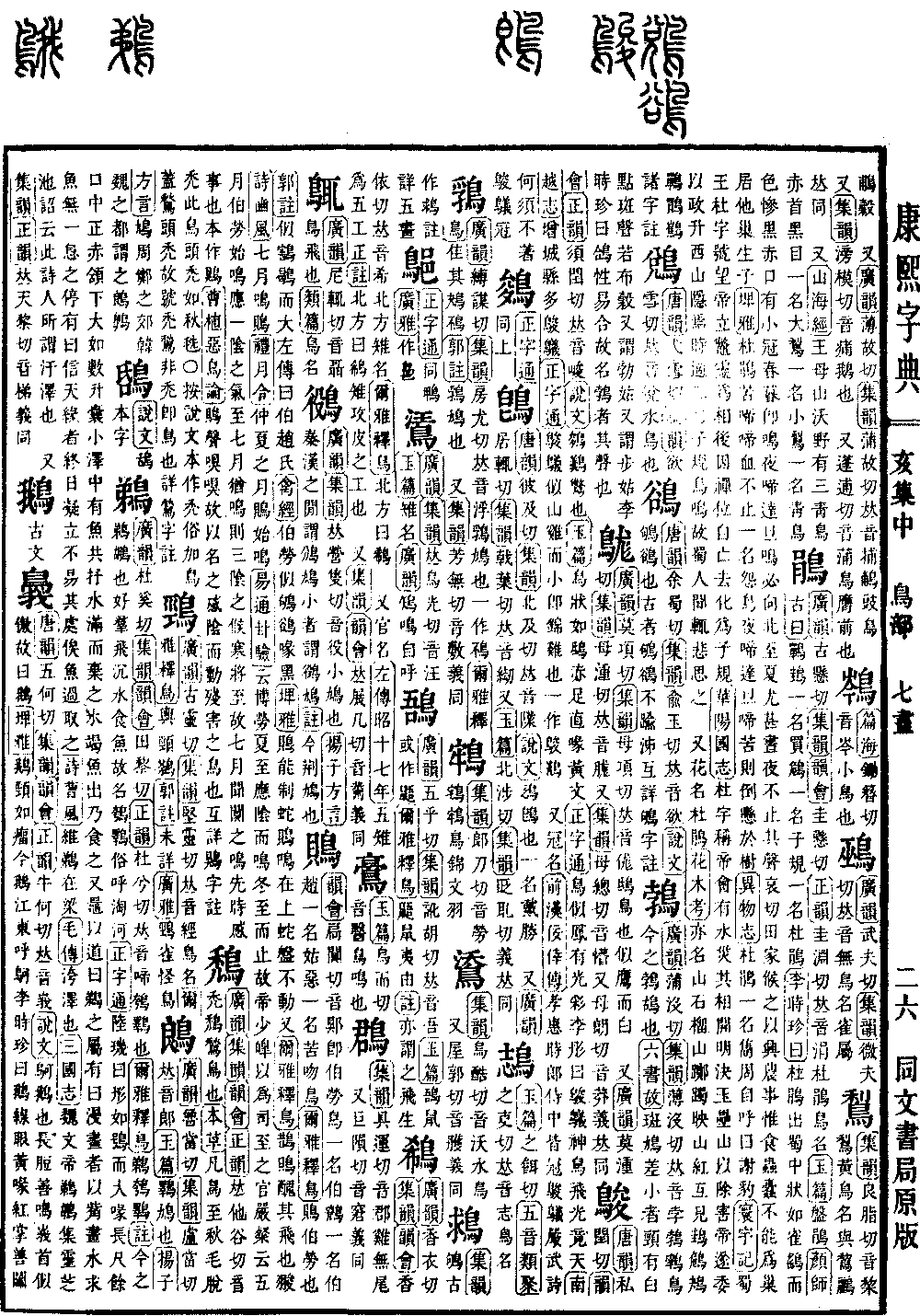
Hai Collection, Middle Volume. Radical: Bird (niǎo). 18 strokes. Page 1490, Entry 25.
According to Collected Rhymes (Yunhui), pronounced ju. It is the shrike bird. Also known as boliao, bozhao, gu'e, or kuwen bird.
Erya: Explaining Birds: The ju is the shrike. Guo's commentary states it resembles the xiehe but is larger in size. Zuo Tradition (Zuozhuan) mentions: The Bozhao clan.
Classic of Birds (Qinjing): The shrike resembles the myna, with a black beak.
Piya: The shrike can subdue snakes; when the shrike calls from above, the snake coils up and remains motionless.
Also, Erya: Explaining Birds: The magpie and the shrike are types of birds that fold their wings when they fly.
Classic of Poetry (Shijing): In the seventh month, the shrike cries.
Book of Rites (Liji): In the second month of summer, the fifth month, the shrike begins to cry.
Yi: Tongguayan states that the bolao (shrike), responds to the yin energy at the summer solstice and cries, stopping at the winter solstice; therefore, the ancient Emperor Shaohao used it as an official to oversee the seasons. Yan Can says: The shrike begins to cry in the fifth month, responding to the nascent yin energy; it is still crying in the seventh month when the yin energy is full and the cold is approaching, so hearing the shrike in the seventh month is a way to sense the timing of events in advance. It was originally written as ju.
Cao Zhi's Discourse on Malign Birds (E'niao lun): The shrike's cry sounds like xiu-xiu, hence its name is derived from this sound. It is a bird that acts in response to yin energy and is considered a predatory bird. See the detailed note under the character ju.
Erya: Explaining Birds: The magpie and the shrike are types of birds that fold their wings when they fly.