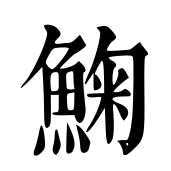
Zi Collection, Page Position: Upper, Radical: Grass (cǎo)
Pronounced ju (falling tone) - similar to "jū".
In the "Guangyun" and "Jiyun" dictionaries, the pronunciation is noted as "ju liù qiè", sounding similar to "jū". The "Shuowen Jiezi" explains it as a type of fish's name, produced in the Pan Kingdom of Lelang. Another explanation is the "zhāi" fish, produced in Jiangdong, which has two teats. The "Leipian" dictionary also records it this way. Sometimes it is also written with other character forms.
Furthermore, in the "Guangyun" and "Jiyun" dictionaries, the pronunciation is noted as "qú zhú qiè", sounding similar to "jū".
Furthermore, in the "Guangyun" dictionary, the pronunciation is noted as "qiū yù qiè", and in the "Jiyun" dictionary, it is noted as "qū yù qiè", sounding similar to "qū".
Furthermore, in the "Jiyun" dictionary, the pronunciation is noted as "qiū liù qiè", sounding similar to "jū". The meaning is the same. The original form of this character was written with the "cǎo" and "gé" radicals.