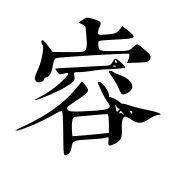
Zi Collection, Upper Volume, Page 135, Entry 01
Pronounced xùn (falling tone)
Pronounced quán (rising tone)
Pronounced ruì (falling tone)
"Jùn" (濬) means to dredge waterways to allow water to flow smoothly. The character is composed of "gǔ" (谷) and "". The component "" indicates uneven, pitted ground. There is a sentence in "Book of Documents (Shangshu), Yi Ji" (益稷) that reads "䜭畎浍距川." It is currently written as "jùn" (濬). It is also written as "".
Additionally, in "Jiyun" (集韵), it is pronounced quán (rising tone), with the same meaning.
Additionally, in "Leipian" (类篇), it is pronounced ruì (falling tone). "Zihui Bu" (字汇补) states that this is the ancient form of the character "ruì" (叡). "History of Former Han (Qian Hanshu), Treatise on the Five Elements" (五行志) records: "Contemplation is called 䜭, and 䜭 can make a person a sage." For other explanations, see stroke 14 under the Water radical.