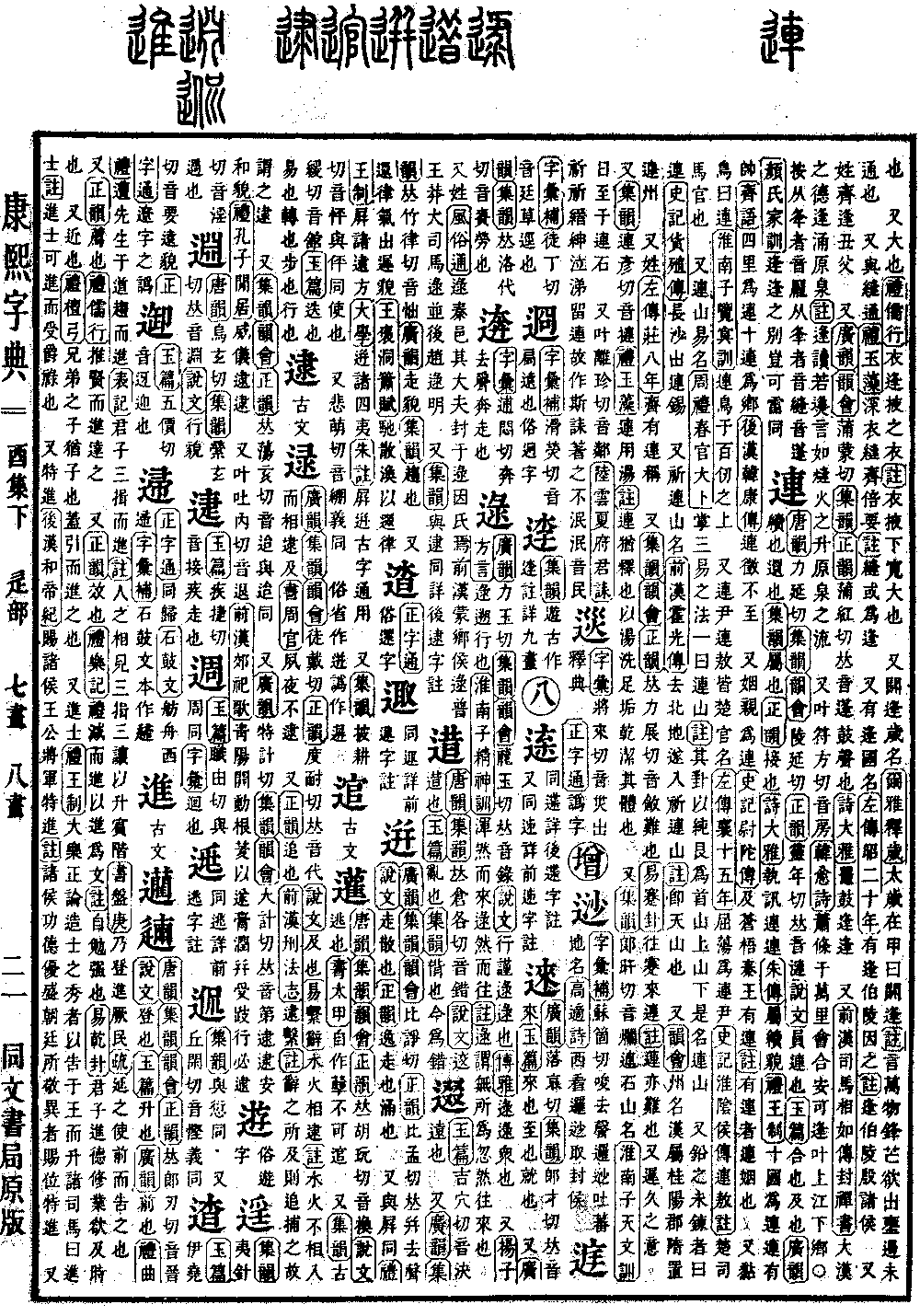
You Collection, Lower Volume
Radical: Walk (chuò)
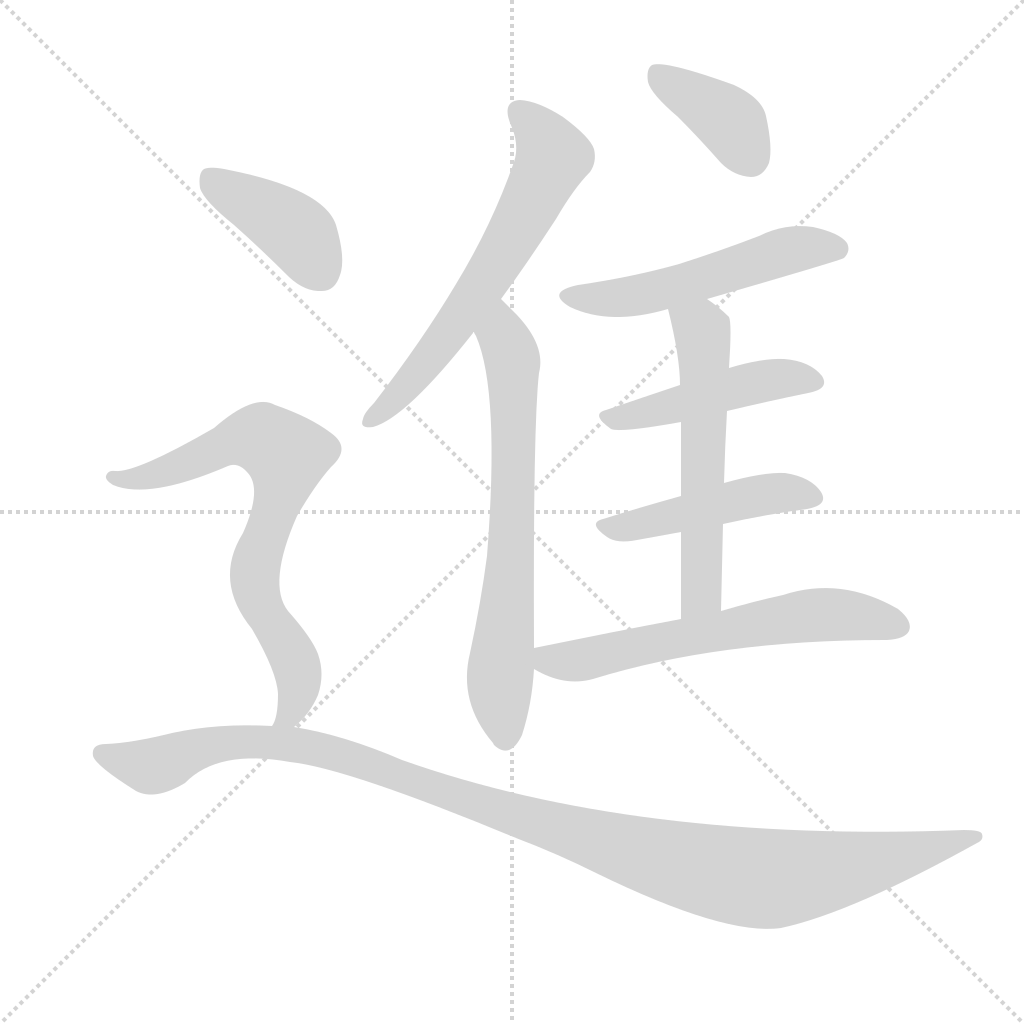
Entry: Jin (advance)
Kangxi Strokes: 15
Page 1259, Entry 30
Ancient documentary records:
Tang Dynasty Dictionary of Sounds (Tangyun), Collection of Rhymes (Jiyun), Rhyme Meetings (Yunhui), and Orthodox Rhymes (Zhengyun) state the pronunciation is jin.
The Analytical Dictionary of Characters (Shuowen) defines it as to ascend.
The Jade Chapters (Yupian) defines it as to rise.
The Broad Rhymes (Guangyun) defines it as to go forward.
Book of Rites (Liji), Record of Ceremonies (Quli): When meeting a teacher on the road, walk quickly to go forward.
Record of Traditions (Biaoji): A gentleman makes three bows then advances. Commentary: When people meet, they bow three times and yield three times, then ascend the guest stairs.
Book of Documents (Shujing), Pan Geng: Therefore he summoned his people to advance forward. Commentary: Invite them to come forward and notify them.
Also, Orthodox Rhymes (Zhengyun): To recommend.
Book of Rites (Liji), Conduct of the Scholars (Ruxing): To recommend the virtuous and talented so they may attain success and prominence.
Also, Orthodox Rhymes (Zhengyun): To present or offer.
Book of Rites (Liji), Record of Music (Yueji): When rituals are simplified, (sincerity) is more manifest, and this sincerity is considered beautiful. Commentary: This is the result of self-exertion.
Book of Changes (Yijing), Qian Hexagram: The gentleman advances in virtue and cultivates his merit, seeking to grasp the right timing.
Also, to be intimate or close.
Book of Rites (Liji), Tan Gong: The sons of brothers are like one’s own sons. This is likely to draw them closer to make them intimate.
Also, an advanced scholar (jinshi).
Book of Rites (Liji), Royal Regulations (Wangzhi): The Grand Director of Music evaluates the best among the scholars, reports them to the King, and notifies the Minister of War; they are called advanced scholars. Commentary: Advanced scholars are those who can be employed and receive titles and salaries.
Also, specially promoted (tejin).
History of the Later Han (Hou Hanshu), Annals of Emperor He: Conferred the title of Tejin upon the dukes, kings, and generals. Commentary: Those among the dukes whose merits and virtues are outstanding and who are particularly respected and favored by the court are granted the position of Tejin.
Also, the same as leftover food (jun).
Book of Rites (Liji), Record of Sacrificial Principles (Jitong): The hundred officials present and remove the sacrificial offerings. Commentary: Jin is the same as jun.
Also, Dictionary Supplement (Zihuibu): The same as to exhaust (jin).
Liezi, Yellow Emperor Chapter: To exhaust one’s cleverness and wisdom, and deplete one’s mental powers.
Also, used interchangeably with to recommend (jian).
Liezi, Tang Questions Chapter: King Mu of Zhou recommended it. Zhang Zhan’s commentary: Jian should be written as jin.
Also, Collection of Rhymes (Jiyun) states the pronunciation is xu ren, and Orthodox Rhymes (Zhengyun) states the pronunciation is qi jin. The same as a parting gift (jin).
History of the Former Han (Qian Hanshu), Annals of Emperor Gao: Xiao He served as the Chief Clerk, managing jin gifts. Commentary: Managing the collection of gift money. Shigu says: The original character for jin is jin, and the sound shifted to jin.
Also, rhymes with zi xin, pronounced jin.
Yangzi, Great Mystery Classic (Taixuanjing): The solar energy guides the advance, and all things flourish and grow.
Textual research:
Tang Dynasty Dictionary of Sounds (Tangyun), Collection of Rhymes (Jiyun), Rhyme Meetings (Yunhui), and Orthodox Rhymes (Zhengyun) state the pronunciation as lang ren, sounds like jin. We respectfully note the original text lang should be corrected to ji.
Liezi, Tang Questions Chapter: King Mu recommended him and questioned him. Commentary: Jian means jin. We respectfully note the original text should be changed to: King Mu recommended him, and Zhang’s commentary says jian should be jin.
Records of the Grand Historian (Shiji), Annals of Emperor Gao: Xiao He served as Chief Clerk managing jin. Commentary: Managing the collection of gift money. Shigu says: Jin was originally written as jin, and the sound shifted to jin. We respectfully note that the cited source is the commentary to the History of the Former Han (Qian Hanshu), therefore the main text should also cite the History of the Former Han. Change Records of the Grand Historian (Shiji) to History of the Former Han (Qian Hanshu).