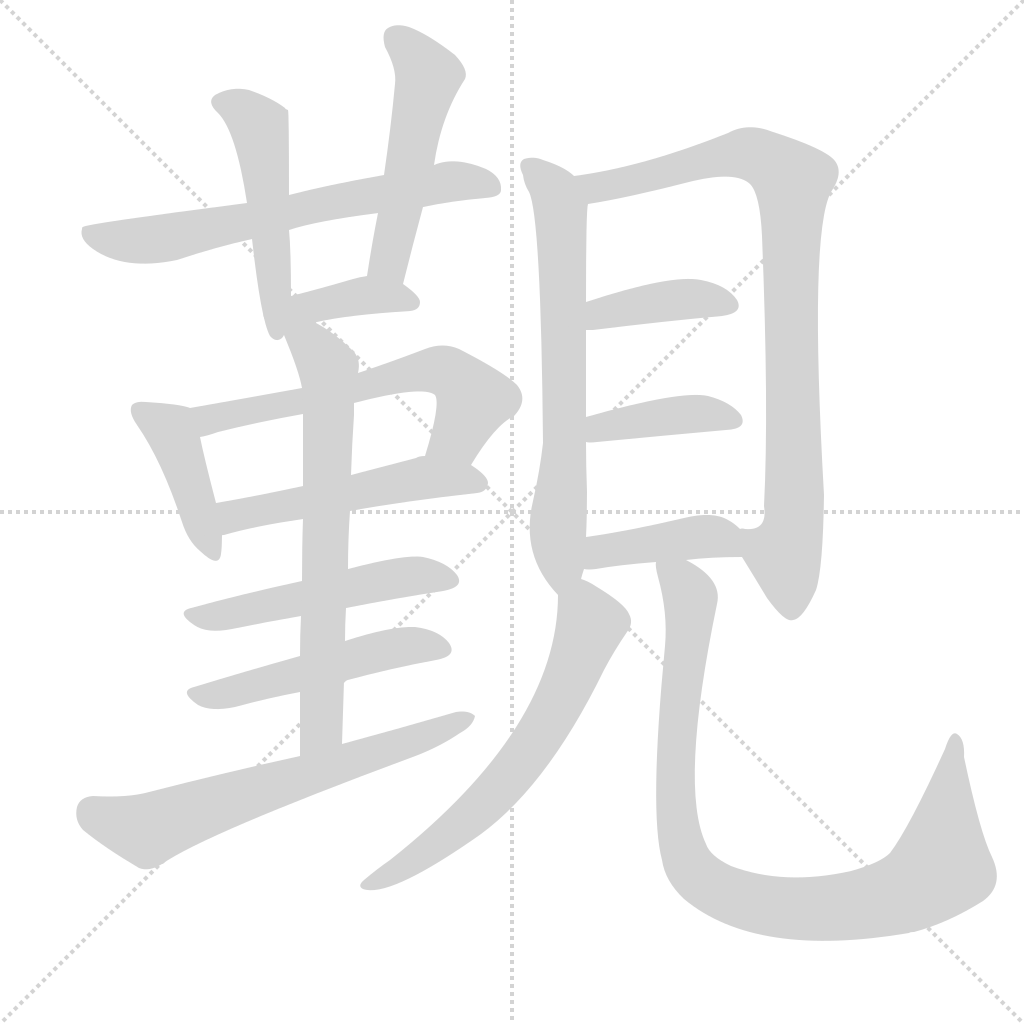
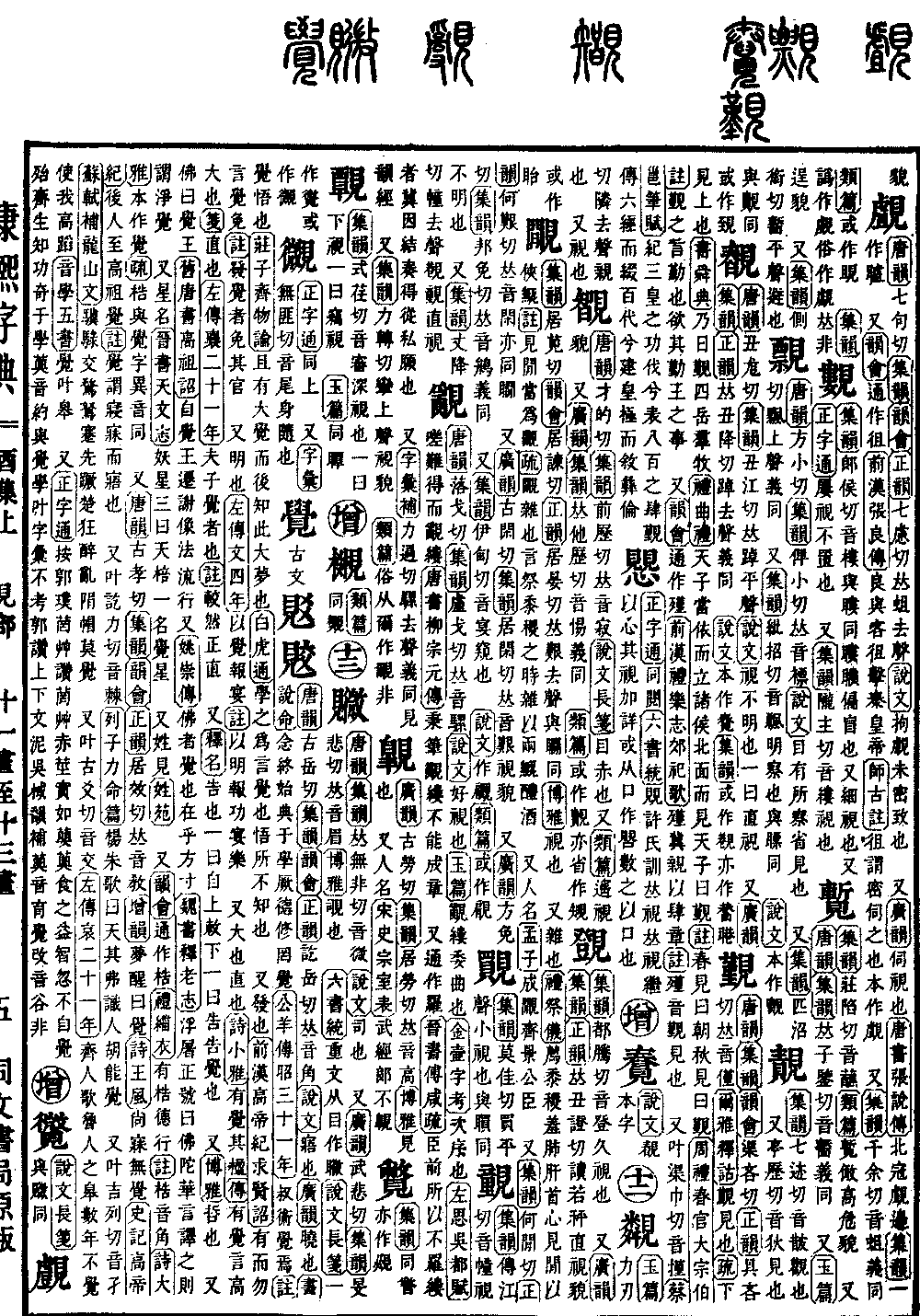
You Collection, Upper Volume
Radical: See (jiàn)
Kangxi Strokes: 18
Page 1137, Entry 07
Pronounced jin (falling tone).
Erya, Explaining Glosses (Erya): Jin means to see. Commentary: To look down upon someone is to see them.
Book of Documents (Shujing), Canon of Shun: He daily held audience (jin) with the four mountain lords and the various regional leaders.
Book of Rites (Liji), Summary of the Rules of Propriety (Quli): When the Son of Heaven stands, he should stand with his back to a screen, and the feudal lords should face north to see the Son of Heaven, which is called jin. Commentary: An audience in the spring is called chao, and an audience in the autumn is called jin.
Rites of Zhou (Zhouli), Spring Offices, Commentary by the Grand Master of Ceremonies: The word jin implies diligence (qin), meaning one wishes for them to be diligent in the affairs of the king.
Also, according to the Rhyme Compendium (Yunhui), it is commonly written in the variant form (jin).
Book of Han (Hanshu), Treatise on Rites and Music, Songs for the Suburban Sacrifices: Jin to reach those who are close within four chapters. Commentary: Jin is pronounced jin, and it means to see.
Also, it rhymes with the sound jin. In the Rhapsody on the Pen (Bifu) by Cai Yong: Recording the meritorious deeds of the Three August Ones, and displaying the splendor of the eight hundred years of audience (jin). Transmitting the Six Classics to link a hundred generations, establishing the Imperial Ultimate to organize the constant norms.