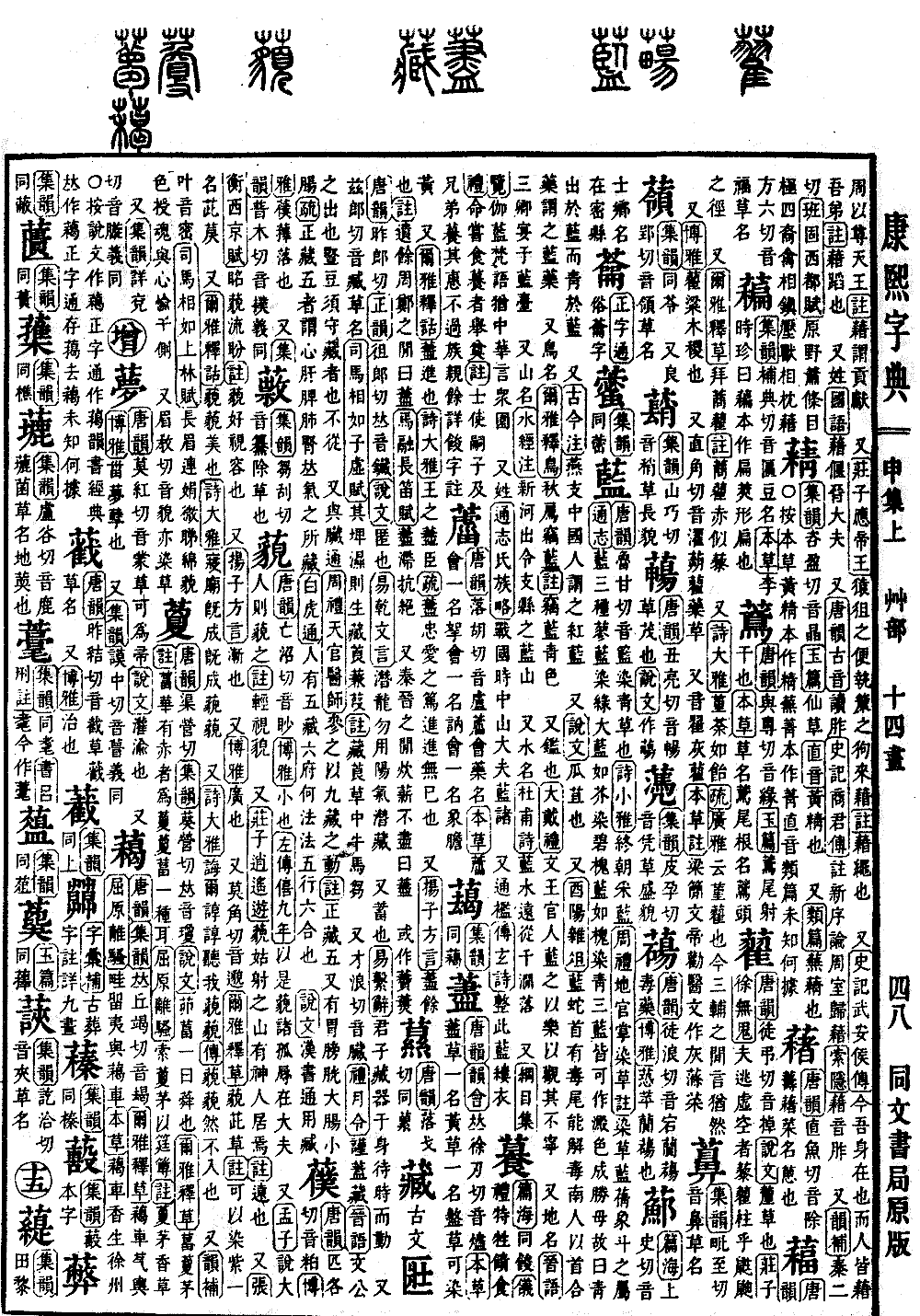
Shen Collection, Upper Volume
Radical: Grass (cǎo)
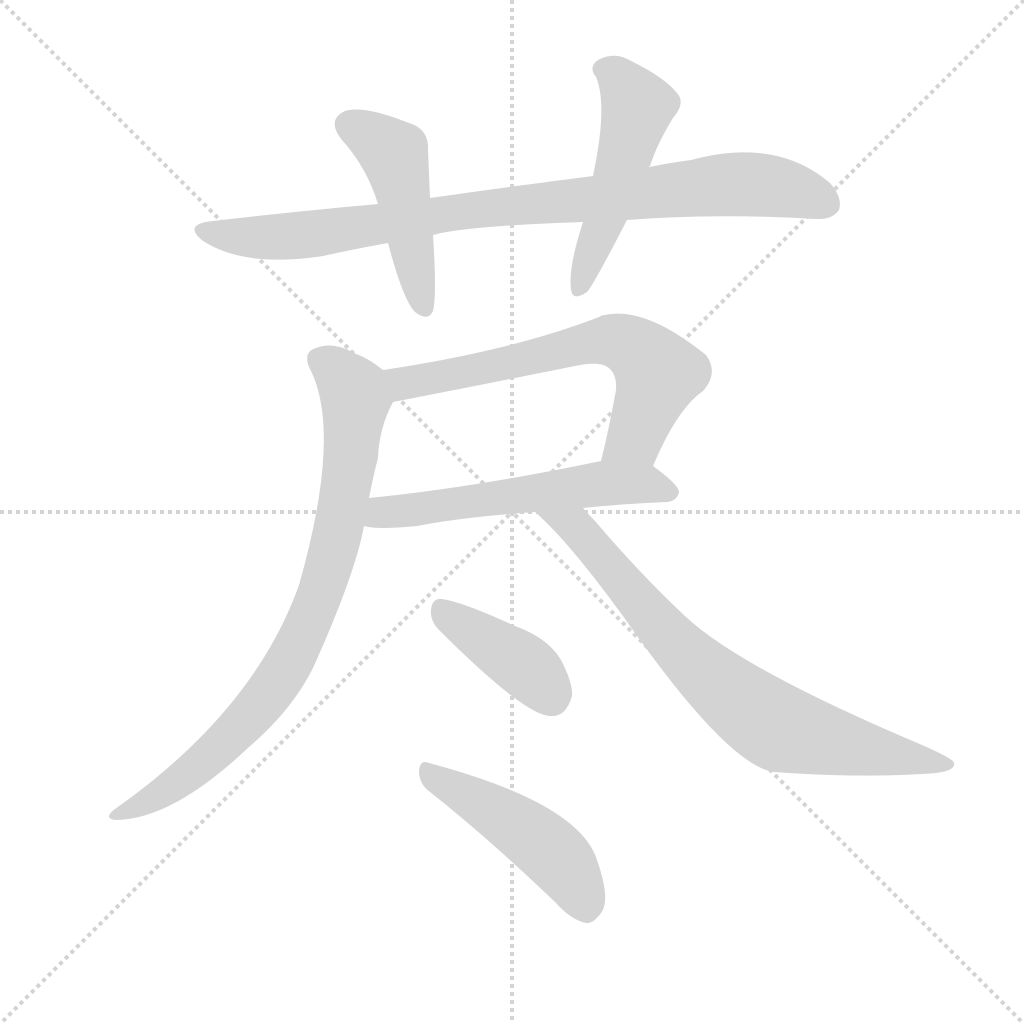
Jìn
Kangxi Strokes: 20
Page 1064, Entry 01
According to Tang Rhymes (Tangyun) and Rhyme Anthology (Yunhui), the character is pronounced jin.
Materia Medica (Bencao) states: Jin grass, also known as yellow grass or li grass, can be used to dye fabrics yellow.
Also, according to Approaching Elegance: Explaining Ancient Words (Erya: Shigu), jin means to advance.
Book of Odes (Shijing): Great Odes (Daya): The king's loyal ministers. Commentary: Jin refers to loyalty and deep devotion, constantly making offerings without ceasing.
Also, according to Yangzi: Regional Expressions (Fangyan), jin means remainder. In the lands of Zhou and Zheng, it is called jin. Commentary: Leftover remains.
Ma Rong: Rhapsody on the Long Flute (Changdi Fu): Jin-zhi-kang-jue.
Also, in the regions of Qin and Jin, firewood that has not been completely burned is called jin. Sometimes written as a variant form.
Textual research: Yangzi: Regional Expressions (Fangyan) states: Jin means remainder. Commentary: Leftover remains; in the lands of Zhou and Zheng, it is called jin. Following the original text, the three characters for leftover remains have been moved to follow the phrase in the lands of Zhou and Zheng, it is called jin.