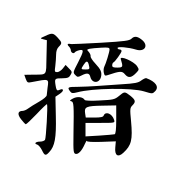
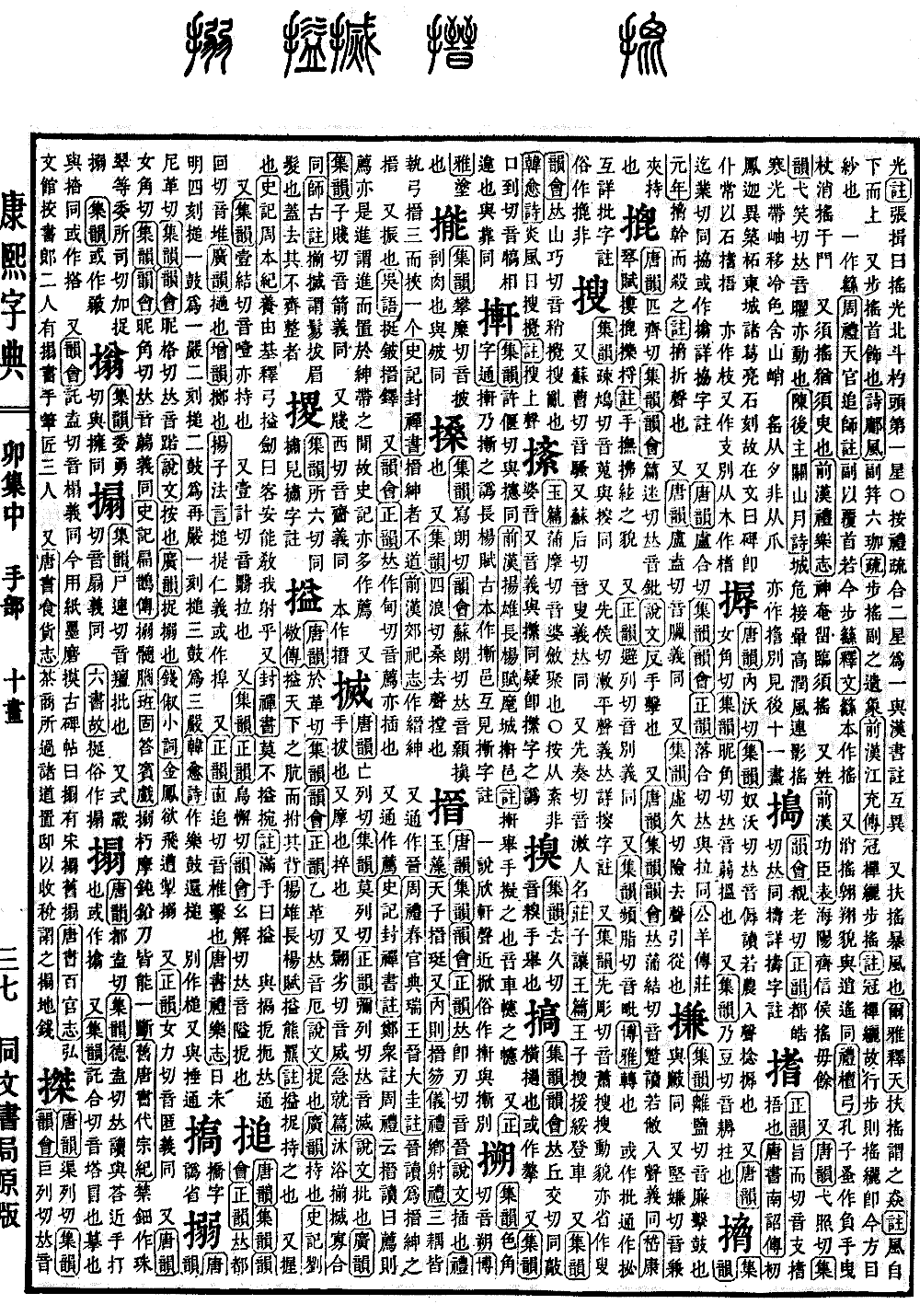
Mao Collection, Middle Volume. Radical: Hand (shǒu). Kangxi strokes: 14. Page 447, Entry 15.
Tang Rhyme (Tangyun), Collection Rhyme (Jiyun), Rhyme Collection (Yunhui), and Orthodox Rhyme (Zhengyun) state it is pronounced jin. According to the Explaining Graphs and Analyzing Characters (Shuowen), it means to insert. In the Book of Rites (Liji), it is written that the Son of Heaven inserts the ivory tablet. Also, in the Record of Internal Regulations (Neize), it refers to inserting the court tablet. In the Book of Etiquette and Ceremonial (Yili), it is recorded that the three pairs of archers each held bows, inserting three arrows and carrying one under the arm. In the Records of the Grand Historian (Shiji), it is written that those who wear the sash do not speak of the Way. In the Book of Han (Qianhan), it is written as jin (referring to the sash). It is also interchangeably written as jin. In the Rites of Zhou (Zhouli), the commentary on the king holding the great jade scepter states that the character is read as the jin of those who wear the sash. It also means to shake. In the Discourses of the States (Wuyu), it refers to straightening the spears and shaking the bells.
According to the Rhyme Collection (Yunhui) and Orthodox Rhyme (Zhengyun), it is pronounced jian. It also means to insert. It is also interchangeably written as jian. The commentary on the Records of the Grand Historian (Shiji) cites Zheng Zhong’s commentary on the Rites of Zhou, stating that the character is read as jian, and thus jian also means to advance. This refers to advancing and placing an object within the sash, which is why the Records of the Grand Historian often uses the character jian. According to the Collection Rhyme (Jiyun), it is pronounced jian, with the same meaning. It is also pronounced ji, with the same meaning. The original form of the character was written as a variation.