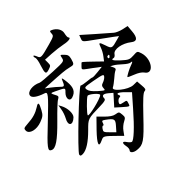
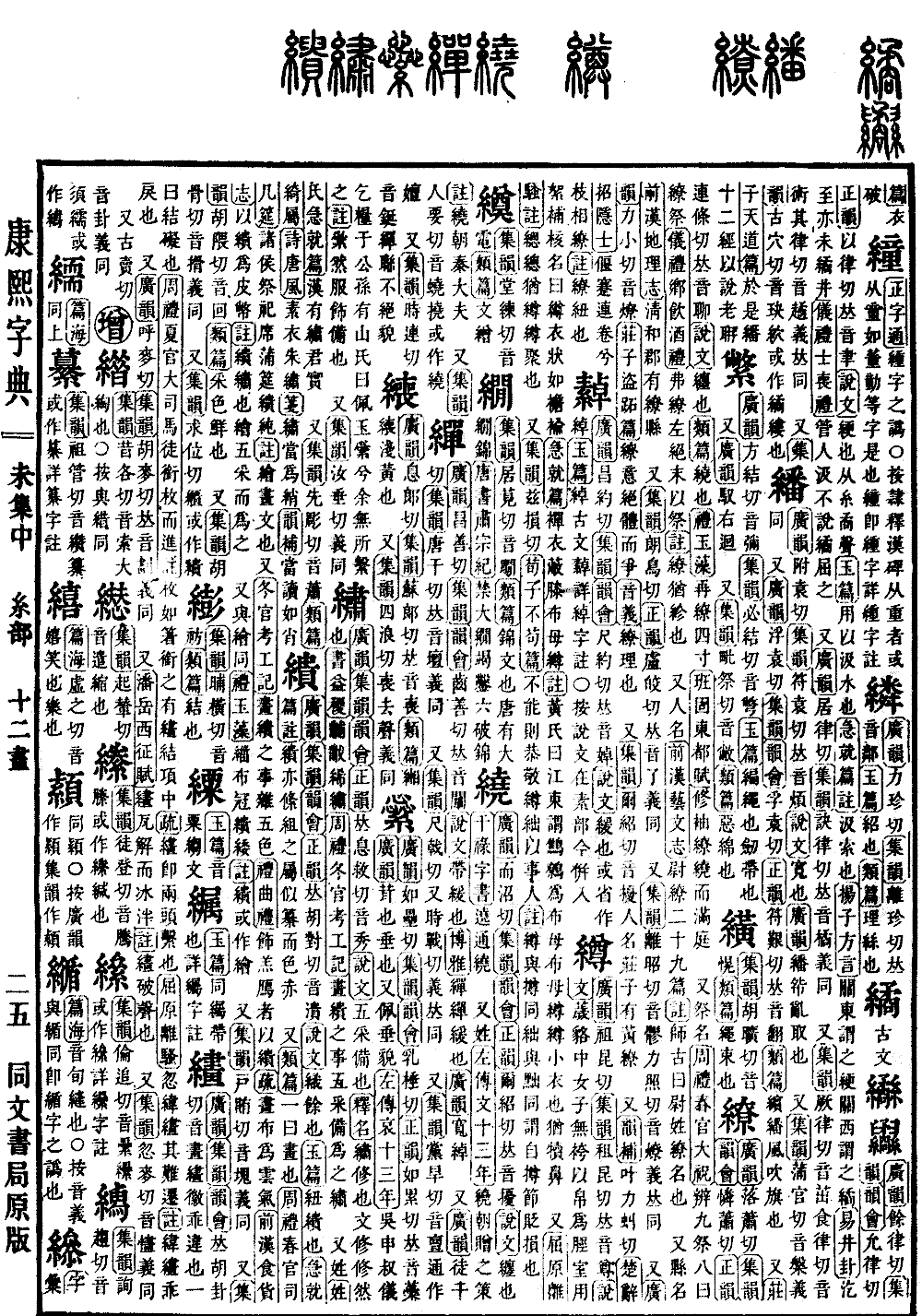
Wei Collection, Middle Volume. Radical: Silk (mì). Character: 繘. Kangxi Stroke Count: 18. Page 939, Entry 03.
Ancient form. According to the Expanded Dictionary of Sounds and Meanings (Guangyun), pronounced yu (falling tone). According to the Collection of Sounds and Meanings (Jiyun) and the Dictionary of Rhymes (Yunhui), pronounced yun (rising tone). According to the Correct Dictionary of Rhymes (Zhengyun), pronounced yi (rising tone). Pronounced yu. According to the Analytical Dictionary of Characters (Shuowen), it means a well rope. Composed of the radical for silk with a phonetic component suggesting an expansive force. According to the Jade Chapters (Yupian), it is used to draw water. According to the notes to the Urgent Lessons (Jijiupian), it is a rope for drawing water. According to the Master Yangs Regional Speech (Yangzi Fangyan), in the regions east of the mountain passes it is called a well rope, while in the regions west of the mountain passes it is called a yu. In the Book of Changes (Yijing), regarding the Well hexagram: Although it reaches the end, it has not yet reached the well with the rope. In the Ceremonial Rites (Yili), in the section regarding the mourning rites for officers, the person in charge of the pipes draws water and does not loosen the rope, but coils it.
Also, according to the Expanded Dictionary of Sounds and Meanings (Guangyun), pronounced ju (rising tone). According to the Collection of Sounds and Meanings (Jiyun), pronounced jue (rising tone). The meaning is the same. Also, according to the Collection of Sounds and Meanings (Jiyun), pronounced zhuo (entering tone). Pronounced shu (entering tone). Pronounced qi (entering tone). The meaning is the same. Also, according to the Collection of Sounds and Meanings (Jiyun), pronounced jue (entering tone). Sometimes written as a variant form. It means thread.