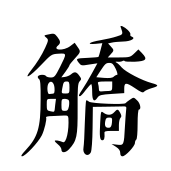
Pronounced ju yao (falling tone) in Guangyun, and ju yao (falling tone) in Jiyun, same pronunciation as "jiao". Refers to horns that are not straight.
Also refers to long horns. One explanation is the appearance of horns standing tall. The commentary for the top line of the Ge hexagram in "Taixuanjing" by Yangzi states: The eye sockets protrude, and the horns stand tall.
Also refers to the "jiao" (角䚩), which is the horn-like covering between the hilt and the blade of a sword or saber. "Huainanzi - Qisu Xun" states: The "jiao" is not too thin.
Also pronounced qu qiao (rising tone) in Jiyun. Describes the appearance of horns.
Also pronounced qu miao (falling tone), same pronunciation as "jiao". Refers to long animal horns.
Also pronounced qu jiao (level tone), same pronunciation as "jiao". Refers to curved horns. The form in "Zihui Bu" is incorrect.
Scholarly analysis: "Taixuanjing" (Yangzi) commentary on the top line states: "The eyes are outlined, and the horns are 'jiao'."
Note: This refers to the top line of the Ge hexagram. The character "Ge" cannot be omitted. The character "Ge" has been added before "top line" in accordance with the original text.