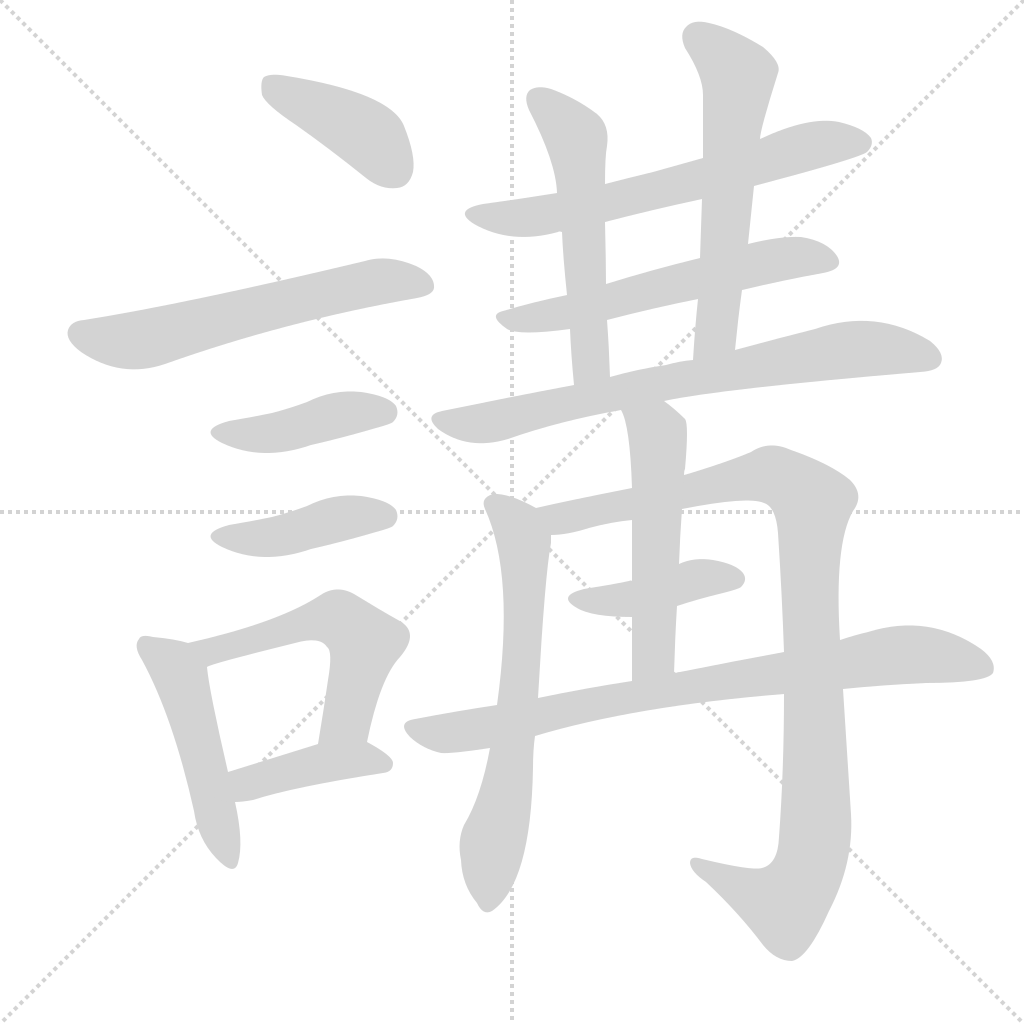
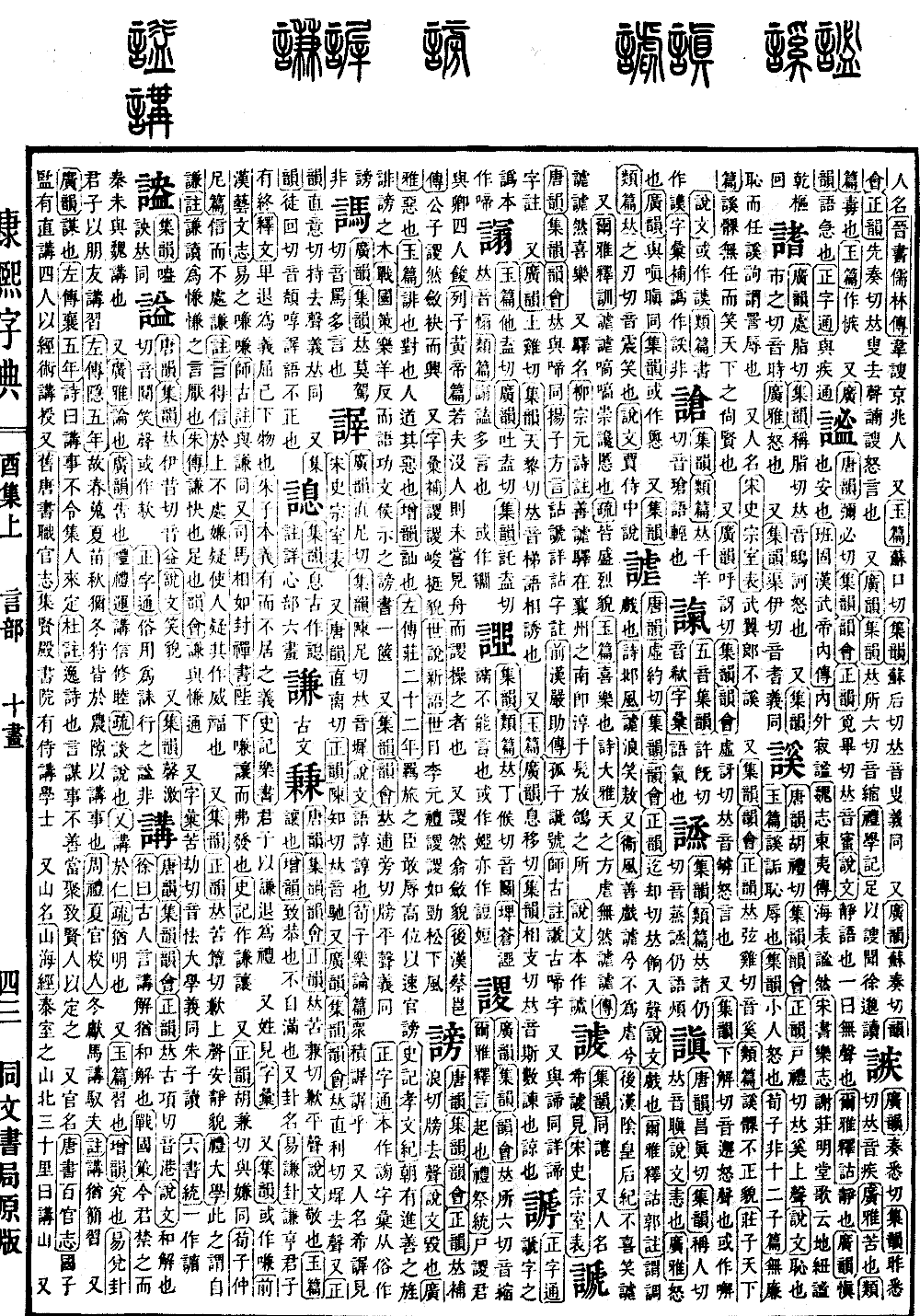
You Collection, Upper Volume
Radical: Speech (yán)
Kangxi Strokes: 17
Page 1175, Entry 24
Pronounced gang (falling tone).
Shuowen Jiezi (Explanation of Graphs and Analysis of Characters) states it means to reconcile or resolve. Xu Kai notes that in ancient times, the term for speaking and resolving was synonymous with reconciliation. From the Strategies of the Warring States (Zhanguo Ce): Now the lord prohibits it, but Qin has not yet reached a reconciliation with Wei.
Also, according to Guangya, it means to discuss. According to Guangyun, it means to announce. From the Book of Rites (Liji), specifically the section on The Conveyance of Rites (Liyun): To foster trust and cultivate harmony. The commentary explains this as to discuss and explain. Also: To discuss benevolence. The commentary explains this as to clarify.
Also, according to Yupian, it means to practice. According to Zengyun, it means to investigate thoroughly. From the Book of Changes (I Ching), specifically the section on the Joyous (Dui) Hexagram: The superior man learns and practices with friends. From the Zuo Commentary (Zuo Zhuan), fifth year of Duke Yin: Therefore, the spring hunt, summer weeding, autumn hunt, and winter hunt were all conducted during agricultural lulls to practice military affairs. From the Rites of Zhou (Zhouli), section on the Summer Official: In winter, horses are presented to practice driving skills. The commentary explains that to practice means to train.
Also, according to Guangyun, it means to plan. From the Zuo Commentary (Zuo Zhuan), fifth year of Duke Xiang: The poem says, if the planning of affairs is not good, gather people to settle it. The commentary by Du Yu notes that this is a lost poem. It means if the planning of affairs is not good, one should assemble worthy people to settle the matter.
Also, it is a title for an official. According to the Official History of the Tang Dynasty (Tangshu), the Imperial Academy had four direct instructors (zhijiang) to lecture on the classics. According to the Old History of the Tang Dynasty (Jiu Tangshu), the Jixian Academy had scholars in attendance for lectures.
Also, the name of a mountain. From the Classic of Mountains and Seas (Shanhai Jing): Thirty miles north of Mount Taishi lies Mount Jiang.
Also, interchangeable with the character meaning to reconcile (jiǎng). From the Book of Han (Hanshu), biography of Cao Can: Xiao He created the laws, and the arrangements were as if drawn with a single stroke. The Records of the Grand Historian (Shiji) uses the character meaning to reconcile.
Also, according to Zihui Bu, pronounced gou (falling tone). It means peace or alliance. From the Records of the Grand Historian (Shiji), biography of Gan Mao: Chu Lizi and Wei reached an alliance to cease military actions. The commentary notes that this instance is read as the word for alliance (gou). The original form of this character is written as something else.