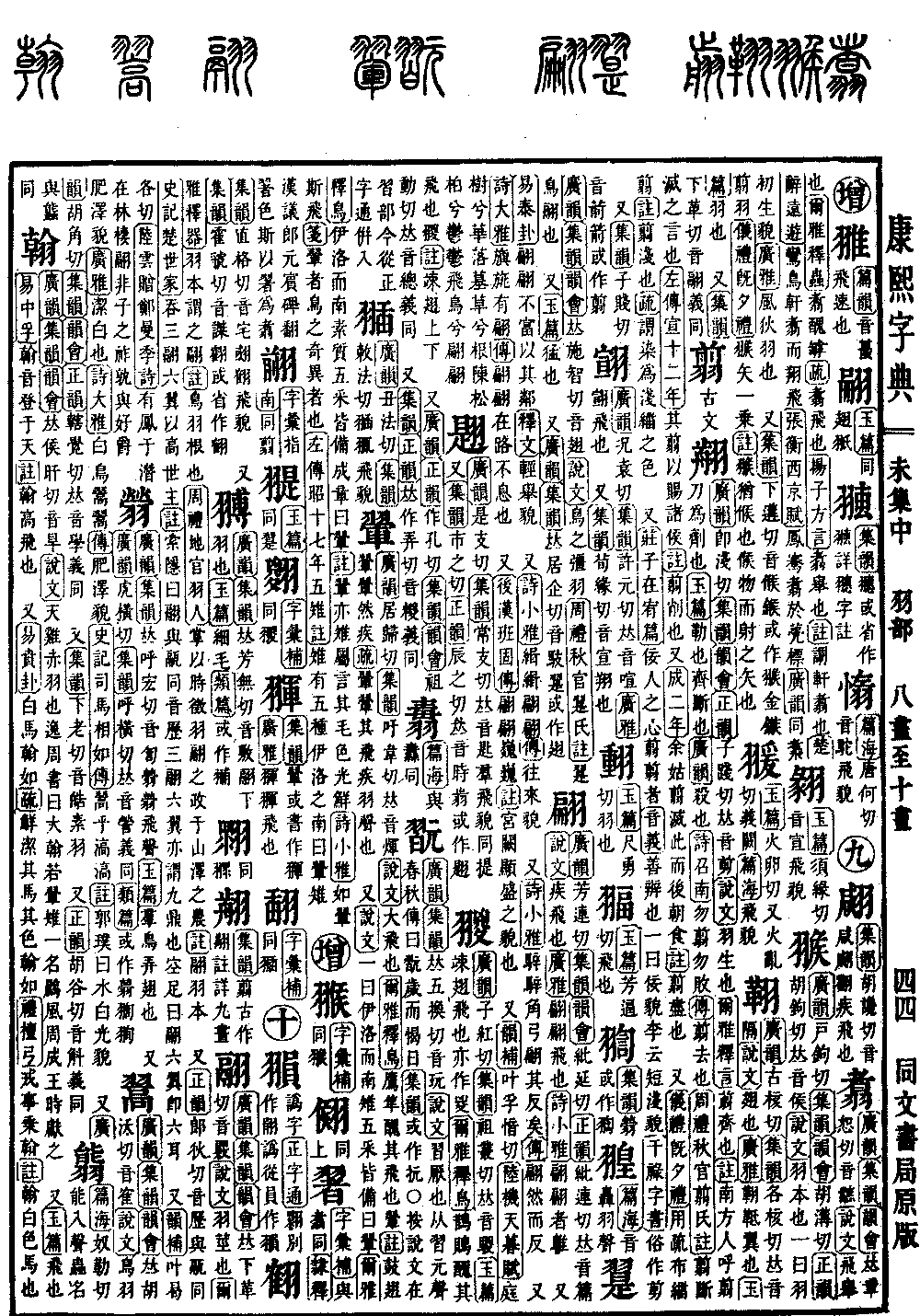
Wei Collection, Middle Volume
Radical: Feather (yǔ)
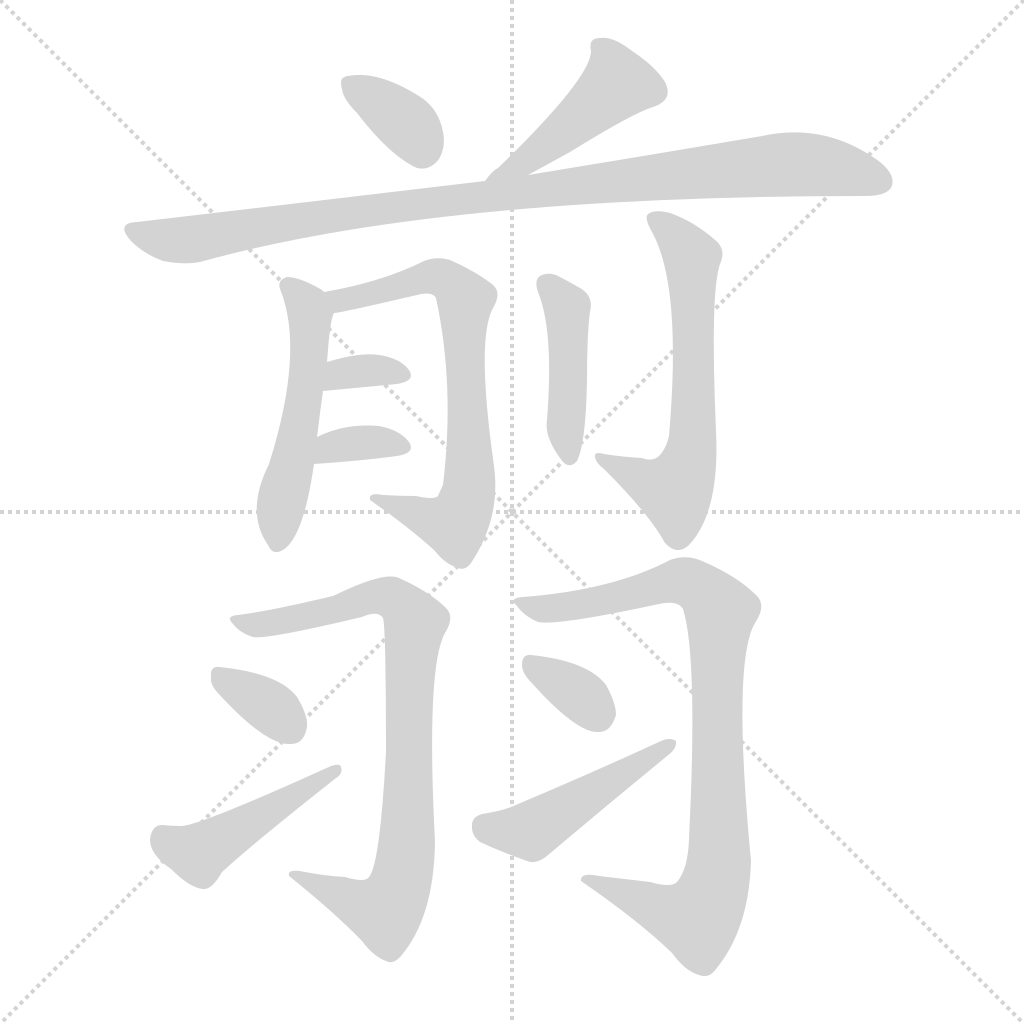
翦
Kangxi stroke count: 15
Page 958, Entry 11
Classical citations:
Broad Rhymes (Guangyun): Pronounced jian (falling tone). Collected Rhymes (Jiyun), Rhyme Compilation (Yunhui), and Orthodox Rhymes (Zhengyun): Pronounced jian (falling tone). The pronunciation is the same as jian (falling tone).
Explanation of Characters (Shuo Wen): The appearance of feathers when they first grow.
Approaching Elegance (Erya): Explaining Words: Jian means neat and tidy.
Commentary: People in the south refer to scissors as ji.
Jade Chapters (Yupian): To restrain; to cut neatly.
Broad Rhymes (Guangyun): To kill or destroy.
Book of Odes (Shijing): Do not prune, do not destroy.
Commentary: Jian means to remove.
Rites of Zhou (Zhouli): Office of Autumn, Notes on the Official of Jian: Jian is a term for severing or destroying.
Zuo Tradition (Zuo Zhuan): In the twelfth year of Duke Xuan: To reduce and distribute them to the feudal lords.
Commentary: Jian means to reduce or diminish.
Also, in the second year of Duke Cheng: I shall first thoroughly destroy these enemies before eating breakfast.
Commentary: Jian means thorough.
Book of Etiquette and Ceremonial (Yili): Using coarse cloth dyed a light black.
Commentary: Jian means light.
Sub-commentary: This refers to dyeing cloth a light black color.
Master Zhuang (Zhuangzi): In the chapter On Letting Be and Exercising Forbearance (Zaiyou): The minds of sycophants are shallow and narrow.
Sound and Meaning: Skilled at clever speech. Another interpretation is the appearance of sycophancy. Li Yun says it means short and shallow.
Manual of Seeking Office (Ganlu Zishu): The common variant is written as jian (falling tone).
Also, Collected Rhymes (Jiyun): Pronounced jian (falling tone). The pronunciation is the same as jian (falling tone). The character jian (falling tone) is sometimes written as jian (falling tone).