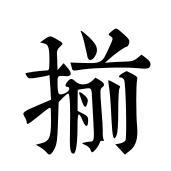
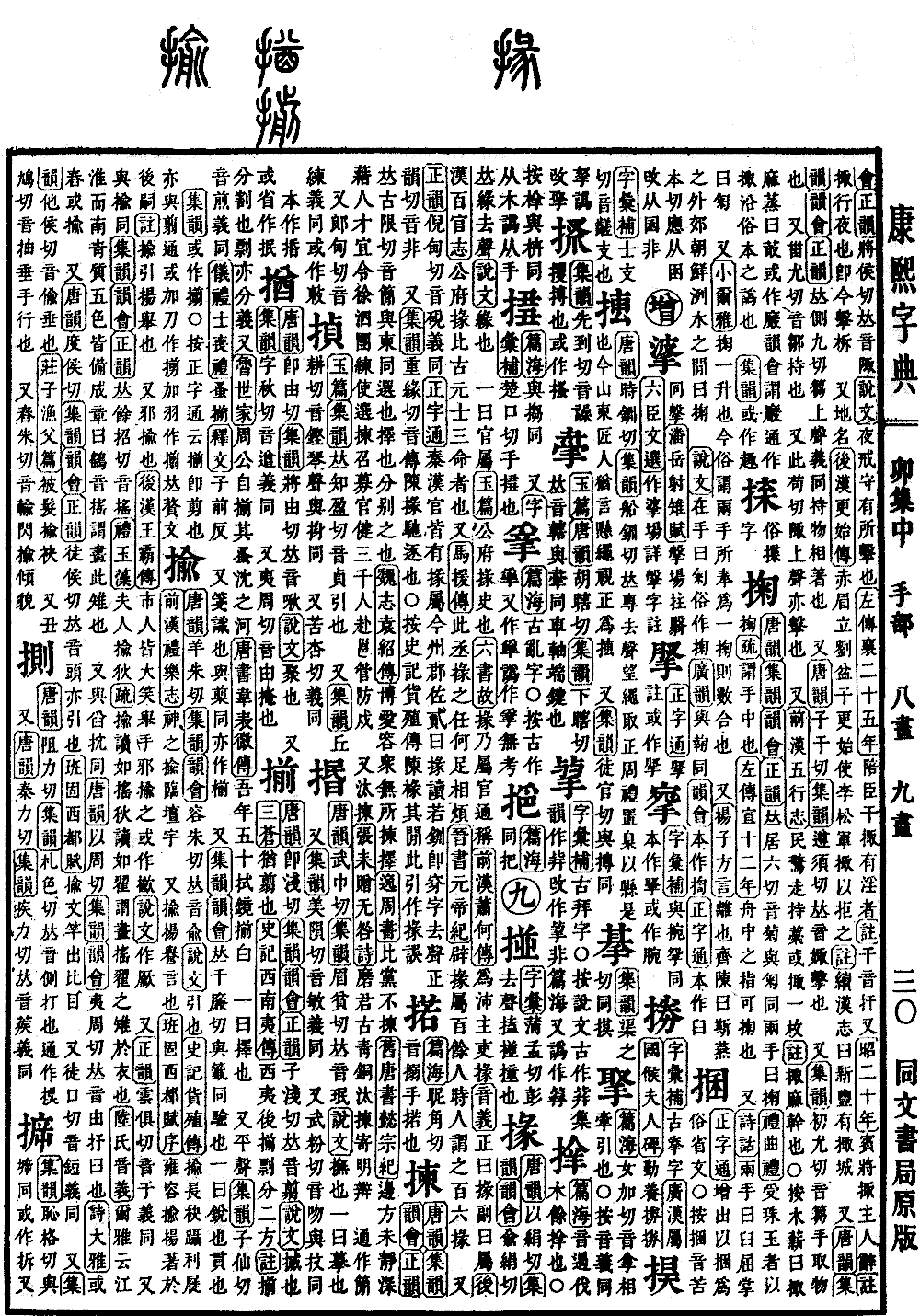
Mao Collection, Middle Volume
Radical: Hand (shǒu)
Kangxi strokes: 13
Page 440, Entry 26
Tang Yun: Pronounced jian (rising tone). Jiyun, Yunhui, and Zhengyun: Pronounced jian (rising tone). In the Shuo Wen Jie Zi (Shuowen), it means to pluck or pull. Sancang says it is synonymous with to cut or shear. In the Records of the Grand Historian (Shiji), Biography of the Southwest Yi: The Western Yi eventually cut and divided into two directions. Commentary: To cut or divide. To plunder also carries the meaning of dividing. In the House of Lu: The Duke of Zhou cut his own fingernails and sank them into the river. In the Old Book of Tang (Tangshu), Biography of Wei Biaowei: I am fifty years old, wiping the mirror and cutting away gray hair. Another definition is to select. Also in the level tone: Jiyun: Pronounced jian. The meaning is the same. In the Book of Etiquette and Ceremonial (Yili), Rites of Mortuary for Scholars: Fingernails cut. Commentary: Pronounced jian (falling tone). Also refers to to mark or identify. Equivalent to the character with the same meaning. Also written as the character variant (jian). Also Jiyun and Yunhui: Pronounced qian. Equivalent to the character meaning a label or tag. Indicates to verify or examine. Another definition is to be sharp. Also refers to to pierce or string together. Jiyun notes that some write it as other variants. According to the Zhengzitong, this character is equivalent to to cut or shear. It is also used interchangeably with the character for scissors. Adding the knife radical or the feather radical is considered redundant.